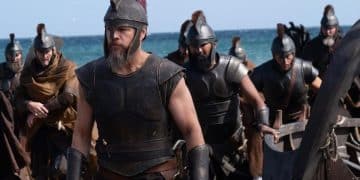
Oppressed Sahrawi filmmakers call for boycott of The Odyssey as Nolan chose to film in occupied territory

Boycott calls are growing as Sahrawis slam Christopher Nolan’s decision to film The Odyssey in occupied territory. All while doing nothing to acknowledge the occupation or the Sahrawis who continue to resist Morocco’s ethnic cleansing campaign to force them from their land.
Nolan chose Dakhla as the location for the film, set for release on Friday 17 July, despite the fact that the land has been occupied by Morocco for 50 years. In turn, critics have pointed out that this can only work to normalise the oppression and forced displacement of Sahrawis.
Sahrawi filmmakers and journalists have condemned this deplorable lack of empathy for the people of Western Sahara and a failure to uphold any sense of “ethical responsibility”. As a result, they now argue that boycotting the film is essential to push back against military occupation, dispossession and injustice.
One of those making this call is Sahrawi journalist and filmmaker Mamine Hachimi who powerfully stated to Middle East Eye:
It is deeply disturbing that while Sahrawi journalists are imprisoned for exposing abuses, an international film production can use our homeland as a cinematic backdrop without addressing the reality of the occupation.
Sahrawi campaigners and filmmakers are calling for a boycott of The Odyssey by Christopher Nolan over his decision to shoot the film in Morocco-occupied Western Saharahttps://t.co/yA77f8mpV3
— Middle East Eye (@MiddleEastEye) July 15, 2026
Imprisoned for life after documenting human rights violations
Imagine a major Hollywood production choosing to film in the occupied West Bank while ignoring Zionist Israel’s occupation and its settler-colonial violence, terrorism and crimes against humanity. The Odyssey was filmed on occupied and dispossessed land.
Like in Palestine, resistance is a crime in itself for people in Western Sahara. Those who dare to document the crimes of the Moroccan oppressor face arbitrary punishments, Some have been imprisoned for life simply for documenting ongoing violations against the human rights of Sahrawis.
Hachimi co-directed a short documentary, ‘Three Stolen Cameras.’ The film spotlights the challenges facing Sahrawi media organisation Equipe Media as it tries to capture evidence of the crimes perpetrated by Morocco against the people of Western Sahara. However, its premiere in Beirut back in 2017 was shut down as a result of undue pressure by the Moroccan government. One of the many attempts by Morocco to make the film disappear.
Those working within the media organisation have faced arrest and harassment from the occupying authorities. This reminds us of Israel — one of only 2 countries, along with the US, that recognise Moroccan sovereignty over Western Sahara — and the way in which it is murdering journalists en masse in Palestine and Lebanon. Moreover, the lawfare used by Zionists and pro-Israel groups across the West to shut down the ability of the wider public to learn the truth about Palestinians also mirrors the struggle of those brave journalists and filmmakers like Hachimi.
Speaking to Middle East Eye, Hachimi added:
This is not a campaign against cinema or artistic freedom – it is a call for ethical responsibility.
Two of my colleagues, Abdallah Lhafaouni, who is serving a life sentence, and Bachir Khadda, who is serving a 20-year sentence, are political prisoners simply because they documented human rights violations in occupied Western Sahara.
The Odyssey — No solidarity
The fact that Nolan has refused to comment on this choice and carried on filming — despite seeing visible protests in Dakhla making clear the anger and frustrations of local people — exposes a complete lack of solidarity between Western filmmakers and filmmakers from the Global South.
The same silence echoes across much of the Western mainstream media. Journalists have shown little urgency — let alone outrage — over the relentless targeting of journalists in Palestine and Lebanon.
The contrast couldn’t be more jarring. Nolan travelled to occupied territory to film his next blockbuster, while other filmmakers risk punishment, sanctions and even criminalisation simply for documenting what life under occupation actually looks like.
This only serves to benefit the Moroccan government, whose minister of culture — Mohamed Mehdi Bensaid — took selfies with Nolan, saying that the film would:
give visibility to Dakhla as a film location and not just a tourist destination.
This becomes all the more offensive to those who have suffered under this oppressive occupation when we learn that Nolan made use of security services provided by the same military that is hurting, injuring and silencing Sahrawis resisting Morocco just a mere few kilometres away.
Sahrawi campaigners say The Odyssey serves to whitewash the long-running and ongoing exploitation of their own territory by Morocco. In turn, this normalises occupation by powerful states, which only leaves ordinary civilians vulnerable to these acts of dominance and aggression.
Colonialist abuses in the global south have long been ignored — receiving nowhere near enough criticism or scrutiny — an issue this film could have avoided:
View this post on Instagram
Missed opportunity to challenge today’s oppressors
The Odyssey looks set to dominate the summer box office. With a reported $250 million budget, it’s one of the year’s biggest releases, and audiences around the world are counting down to Friday. Packed with mythology, epic battles, gods and sorcery, it’s also poised to make its creators and investors a fortune.
But in chasing an ancient story, the film missed the chance — whether by choice or not — to shine a light on a very real struggle unfolding today, and on the remarkable resistance that has endured through five decades of Moroccan occupation.
Sahrawi filmmaker Abidin Mohamed Hamudi argues that, instead of standing with those fighting for freedom, human rights and self-determination, the team behind The Odyssey has made itself “complicit” in the abuses taking place in Western Sahara.
Speaking to MEE, Hamudi argued that Hollywood’s silence reflects the priorities of capitalism and the corrosive logic of Western economic interests. He concluded:
Shame on them – history will put everyone in the place they deserve, and they will be in the dustbin of history, remembered as nothing but cultural parasites.
With #TheOdyssey about to be released, it's more important than ever to know the truth behind #ChristopherNolan's film and to hear directly from its victims. Thank you, @MiddleEastEye, for giving a voice to those silenced by #Morocco and its accomplices
🔗 https://t.co/bKfcKv2iCD pic.twitter.com/GqCMADpxxH— FiSahara (@FiSahara) July 16, 2026
Nolan’s past comments regarding criticisms were that “they’re always irrelevant”, giving little hope he will right his wrong in this instance:
Christopher Nolan says the online backlash to ‘THE ODYSSEY’ comes with the territory.
“These conversations that happen before people see the film – they’re always irrelevant. Because no one having them knows what the film actually is yet.”
(Source: https://t.co/J378r5GWMy) pic.twitter.com/fUfthbUeyV
— DiscussingFilm (@DiscussingFilm) July 10, 2026
The Odyssey — More backlash but for all the wrong reasons
Nevertheless, Nolan may be in for some financial woes. Alongside the boycott calls from activists, the film is also facing backlash from far-right bigots targeting its casting of a Black woman as Helen of Troy and trans man actor Elliot Page as Sinon.
That double-sided controversy could end up hitting The Odyssey where it hurts most: at the box office.
BOYCOTT THE ODYSSEY MOVIE pic.twitter.com/lmSo4gFZEV
— GORGO (@GORGO4547) July 11, 2026
Elites failing ordinary people, yet again
Therefore, it seems that an opportunity was there for successful Western filmmakers to use their celebrity status and their privilege to help those made voiceless — which would be a true act of a genuine filmmaker.
Others, including Javier Bardem, Greta Thunberg, and Pedro Almodóvar, have urged Christopher Nolan to cut any scenes his team filmed in the occupied lands of Dakhla. So far, Nolan, his production company Syncopy Inc., and Universal Pictures have stayed silent.
That silence risks turning Nolan’s latest film into yet another reminder of Western indifference to — and complicity in — the crimes against humanity and historical breaches of international law still taking place today.
Featured image via IMDb


Leave a Reply