
Elon Musk no longer a trillionaire as AI bubble pops and SpaceX crashes

On Friday 12 June, Elon Musk became the world’s first trillionaire. He achieved this on the back of his company SpaceX going public, despite said company not being profitable. This has inevitably led to the following:
JUST IN: SpaceX lost $1 trillion in market cap since last week
— Kalshi (@Kalshi) June 23, 2026
Oh, and thanks to all this, the wretched Musk has already lost his ‘trillionaire’ status:
Elon Musk is no longer a trillionaire after a global rout in tech shares wiped $500bn (£379bn) off his fortune👇https://t.co/XYksFxIBdq pic.twitter.com/IMDRbV9LwZ
— The Telegraph (@Telegraph) June 24, 2026
Hey Elon Musk: money isn’t real
In a piece detailing how Musk blagged his way to becoming a trillionaire, we noted that SpaceX is actually three different companies taped together. And of those three companies:
- SpaceX is not profitable.
- StarLink is profitable.
- Grok AI is really not profitable.
Simply incredible. Elon has mastered the art of creating valuable companies that don’t actually make money. https://t.co/HYJrHduvoJ
— D (@_Unknown_D_) June 12, 2026
We added:
so SpaceX is not what you’d call a profitable company. In fact, it made a $4.9 billion loss last year. But despite this, when it went public, it achieved a valuation of $2 trillion.
Elon Musk managed to convince investors that SpaceX was worth trillions because:
- Generative AI models like Grok will one day become all-knowing super intelligences (they won’t).
- SpaceX is going to build data centres in space.
Think physics before you believe in the SpaceX lies. Each data center averages 10 million pounds of servers, imagine halling multiple data centers into space.
Data centers use millions of gallons of water for cooling. Vacuum of space is terrible for cooling. https://t.co/8Hy3shaby1 pic.twitter.com/tsQQAjvkDk— MrsDoubtFire🇺🇲 (@MrsDoubtFireSF) June 12, 2026
Following the scrutiny which arose after SpaceX went public, investors have now started to question SpaceX’s value. And as they say, what goes up must come down:
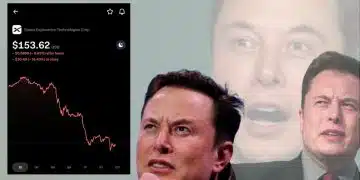
SpaceX share prices are crashing into the ground.
Just as their rockets do after they blow up. pic.twitter.com/lTGjkPwUCm
— BladeoftheSun (@BladeoftheS) June 23, 2026
What’s happening with SpaceX isn’t confined to SpaceX. We’ve been living in an AI bubble for sometime now, and the signs are that the bubble is popping:
JUST IN: $1,500,000,000,000 erased from the U.S. stock market at open pic.twitter.com/ExYuNidcIs
— Kalshi Finance (@Kalshi_Finance) June 23, 2026
Why is it popping now?
It’s popping because AI companies recently tried charging what the tech actually costs. Up until now, they’d been subsidising the cost with billions of dollars of investor money. Once they stopped doing that, their customers panicked, because:
NEW: Uber is reportedly capping employee use of AI vibe-coding tools at $1,500 per month after blowing through its AI budget.
— Polymarket (@Polymarket) June 2, 2026
NEW: AI consultant reveals a client accidentally spent $500,000,000.00 in a single month after failing to set employee limits on Claude usage.
— Polymarket (@Polymarket) May 28, 2026
Oh, and it doesn’t stop there.
Once these companies realised how expensive the tech is, they started asking ‘but it’s giving us a good return on investment, right?‘
The answer is it’s actually very difficult to show any return on investment for most companies. So the tech isn’t just expensive; it’s also potentially useless for any business which is driven by the profit motive – i.e. every company in the Fortune 500.
Cisco-fication
We’ve seen what’s happening with SpaceX before; specifically with Cisco and the Dot Com Bubble. Cisco builds the hardware that the internet relies on and that made it seem super valuable in the Dot Com era, but as Slashdot reported in 2025:
Cisco’s stock price touched $80.25 on Wednesday, finally eclipsing its dotcom-era peak of $80.06 set on March 27, 2000 — when the networking giant briefly surpassed Microsoft to become the world’s most valuable company. The journey back took 25 years, eight months and 13 days. The company’s fundamentals improved dramatically over that period, of course. Revenues have nearly quintupled since 1999, profits have quadrupled, earnings per share have grown eightfold, and margins have remained healthy throughout. Investors who bought at the peak still lost money to inflation for a generation.
If you’re a SpaceX investor and you get lucky, then 25 years from now your stock may be worth slightly more than what you just paid for it (not adjusted for inflation).
If you’re unlucky, you just bought into the latest fantasy of an addled, Nazi-boosting Epstein associate.
Oh, and f*ck you for doing that!
Sent from Musk to Epstein on Christmas Day at 6am. https://t.co/Jx5o80a38H
— Mehdi Hasan (@mehdirhasan) January 31, 2026
Featured image via the Canary


Comments 1
Leave a Reply








Musk has “uncontrolled disassembly” of rockets, rather than spaceships exploding, a little like Putin launches “Special Military Operations” rather than an old fashioned war to regain former imperial possessions.
It would be rather fun to see grifting Elons’ financial empire uncontrollably disassemble. The amount of taxpayer funds that he has been showered with, first for Tesla and then for Space X, he is the most entitled welfare recipient that there has ever been.