
Labour manifesto plans will increase GDP by… wait for it… 0.1%
'Tinkering around the edges'

Both the Labour manifesto and the Tories’ pledges will barely increase gross domestic product (GDP) and hardly impact anything else in the economy, either. That’s according to analysis by the think thank the National Institute for Economic and Social Research (NIESR).
Labour manifesto: increasing GDP by basically nothing
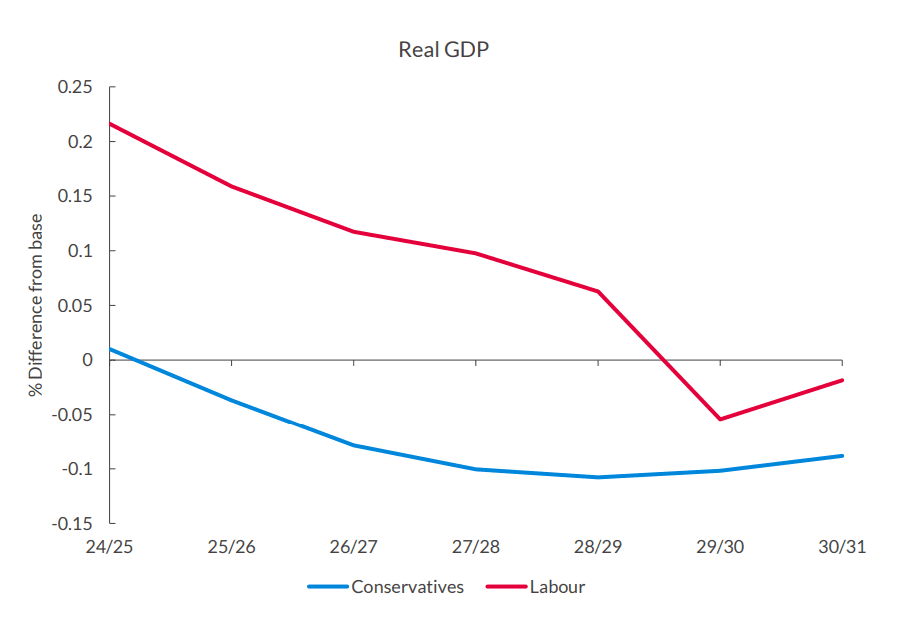
Although neither party would meet current fiscal targets, the Labour Party’s tax and spending plans would slightly increase real GDP over the next five years, whilst the Conservative Party’s plan would slightly improve the public finances, according to NIESR’s macroeconomic analysis of the main parties’ spending pledges.
Using NIESR’s in-house global econometric model, NiGEM, the analysis assesses the figures from the Conservative Costings Document and Labour’s Fiscal Plan, finding that:
- Labour manifesto tax and spending plans increase real GDP by an average of 0.1% over the next five years, driven primarily through investment via their Green Prosperity Plan.
- The Conservatives’ tax and spending plans’ decrease real GDP by an average of 0.1%.
Although neither party would meet current fiscal targets, the Conservative plan slightly improves the public finances relative to NIESR’s baseline forecast.
The Labour manifesto initial investment in the Green Prosperity Plan slightly increases the debt-to-GDP ratio.
Both parties’ plans would have a positive impact on business investment:
- Labour’s plans would boost it by 0.6% on average driven by productivity gains and increased economic activity.
- The Conservatives’ plans would boost it by 0.5% on average, driven by lower long real rates.
Neither the Conservatives nor Labour will have the Debt-to-GDP ratio falling until 2030/31.
To meet the current target – that is to have the debt-to-GDP ratio falling at the end of the five-year period – the Conservatives would need it to fall by one percentage point in 2028/29, about £32bn, while Labour would need it to fall by two percentage points, about £65bn, and not rise further.
‘Tinkering around the edges’
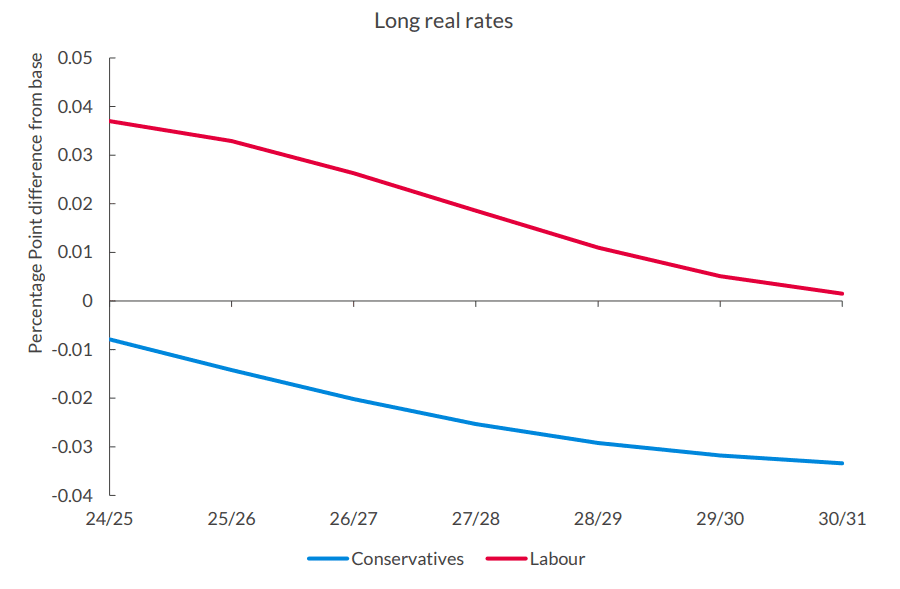
Moreover, both parties’ plans would barely impact on overall interest rates. The extra investment from the Labour manifesto leads to a higher policy rate, as extra demand in the economy means the central bank needs to keep rates higher for longer to tame inflation. Long real rates (interests rates adjusted for the effects of inflation) increase by about 3.7 basis points.
In contrast, as demand and the debt burden fall under the Conservative plans, inflationary pressures ease. This leads to a lowering of the long real rate by about 3.5 basis points in the long run. It’s important to note that this effect is so small as to be effectively zero:
Professor Stephen Millard, deputy director for macroeconomics at the NIESR, said:
This analysis suggests that both parties plans are simply ‘tinkering at the edges’. What is needed is bolder thinking: a plan to increase spending where it is desperately needed, to acknowledge the need to raise taxes to finance this, and to rethink the current fiscal framework so as to allow more borrowing where it will lead to higher growth in the future.
Featured image via X – screengrab


Comments 1
Leave a Reply









With regards to the article “Labour manifesto plans will increase GDP by… wait for it… 0.1%” what you write is incorrect, it actually reads like something written by the IFS, which is simply a neoclassical/neoliberal propaganda organisation. UK debt is national savings plus much of UK pensions. If the UK clears its debt then most of people’s pension pots and everything people save with NS&I would need to be returned to them, and no one wants that. In the same way that the savings that people have in banks are not referred to as the bank’s debt, even though that’s what it is, money the bank owes you, so too the national debt is also simply people’s savings (hence National Savings and Investments). Also, raising interest rates to combat inflation is a fiction. The historical record shows (over 500 years of UK data) that inflation has never required interest rates to rise in order to bring inflation down. “Interest rate rises to combat inflation” is simply an excuse to transfer more wealth to the already wealthy (tax rises could just as easily take money out of the economy, and price controls are also within the government’s remit). You’re undermining your own counter to all the government-corporate bullshit that saturates the media. Richard Murphy of Tax Research UK knows his stuff, and well worth a look, on this issue and much more. I read the Canary and find it a haven from the utter shite spewing from mainstream outlets (I particularly enjoy the fact that you don’t pull your punches, calling Thatcher a cunt being a satisfying case in point), it saddens me when these things slip under the radar, supporting a false status quo narrative. Economics is inseparable from politics, in fact, if politics was an equation, economics would be what comes after the equals sign. Which means that much of what’s written by pretty much any newspaper about the economy will be political rather than factual, since the press is owned by billionaires.