In-work poverty is a scourge that is nowhere near being solved – yet

A new benchmark – like the Living Wage Employer standard – is needed to enable businesses to tackle the scale and depth of in-work poverty, think tank the Social Market Foundation says.
Social Market Foundation: in-work poverty a “major issue”
The Social Market Foundation (SMF) has launched a proposal for an in-work poverty benchmark. It is designed to enable employers to tackle in-work poverty among their staff, supply chain and the communities they operate in.
Over three years, the SMF has been exploring in-work poverty in the capital, businesses’ desire and barriers to addressing it, and has proposed a tool that could help them in doing so.
In-work poverty is a major issue in the UK, and has increased over the last two decades. It is most acute in the capital, with around a third (32%) of households where at least one adult is employed were in poverty in 2022/23.
Private sector and public sector employees that spoke to SMF as part of its in-work poverty project expressed a clear need for better provisions for sick pay, flexibility, in-work progression and upskilling, sufficient hours and subsidies to cover the high cost of living in the capital.
The SMF’s proposals come at a time when Keir Starmer and the Labour government have put employment reforms front and centre of legislative changes at the King’s Speech.
A new benchmark for employers
Its proposed benchmark – similar to the Living Wage Employer scheme, where businesses commit to paying their employees a wage that meets the basic cost of living – is designed with relatively low barriers to entry and providing clear “pathway” for firms to follow to improve their anti-poverty offer, and could play a key part in helping the Labour government achieve it’s ‘Plan to Make Work Pay’ ambitions.
Previous Social Market Foundation (SMF) research found that an overwhelming majority (84%) of London’s businesses viewed in-work poverty among their workers as a concern, and that 70% of them are motived to help tackle it by taking voluntary measures above and beyond legal minimums – such as paying the National Living Wage.
While the benchmark has been developed with Londoners and London employers in mind, it is just as relevant for and applicable to businesses in the other parts of the UK, the SMF said.
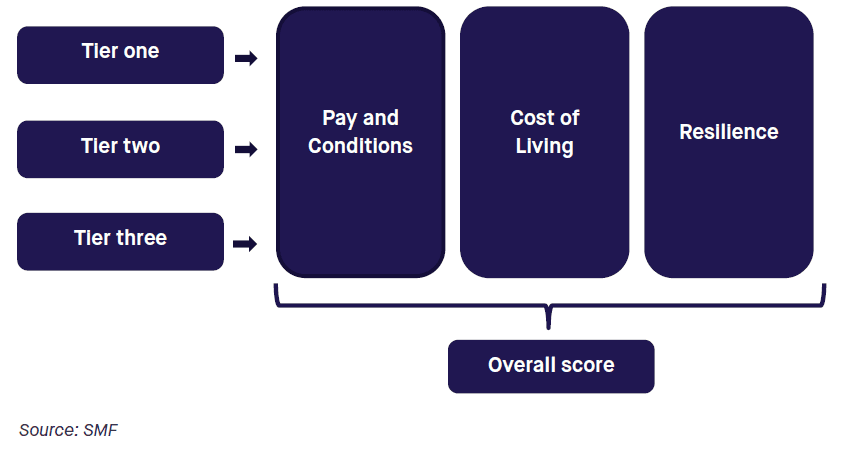
The proposed benchmark is unique in that it covers a wide variety of drivers of in-work poverty, encouraging businesses to help employees with cost of living pressures, financial resilience, and pay and conditions.
The SMF’s proposed benchmark has been taken on by the Living Wage Foundation, who will be leading on a new phase of the benchmark development process, with continued SMF involvement, and exploring how to transform the benchmark into a practical business tool, trusted by employers, investors, consumers and workers:
Making a “big difference” to in-work poverty
Richard Hyde, senior researcher at Social Market Foundation, said:
In-work poverty is a huge problem in London. The contrast between the wealth of the UK’s capital on the one hand, and the high rates of poverty of those in work on the other, is stark. It poses a real challenge to politicians and we need feasible ways of dealing with it.
The SMF spent three years developing the outline of a potentially practical remedy. Building on the available evidence base about the causes of in-work poverty and following extensive engagement with stakeholders from the business community as well as trade unions, poverty charities, the public sector and with relevant academics, we have proposed a comprehensive in-work poverty benchmark for employers that could help encourage businesses to take the kinds of steps that will make a big difference to those workers in London that are stuck in in-work poverty.
We are very excited to see this idea being taken forward by the highly respected Living Wage Foundation, who have been leading the fight in the UK against in-work poverty for many years with their ground-breaking use of employer accreditations to tackle this problem.
Katherine Chapman, director of the Living Wage Foundation, said:
More than 15,000 UK employers have committed to paying the real Living Wage, including 3,900 in the capital. It’s clear that many employers want to play their part in tackling poverty. With nearly a million adults in London living in poverty despite living in a working household, this commitment is crucial.
This benchmark sets out how employers can go even further by boosting pay and conditions, supporting workers with the rising cost of living, and fostering long-term economic resilience among their workforce.
We’re thrilled to be launching a project to translate this benchmark into something that will work in practice, aiming to develop an accreditation for responsible employers and change the face of in-work poverty in London and across the UK.
“Work should be a way out of poverty” – but it’s not
Klara Skrivankova, director of grants at Trust for London said:
Work should be a way out of poverty. But more than half of Londoners in poverty are working.
Businesses can help change this and do more to support workers. We know that many employers want to, but often don’t know how.
This benchmark puts forward an actionable, measurable approach that will help businesses to play their part in addressing in-work poverty in London.
Featured image via Envato Elements


Leave a Reply