20 of the world’s biggest supermarkets aren’t being upfront about their methane emissions

Despite mounting evidence of the environmental impact of methane emissions, the world’s largest supermarkets are failing to take responsibility for their role in the crisis.
Methane emissions in the food retailer supply chain
A new report by Changing Markets Foundation and NGO Mighty Earth reveals that 20 major retailers – including Carrefour, Lidl, Tesco, Walmart, and Ahold Delhaize – are ignoring the need to track or reduce the methane emissions linked to their supply chains:
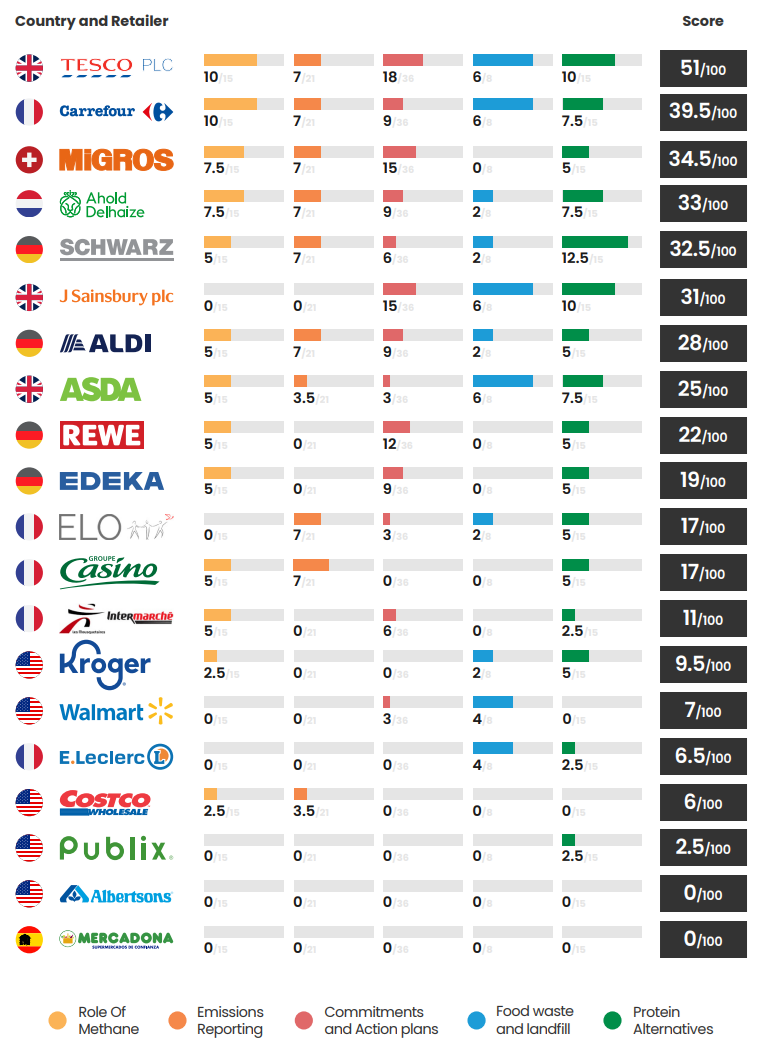
With meat and dairy responsible for at least a third of their total emissions, this alarming failure raises serious questions about their commitment to sustainability and climate action.
The findings expose a troubling lack of transparency, as none of these industry giants publicly report their methane emissions, despite methane being 80 times more potent than carbon dioxide (CO₂) in the short term.
As global efforts intensify to curb greenhouse gases, the failure of these companies to acknowledge and address their methane footprint puts them under increasing scrutiny. With pressure mounting from regulators, investors, and consumers, these retailers must move beyond greenwashing and take concrete steps to slash emissions before it’s too late.
Gemma Hoskins, global methane lead at Mighty Earth, said:
Food retailers are ignoring the methane problem hidden in the meat and dairy aisles and risk losing consumer trust. Methane is a superheater greenhouse gas responsible for about a quarter of the heating the planet has already experienced. But it’s short-lived, so rapid cuts would be a win for climate and nature.
Retailers are uniquely positioned to urgently drive down agricultural methane emissions in their supply chains. That starts with being honest about the impact of the products they sell and working harder and faster to reduce that impact.
Meat and dairy: lack of transparency on methane emissions
The report reveals that over 90% of European food retailers’ emissions come from their supply chains, with meat and dairy accounting for nearly half. Yet, none of the retailers analysed disclose methane emissions or the footprint of the meat and dairy products they sell.
Food retailers also fail to commit to deforestation-free supply chains for key commodities like beef, soy, and palm oil, despite the 2025 EU Deforestation Regulation (EUDR) deadline. Livestock farming is a leading driver of the Amazon’s destruction, responsible for 88% of deforestation.
While fossil fuel companies face intense scrutiny, the climate impact of the meat and dairy industry remains largely neglected. Rapidly cutting methane emissions by transforming this sector – alongside phasing out fossil fuels – could be a game changer in the fight against climate disaster.
Methane alert: supermarkets’ ‘complete lack of action’
Methane levels have more than doubled in the past 200 years, with around 600 million tonnes released into the atmosphere annually – roughly 40% from natural sources and 60% driven by human activity.
As a greenhouse gas, methane is 80 times more potent than carbon dioxide over a 20-year period, responsible for 25% of global heating. Though it remains in the atmosphere for a shorter time than CO₂, it is far more effective at trapping heat, earning its reputation as a ‘super-heater’.
Animal agriculture is a major contributor, responsible for 16.5% of global greenhouse gas emissions and 32% of human-caused methane emissions – largely from a byproduct of livestock digestion process (burps) called enteric fermentation, and manure. Each year, 83 billion land animals are slaughtered for meat production, further driving these emissions.
Changing Markets Foundation and Mighty Earth are calling on food retailers to take responsibility by publicly reporting their emissions, setting science-based climate targets, and reducing methane emissions by at least 30% by 2030, in line with the Global Methane Pledge adopted at COP26. With their vast influence over supply chains and consumer choices, food retailers must lead the shift toward a sustainable food system, rather than placing the burden on consumers.
As key players in the global food industry, major food retailers have the power – and the duty – to pressure dominant meat and dairy producers, including JBS, Tyson, and Cargill, to adopt more transparency and sustainable practices, and cut methane emissions at the source.
Maddy Haughton-Boakes, senior campaigner at the Changing Markets Foundation, said:
Methane emissions are a major blind spot of supermarkets. Our scorecard reveals a complete lack of action, with the most powerful players in the food supply chains completely ignoring their government’s commitments to cut methane emissions by 30% by 2030. This must change urgently.
Some retailers acknowledge the problem and have taken small steps, but none are treating it with the urgency it demands – there are no real leaders here. Cutting methane this decade is our emergency brake on runaway global heating, yet retailers are barely pressing it. The companies that dominate our food system must step up now and take real action to slash their methane emissions.
Health impact: antibiotic-resistant bacteria
Excessive meat consumption is a major threat to both the planet and human health. It drives greenhouse gas emissions, deforestation, and destroys ecosystems rich in biodiversity. But the dangers don’t stop there – scientific studies reveal that high intake of red and processed meat significantly increases the risk of ischaemic heart disease, pneumonia, diabetes, colon polyps, and diverticular disease.
The World Health Organisation (WHO) has found compelling evidence that processed meat directly contributes to colorectal cancer, a finding further reinforced by research from the Agency for Science, Technology and Research (A*STAR) and the National Cancer Centre Singapore (NCCS).
Adding to these dangers, the meat industry’s rampant use of antibiotics in livestock farming has accelerated the rise of antibiotic-resistant bacteria, a looming public health catastrophe.
Antimicrobial resistance (AMR) results in higher mortality rates, prolonged illness, the spread of epidemics, and an overwhelming strain on global healthcare systems.
A call for companies to step up
Changing Markets Foundation and Mighty Earth are urging food retailers to urgently develop climate plans to reduce methane from meat and dairy sources, adopt public transparency in climate reporting and disclose methane emissions, and set a target for methane reductions.
The pressure is mounting for food retailers to confront the methane problem head-on. As consumers become more aware of the environmental and health implications of their food choices, the demand for transparency and accountability will only grow.
Food retailers can no longer afford to ignore the environmental cost of the products they sell. By taking quick and decisive action to reduce methane emissions, they not only have the chance to be at the forefront of the sustainable food movement but also to regain consumer trust and position themselves as true leaders in the fight against climate change.
With the urgency of the climate crisis at an all-time high, it is crucial that these companies step up to the challenge. If they fail to address methane emissions now, they risk locking in further damage to the planet, compromising both our future, our health, and their role in the global economy.
Featured image via the Canary


Leave a Reply