
EXPOSED: Labour’s plan for DWP cuts to severely disabled people’s Universal Credit came from the Resolution Foundation

A thinktank appears to be at the heart of the Labour Party-led Department for Work and Pensions DWP brutal Universal Credit cuts. In particular, it revolves around the government’s plans to cut the health-related part of Universal Credit, known as LCWRA.
However, it wasn’t the usual suspects pushing for this. Instead, it came from a surprising source, because ordinarily, the thinktank in question is at the forefront of pulling apart the ableist benefit cut policy-making. Shockingly, it was the Resolution Foundation.
DWP Universal Credit cuts
As the Canary’s Steve Topple previously reported, on Friday 7 March, the DWP leaked its plans for up to £6bn in welfare cuts to ITV News. Notably, this largely revolved around changes to Personal Independence Payment (PIP) and DWP Universal Credit cuts that would hit chronically ill and disabled people the hardest. Specifically, these were:
- £5 billion in Treasury ‘savings’ by making it harder for people to qualify for DWP PIP.
- Freezing of PIP payments next year so that the award does not rise with inflation.
- Raising the basic rate of Universal Credit (UC) for those in or searching for work while cutting the rate of the benefit for those judged unfit to work (LCWRA addition in UC).
- £1 billion of the proposed cuts invested in employment support for those in receipt of health-related benefits who are looking for work.
However, the government is now purportedly planning to scrap the PIP freeze after backlash from the public and its own MPs. Nonetheless, it’s still looking to proceed with the rest of its plans.
On top of this, the Times followed this up the following Friday 14 March with further information on the government’s plans. This included reducing benefits for one million people, and tightening eligibility criteria. The latter would particularly target people suffering from some mental health disorders, and those who have difficulty washing, dressing, or even eating.
So, the question was of course – who has been shaping the Labour Party’s plans over this?
As it turned out, where the LCWRA ‘reform’ is concerned, it seems to have been the Resolution Foundation.
Enter the Resolution Foundation
To start, the Canary found that the thinktank has been promoting DWP Universal Credit cuts at least since November 2024. Notably, its senior economist Louise Murphy did so in a oral evidence session to the House of Lords Economic Affairs Committee.
This was the committee that in January, put out a disgraceful report attacking disability benefit claimants. In particular, this called for the government to ramp up conditionality and implement more assessments for people not fit for work. However, as John Pring from the Disability News Service (DNS) noted, the committee took no evidence whatsoever from disabled claimants or Deaf and Disabled People’s Organisations (DDPOs). Moreover, Pring highlighted how Tory peer George Bridges led the committee and that he is:
a former chair of the Conservative research department, and the party’s former campaign director, a former leader writer for The Times, and now a senior adviser to the Spanish bank Santander.
Nonetheless, on 12 November, Murphy gave evidence alongside a representative each from the CSJ, and Policy Exchange. Dr Sean Phillips spoke for Policy Exchange. He is a co-author for the thinktank’s recent report pushing for draconian PIP reforms, and which made the erroneous conflation of it as an out-of-work benefit. Meanwhile, policy director Edward Davies provided the CSJ’s input.
But while both Phillips and Davies presented the nonsense notion that the generosity of not fit for work benefits was ‘incentivising’ claimants, it was actually Murphy that put forward an alarming suggestion for tackling this that the Labour government now appears to have taken up.
A ‘bit more generous’ on the basic rate…
Committee member and peer Alison Wolf asked each of them in turn:
what would be your two proposals to change the benefit system such that, in a concrete and doable way, it reduced the rationality of staying on long-term benefit for ever and got more people back on that work route?
And this was when Murphy told the committee (our emphasis):
The first is working to remove this cliff edge, so that we derisk movements into work. To me, the fundamental issue is that people, rationally, will be thinking, “Even if I will perhaps be better off in the long term if I find a higher paying job, I immediately risk losing £400 a month”. For people on low incomes who are likely to be in receipt of benefits, that will be at the front of their minds.
There are ways you can do that. Either you can move to a slightly more gradated system, so that, rather than it being zero or £400, there are levels depending on whether you are able to do part-time work, full-time work and so on. Or you just increase the level of benefits for everyone slightly to make the overall level of benefits seem a bit more generous, but significantly decrease the amount for people who are out of work due to ill health. There are pros and cons, but I certainly think that there are ways to remove the all-or-nothing scenario.
In other words, Murphy pointed to cutting the LCWRA component of Universal Credit. Now of course, the Labour Party government appear to be gearing up to do just that. It therefore seems likely that the DWP has adopted Universal Credit cuts on the Resolution Foundation’s advice.
So-called ‘incentives’ to get back to work – but actually DWP Universal Credit cuts
Moreover, this isn’t the only instance of the Resolution Foundation promoting DWP Universal Credit cuts policy either.
That’s because, ironically, it put this forward in a recent report that thoroughly lambasted the government for its plans to cut disability and sickness benefits.
The Canary reported on this analysis at the time, which the thinktank released the day before ITV dropped the leaked details of the government’s plans. The Resolution Foundation’s big take-aways were that:
reducing access to DWP disability benefits should not be the primary focus of government cuts. The organisation emphasises that any attempts to tighten eligibility could lead to devastating financial consequences for those already relying on these vital supports.
In a landscape where welfare cuts often hit the most vulnerable, the Resolution Foundation highlights the stark reality faced by people with disabilities and health issues. They argue that freezing benefits as a method to curb government spending would only yield savings of approximately £1 billion annually by the end of the parliamentary term, a negligible amount compared to the hardships that would be bestowed upon claimants.
However, amid the thinktank’s evisceration of DWP moves to cut disability benefits, was the damning policy. In its press release, it stated that:
The scale of losses faced by newly ineligible incapacity benefit claimants is due to the large gap between basic and health-related support in Universal Credit (UC). For a single adult, basic support of just £393 a month more than doubles to £810 a month if they are eligible for health-related support. This creates a strong incentive to claim the latter.
The Government should look to close this gap by redistributing levels of health-related support into basic awards. If the Government is committed to making cuts in the short term, it could reduce the gap by freezing health-related support in cash terms between 2025-26 and 2029-30, saving £1 billion a year by the end of the Parliament.
But cuts for chronically ill and disabled people
The report goes further than this on DWP Universal Credit cuts. Under the guise of ‘redistribution’, it presents a number of possible scenarios in a column chart:
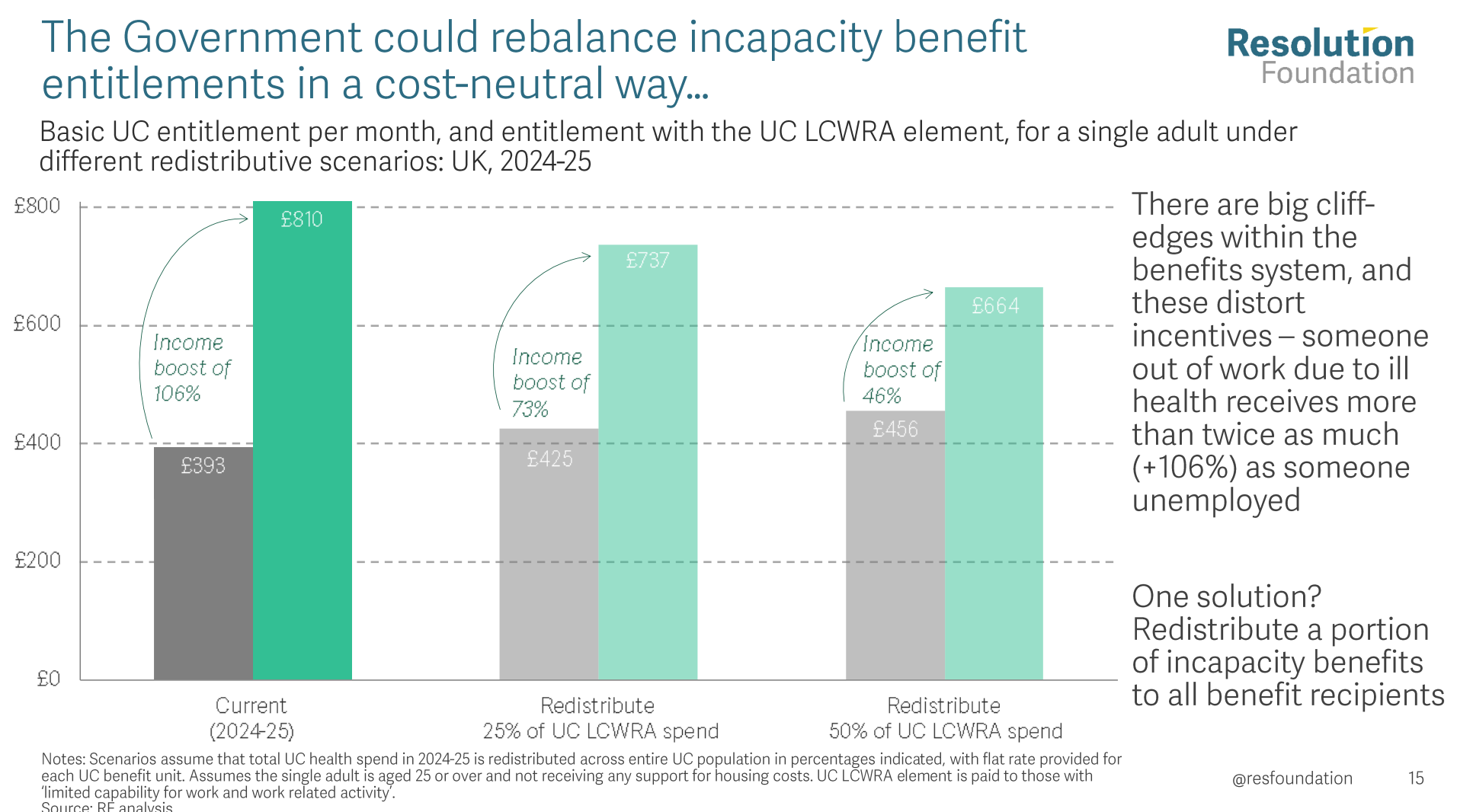
The green columns represent the amount a person over the age of 25 claiming the Universal Credit basic rate and LCWRA part would get. Conversely, the grey column is what an individual over 25 claiming the basic rate would receive.
Essentially, it illustrates three separate scenarios, the first being the current set-up. The second shows what would happen to these benefits if the DWP were to cut the LCWRA component by 25%. Similarly, the third shows this if the DWP cut it by 50%.
In effect then, the idea is to increase the amount that claimants on the basic rate would get. At 25% redistribution, the DWP would increase their Universal Credit to £425, and £456 in the 50% option.
However, there’s one glaring issue with this. It would mean that chronically ill/disabled claimants unable to work would have significant cuts to their Universal Credit. Under the 25% redistribution, chronically ill and disabled claimants not fit for work would lose 9% – or £73 a month – of their Universal Credit. For the 50% scenario, they would see cuts of 18% – £146 a month – to their benefits.
Yes the basic rate is woefully inadequate, but why cut the LCWRA?
To sum up then, the Resolution Foundation is advocating that the government should CUT chronically ill and disabled people’s benefits. It’s reasoning for doing so? To ‘incentivise’ people back into work. In other words, it’s implying the worn and preposterous notion that people are claiming the LCWRA because they’re too generous. Seemingly to demonstrate this, the graph singles out the “income boost” LCWRA claimants get over those on the basic rate. At current levels, it points out this is 106% more. For the 25% scenario, it shows this would be 73%, and 46% for the 50% cut to the LCWRA.
Of course, the thinktank is highlighting this in the context of the woefully inadequate present Universal Credit basic rate. This undoubtedly needs to increase, as it doesn’t even cover the costs of the bare minimum essentials people need to live. However, the idea that chronically ill and disabled people unable to work should shoulder the costs for this is atrocious. This is especially appalling given that chronically ill and disabled people are more likely to be facing destitution – many of whom will rely on benefits as their main source of income.
Murphy communicated the abysmal situation on the basic rate to the committee in another part of the session:
The other thing that has changed is that the benefit system has become less generous overall. We squeezed other parts of the system gradually through the 2010s, for example through the benefit freeze and the introduction of things like the benefit cap. That just means that people feel worse off overall.
If you are feeling financially vulnerable, the incentive to get that extra £400 is greater. That came out very clearly when we were speaking to advisers on the ground, who said that the introduction of the benefit cap, for example, has had a big impact on people’s decision-making.
Suggesting that people are claiming the LCWRA because the basic rate is so low, is patently ridiculous. The implication is that people aren’t sick or disabled, or aren’t that sick or disabled that they can’t work.
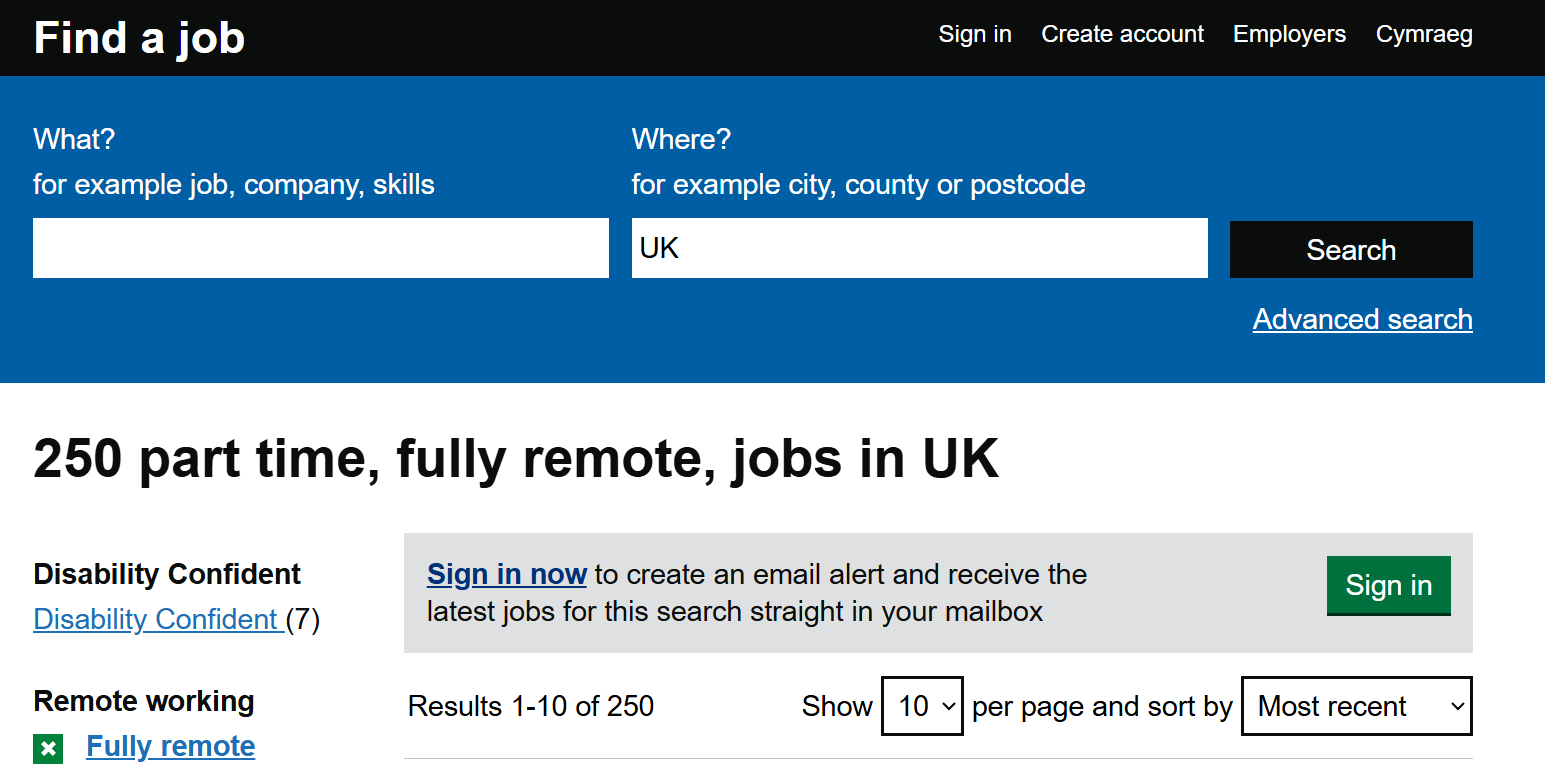
It’s also skirting over the fact that it’s society which is disabling people too. Even if some people in the LCWRA could work, it doesn’t translate to there being suitable, accessible work. For instance, the DWP’s ‘Find a job’ website is currently listing just 689 “fully remote” jobs out of more than 114,000 in the whole UK. Of these, just 250 are part-time positions – and only 7 of those are ‘Disability Confident’:
It therefore plays right into the hands of the right-wing corporate media and politicians’ actions to malign certain disabled claimants, namely neurodivergent people and those with mental health conditions. In short, the ‘incentive’ framing buttresses DWP boss Liz Kendall’s “taking the mickey” demonisation of chronically ill and disabled benefit claimants.
Reject the premise for DWP Universal Credit cuts, or move over
The Canary contacted the Resolution Foundation for comment on DWP Universal Credit cuts. It only seemed to double-down on this position:
In our recent work considering possible approaches to slowing the increases in spending on working age health related benefits, we have pointed out that there is a very large difference in entitlement between the standard rate of UC and what you get by being entitled to the LCWRA (the difference is over £400 a month). This means that UC claimants have a very strong incentive to try to get on to the LCWRA and might then be reluctant to do anything which risks them losing the LCWRA. We have suggested that, especially given that core UC entitlements are so low, it might be better to redistribute money from the LCWRA element to the basic allowance of UC.
Overall, it’s shameful that the Resolution Foundation is buying into the government’s premise that it even needs to make cuts to welfare in the first place. Worse still, it’s loaning legitimacy to the DWP’s pitch to punch down on chronically ill and disabled people to meet chancellor Rachel Reeves’s self-imposed ‘savings’.
Perhaps however, the thinktank’s de-fanged approach should also come as little surprise. After all, its former chief executive from 2015 to 2024, Torsten Bell, became a Labour MP in July’s elections. What’s more, he holds a dual post as both parliamentary under-secretary to the Treasury, AND the DWP. That is, he works directly under both Reeves and Kendall – the two cabinet ministers largely spearheading Labour’s latest callous proposals.
In that context, the Resolution Foundation’s ostensible shaping of the health-related Universal Credit plans only makes sense. All the same, it will come as a shock to the many chronically ill and disabled people who had counted on the thinktank to be on their side.
Featured image via the Canary


Comments 4
Leave a Reply









Same old story. Attack on the Disabled and the Sick. Easy targets, who, in the main, are unable to defend themselves. Smacks of Cameron’s Welfare Death Squad, IDS and Grayling, when, between 2010 and February 2013, 136,000 people died within six weeks of losing their ESA entitlement. IDS famously said, “I don’t care who’s died! I’m proud of my Welfare Reforms!”.
Crimes Against Humanity springs to mind!!
Trying to make sense of Labour Party policy is like trying to make sense of Trump. Americans frustrated by their media taking everything Trump says at face value and debating it like a rational proposition say their poodle media e.g. Fox News etc are ‘sanewashing’ him i.e. tying themselves in knots to find ways to make what Trump say sound like something you’d expect a President to say rather than the word salad it is. While the media pretend Trump is behind policy and is actually running his government, the sanewashing media cannot focus on those behind Trump who are really running things. The attention should not be on Trump but the likes of Curtis Yarvin or his sugar daddy Thiel and the other oligarchs bank-rolling the ‘dark enlightenment’ attack on democracy across the globe. In the same way, we must recognise the Labour Cabinet are quite mindless, not the true authors of their policies, and the real agents of political change are the people behind them – ‘think tanks’ and the dark money funding them.
I think anyone trying to see a reasoned basis for Labour policy are also ‘sanewashing’. As I see it, the truth is that no one in the Labour Cabinet are moved by political philosophies or values. They do not think. All of their thinking is outsourced to their pundit ‘advisors’ (as in the case discussed by this article, and just like Cummings and his minions did the thinking for Johnson and we have the brexit and covid legacies to show for it). Starmer’s Cabinet operate on a moronic, one word slogan level. Everything is on behalf of ‘growth!’ and the only way to filter out bad ideas is if they are ‘popular!’ with focus groups that have been designed to reflect the views and values of actual or potential Reform voters or those even more rightwing. Since Reform and the Far-Right are moulded by social media algorithms, their views and values are largely engineered by Nazis like Elon Musk through platforms like X/Twitter. You could even say what we have today in UK is in effect government by AI. Thus Labour is outsourcing its policy-making to think groups and social media i.e. to resources overwhelmingly funded, owned, and controlled by the Oligarchs. Labour is a Far-Right puppet. We should realise that and stop pretending/washing it otherwise.
I know it is hard to accept Labour is no longer a Leftist party, not even ‘centre-left’ (LibDems and Greens are now to Left of Labour), especially if you grew up in C20th thinking that Labour were on the side of workers, or favoured social justice, or if more recently, in the C21st, you joined Labour because Corbyn and ‘Green New Deal’ felt like a beacon of hope. But giving Labour the benefit of any doubt and clinging to what you want to be real rather than what is actually real is a kind of self-harm. You are just ‘leftwashing’ or ‘sanewashing’ something that is very corrupt, very dangerous, and very anti-democratic. If you see US under Trump/Musk and fear it might happen here, I have to tell you, you are wrong. The USA is not our future, it is our PRESENT and I think most of the UK population is still in denial. I read somewhere that in a crisis, faced with novel threats or opportunities, over 80% of people do not change their ideas or behaviour but still act as if life was just like it was before. Less than 1 in 5 of us have the reality checking, the self-discipline, the versatility, the broad-mindedness, and resilience to rapidly adapt to new circumstances – avoid danger, seize chances. This 20% is the measure of human survival. They are the future of humanity because they survive what are extinction events for everyone else. I hope the people reading The Canary will be amongst the most adaptable so that ‘when facts change, I change’ (to quote some economist, was it Keynes?) is engraved on your hearts. Trundling on in a mindset that belongs to the pre-2008 mindset (to pick a watershed date) suits Starmer who seems never to have had an original political thought but to rely on what his earlier self experienced under 1990s Blairism as if it were true for all ages – which is why he is so easy to manipulate via social media and other C21st innovations. Voter passivity (also a more C21st than C20th phenomenon) aids his Far-Right puppet-masters to achieve their evil goals. But bringing C20th mindsets to C21st reality is not doing you any good. Take care of yourself, see Labour for what they really are, not for what you wish they were, live in the here and now.
I see no way to better government while Starmer and his Cabinet are in place. Labour MPs need to replace these puppets with political heavyweights driven my vision not focus groups – are there any MPs of such calibre under the age of 60?!? I cannot name any off the top of my head. Labour have a huge majority. They could radically rebuild a better, fairer society. But only if they have the political will to do this autonomously and are not just mindlessly following a path laid out by oligarchs. Can Labour become a real political force? I am not holding my breath.
As one of those disabled/chronically ill, who will be directly affected by these cuts – because cuts they are – I’d really like to know how Labour will be allowed to cause us such deliberate damage to us, by using our already povery-inducing Benefits, & making them so little, that we’ll be unable to even survive on them?
Surely, the amount of Disability Benefits – that we had to go through hell & back, to be awarded -were set, as by Law, to the minimum allowed?
If this is, in fact, true, then surely ANY direct cuts to our Disability Benefits, will be against our Human Rights, as well as our Rights as People of Disabilities?
It is well researched that, even if our Benefits stay the same, all those of us, under the aegis of the LCWRA, are barely surviving on levels of Benefits that are still at least £1,000 per month LESS than we actually need, in order to live as equally as possible, as anyone who is able-bodied.
Even our most basic needs, are far more expensive to pay for, & are far higher in human-power needs, than someone fit & healthy, & able to go to work!
Surely, if Labour is trying to encourage those who, by their own rules, are deemed to be UNABLE to Work , to actually TRY to do so, then how will cutting our PIP, by around 50%, enable us to get, & keep, these fictitious jobs?
Even if we all suddenly had a miracle, that would allow us to take up some form of work, we would now be in such dire financial straits,
that this would be impossible to do.
Have Labour really forgotten that PIP was ALREADY deliberately designed to be as hard as possible to claim, & that, despite this, those of us with the endurance to answer all of their most humiliating questions, only managed to do so, due to having to learn patience, after YEARS of being too sick, or disabled, to do anything quickly.
We also had to supply Reams of Medical Evidence, that the DWP insisted we supply them, even though accessing Consultants,, or even our own GPs these days, in order to prove, without a doubt, that we aren’t the ‘fakers’ a succession of Governmental Talking Heads continue to accuse us of being,, to this day!
PIP was designed to take over from DLA, in what was a very obvious Cost-cutting exercise, & was designed as both an In-work, as well an Out-of-work Benefit.
This was so that those who are fortunate enough to be ABLE to take up some kind of work work, then have a great need for the Mobilty Element of PIP, in order to be able to get to, & from, work, as safely as possible!
Knowing all of this who, in their right mind, would deliberately cause those ones still able to do some work, to have to give it up,, due to losing their Mobility Car!
Those of us who are unable to drive, have to use our mobility element to either pay for Taxis whenever needed, or pay other people to take us where we need to go.
Those who, like me, are Housebound, & virtually always bedbound, have to use that money to pay other people to do whatever we can’t do for ourselves!
Every penny of my PIP goes on paying 3 people to help me stay in my own home, as safely as possible. Both Elements are used in buying heating oil, or calor gas for my cooker, so meals can be prepared for me – that’s when I’m not in such pain, that eating makes me feel sick!
But, every single penny of both my ESA, & PIP, is spent on keeping me safe in my home, & paying my ever-increasing Utility Bills, & Grocery Shopping – I do that with a regular, fortnightly online shop, & the Supermarket delivers it to me, directly into my home, with the delivery person emptying my food in the kitchen for me.
But,, after all of that is paid out, there’s nothing left for me to save, in case of emergencies. Sometimes, if an unexpected expense happens, I go without food, to pay for whatever it is , as there’s nothing else to spare!
How our Government expects us to have a level playing field with the Able-bodied, I don’t know, as their constant rhetoric of ‘Benefit Cheats’; of ‘Liars claiming unfairly’; has made the world outside our homes a dangerous place to be.
There are monthly reports, of yet more disabled people being attacked, beaten up, spat upon, abused physically, emotionally, & mentally – often by the same people that are part of our neighbourhoods!
With all of this to contend with why have we been made the scapegoats of governments, for too many decades to count?
So angry, but so unsurprised.
The luxury we cannot afford are the parasitic rich and warmongering.