Children of the 2026 World Cup — generational ties on full display

At the World Cup, it’s not just the matches that repeat themselves—names also recur across generations. Between fathers who played in the World Cup decades ago and their sons who now stand on the same stage, one of soccer’s most compelling human stories unfolds. In particular, the family legacy is passed down the generations.
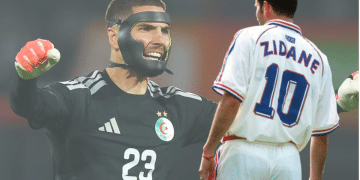
The 2026 edition features a series of stories bridging past and the present, where Mazinho crosses paths with his son Thiago Alcântara, and Zinedine Zidane with his son Luca. There’s also Mustafa Shubair, following directly in the footsteps of his father, Ahmed Shubair.
World Cup football families — same roots, different paths
One of the most notable stories of soccer legacy involves the Brazilian Mazinho and his Spanish son, Thiago Alcântara. This is an example that reflects how a name is passed down within a single family across multiple national teams. In addition, it reveals the creation of distinct soccer identities.
In the same vein, Zinedine Zidane remains one of the game’s most iconic figures, thanks to his historic achievement with France at the 1998 World Cup and his run to the final in 2006, while his family legacy extends to his son Luca Zidane, who has chosen a different path in terms of international representation, alongside Mustafa Shubair’s participation in the same scene as part of the current generation.
The Shobeir name returns to the World Cup
The Shobeir family name has returned to the World Cup after more than three decades. This is thanks to Mustafa Shobeir’s participation in the current tournament.
Ahmed Shobier had represented the Egyptian national team at the 1990 World Cup, playing in notable matches against the Netherlands and Ireland, before his name became associated with one of the most significant rule changes in the game—the prohibition against a goalkeeper handling the ball after it is passed back to him by a teammate—following a time-wasting tactic he employed in one of the matches.
Nordic father-son duos at the World Cup
This phenomenon is no longer limited to individual players. It extends to national teams as well. During the 2006 World Cup, Daniel Andersson played for the Swedish national team. He is the son of Roy Andersson, who represented Sweden at the 1978 World Cup. Because of this, the father-son legacy continues in the Swedish national team’s World Cup history.
At the 1994 World Cup, the Norwegian national team returned to the tournament after a long absence, featuring Alf-Enge Haaland, Goran Sorloth, and Erik Thorsvedt. Thorsvedt played in every match, while Haaland played in two; Sorloth did not play at all.
Today, 32 years later, their sons are competing in the current tournament. Erling Haaland continues his remarkable run, having scored 57 goals in 51 international matches. He kicked off his World Cup campaign with a brace against Iraq. At the same time, Alexander Sørloth took part in that same victory. Meanwhile, Kristian Thorsvedt came on as a substitute in the match.
Genes alone aren’t enough
Despite frequent talk about the role of genetics in the transmission of talent, soccer remains a game that recognises only individual achievement.
Pelé remains the most prominent example: he grew up in a soccer-oriented environment where his father was a player, but his father was unable to continue his career due to injury. Pelé then emerged to forge an exceptional legacy and become one of the greatest World Cup legends in history.
Featured image via the Canary

Leave a Reply