The Wall Museum: sumud, survival, and resistance under Israeli occupation in Bethlehem

In northern Bethlehem, a community-led project is preserving Palestinian experiences of life under occupation through public documentation. Centred around the Sumud Story House, the initiative gathers and displays personal testimonies in the shadow of the separation barrier.
The separation barrier: creating a ghost town in northern Bethlehem
The Sumud Story House of the Arab Educational Institute (AEI) is located in Northern Bethlehem and was opened in 2009. It is close to the sacred site of Rachel’s Tomb, also known as Bilal Bin Rabah Mosque.
“Israel” has banned Muslims from accessing Rachel’s Tomb since it occupied the West Bank in 1967. During the 1990s, the site became an Israeli occupation military stronghold with the Jerusalem-Bethlehem checkpoint 300 close by. Then, in 2004-05, “Israel” erected the nine-metre-high concrete separation wall around the shrine. This entirely separated the holy site from Bethlehem, prevented any Palestinian access, and completely transformed the area. No less than 65 Palestinian shops, workshops and garages in the area closed their doors after the barrier was put up.
Claudette Mubarak, director of Sumud Story House tells the Canary:
Before the wall was built, this area was full of life. It was very busy with people coming and going. But after it was constructed, people started to leave. Many shops and houses were now behind the wall so they couldn’t be accessed any more. There was no life in the area, and Palestinians were suffering a lot. People only came here if they wanted to pass through Checkpoint 300 and go to Israel.
Social healing and sumud
In 2009, the former director of the Arab Educational Institute (AEI) decided to help bring life back into the area. What these Palestinians needed was somewhere safe where they could meet, talk, express their feelings, process their trauma, and tell their stories. Women began coming together, and meeting on a weekly basis for cultural and social events. These meetings continue today, and have grown in size.
Mubarak explains:
Through these meetings we collected a lot of stories from these women. We felt these should be used in some way, and written as a documentation.
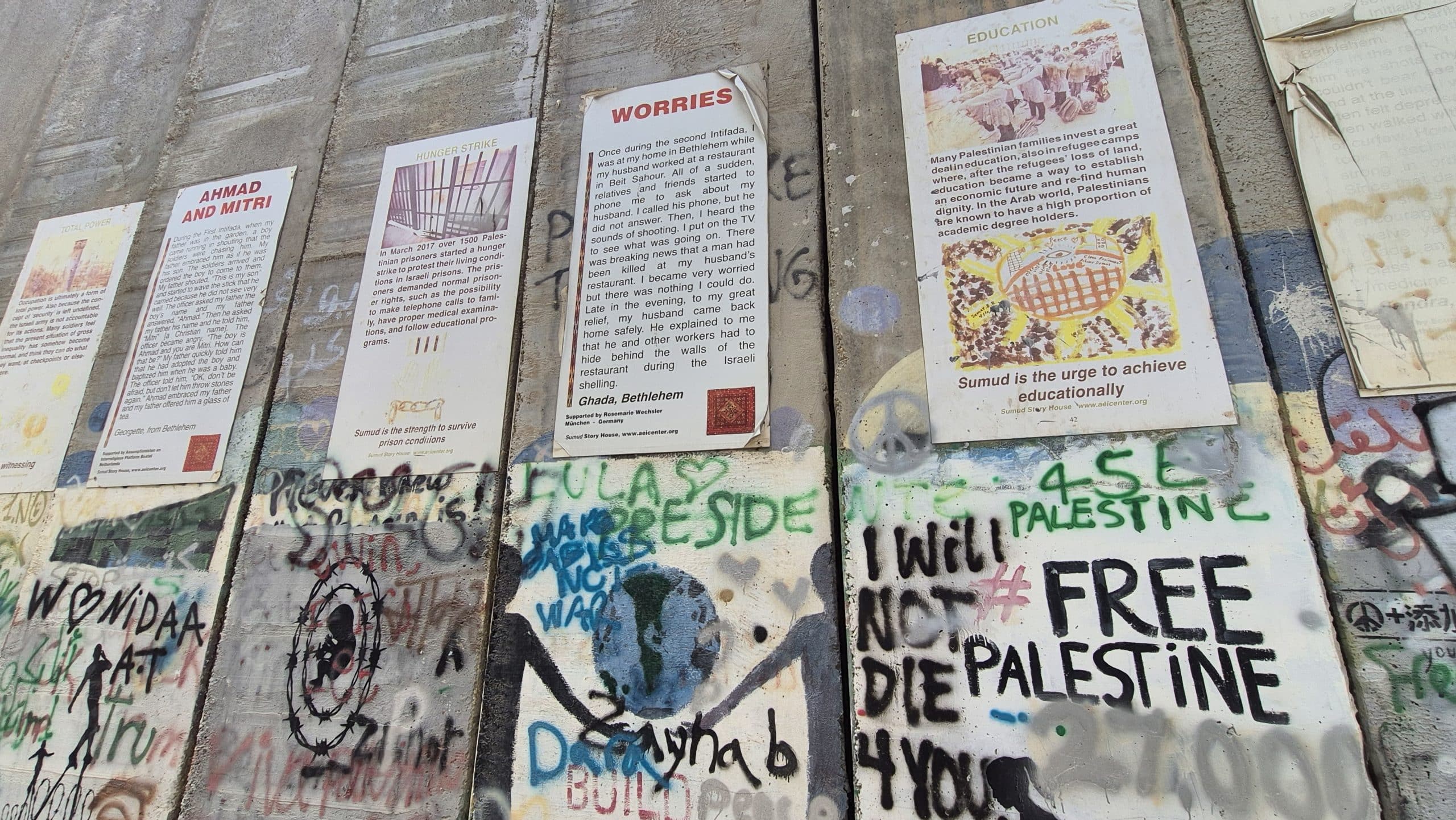
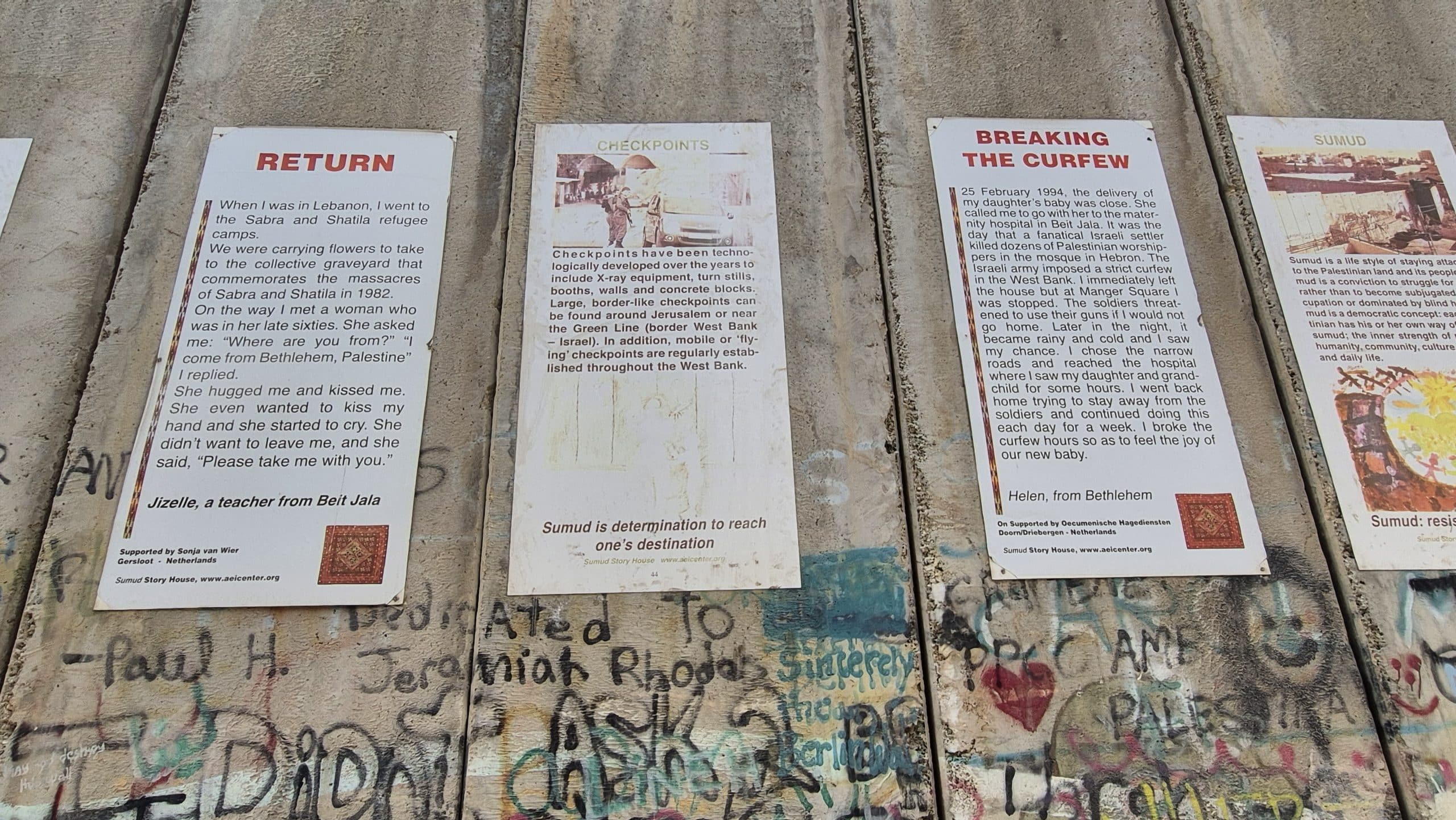
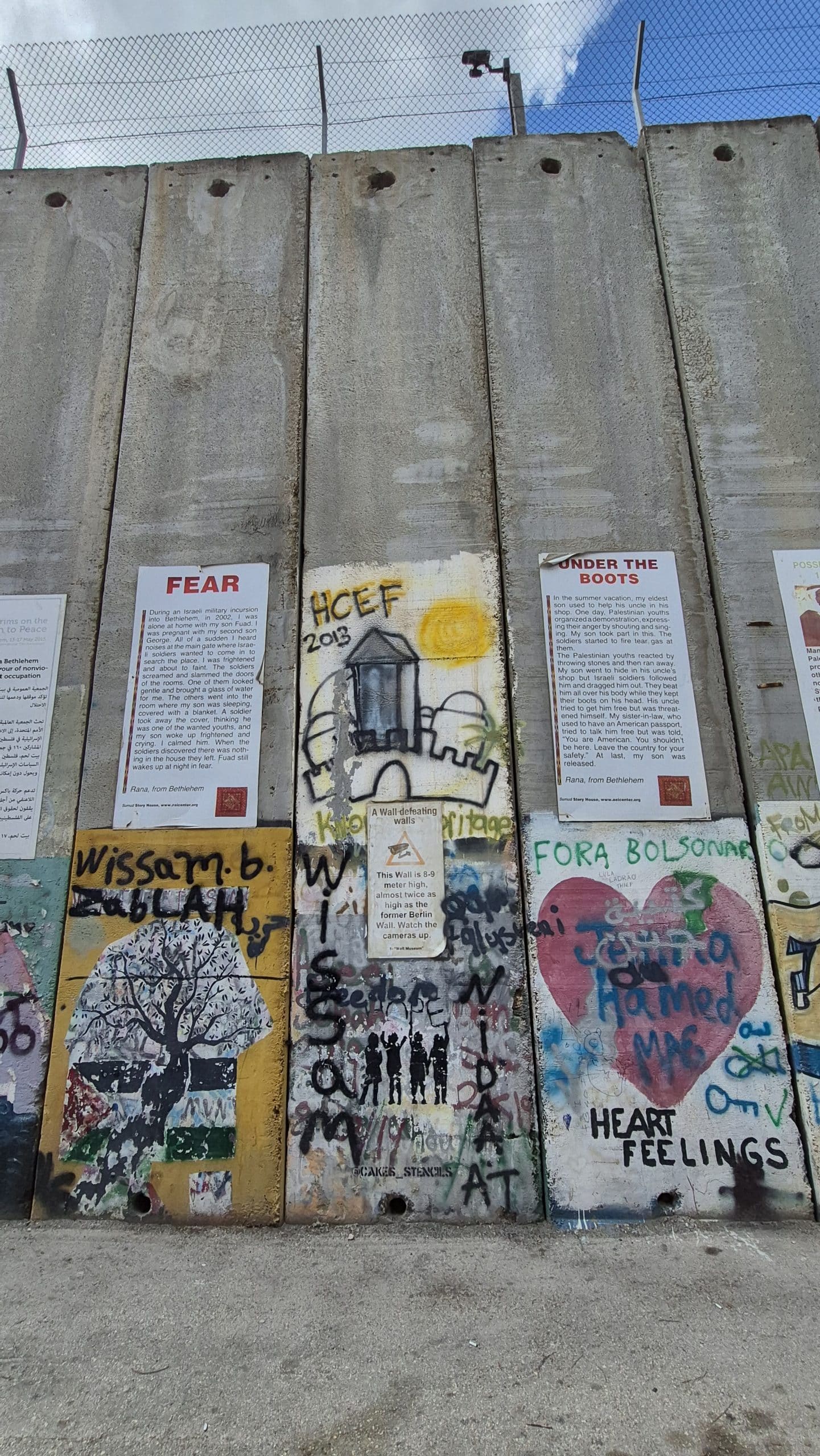
The women, the youth and the stories came from the neighbouring towns of Bethlehem, Beit Jala, and Beit Sahour. And also the nearby refugee camps and surrounding villages. Each story has been translated into English and made into a poster, so those visiting Bethlehem can see, read and remember them.
At first, they were displayed in Sumud Story House. But staff eventually decided to move them somewhere more visible to the public.
Mubarak says:
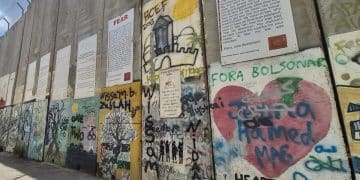
We decided to put them on the wall, as a way of non-violent resistance against the wall. In this way, people passing by can at least know about how the Palestinians live. The “Wall Museum” is a tool for advocacy, communicating about Palestine, especially for foreigners. We hope that one day the wall will fall, but the stories of course will remain. These stories talk about children, youth, and women. They are stories of living together as Christians and Muslims, of struggle, hopes and dreams.
The “Wall Museum”- an act of preservation and resistance; sumud
There are currently more than 270 personal stories, testimonials and poems in this open air documentation project. They are attached directly to the concrete separation barrier surrounding Rachel’s Tomb. Since October 2023, the worsening situation across the occupied West Bank has meant no new posters have been added, as the risks associated with documenting and displaying Palestinian experiences have grown.
For the Arab Educational Institute, the Wall Museum is more than a cultural project. It is an act of preservation and resistance, ensuring that the lived experiences of Palestinians under occupation are publicly recorded rather than erased.
Sumud is a concept, and literally means steadfastness or resilience. But it is more than staying on the land- it is a way of life. Palestinians love life, and each person has his or her own way of practicing sumud, which allows them to live their lives despite occupation. These people laugh, dance, continue their studies, and stay on their land, despite all the suffering and hardship the Israeli occupation intentionally inflicts upon them.
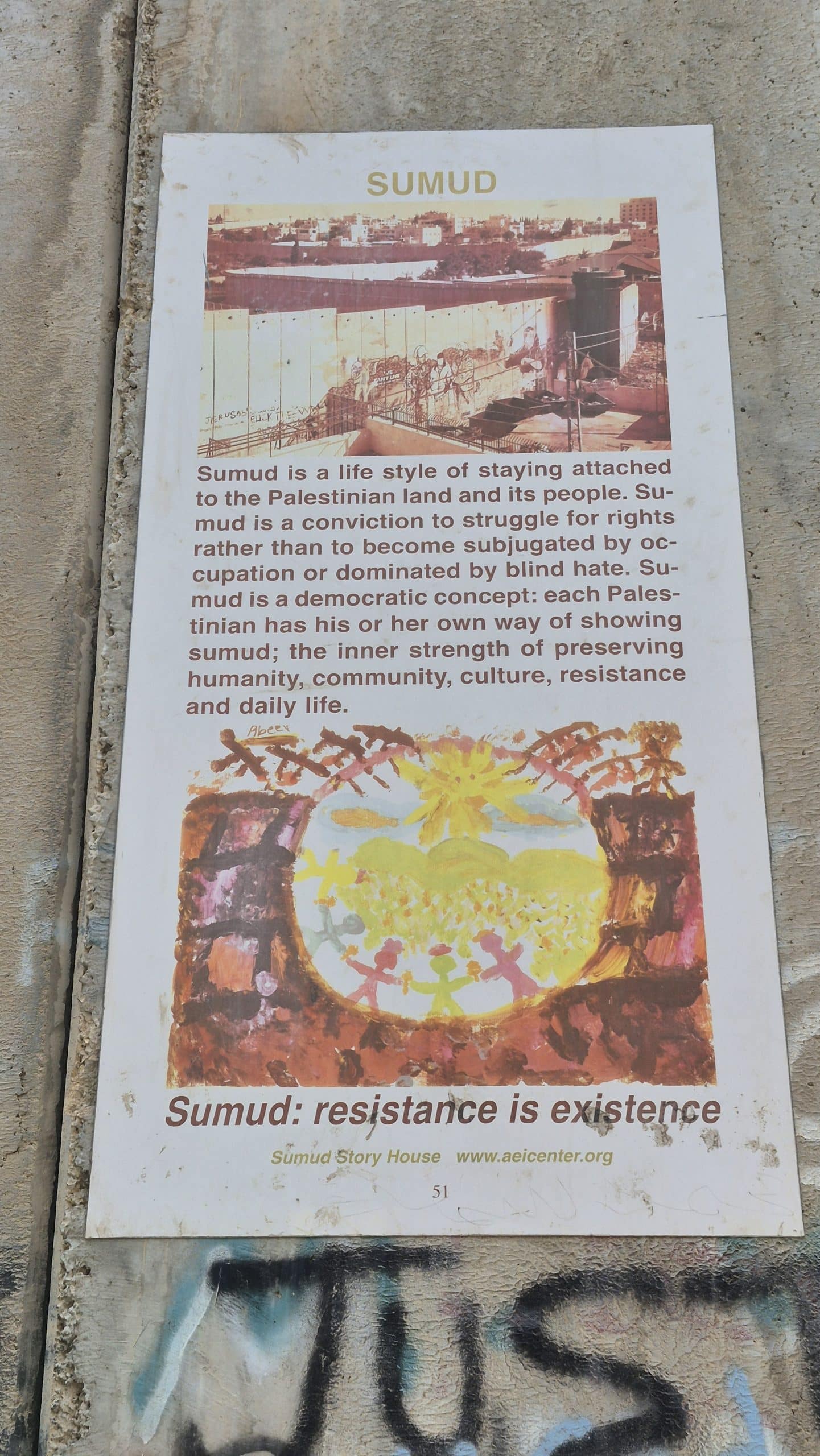
Since the genocide in Gaza, sumud is one of the few things Palestinian people still have, according to Mubarak. She says:
Sumud is like the candle that gives people light in the darkness around them. This is the only solution they have nowadays.
“Israel” has made sure life is never easy for Palestinians. But things are especially difficult for them now. They are currently living through the deepest economic crisis ever recorded. More than 900 obstacles placed throughout the occupied West Bank have seriously impeded freedom of movement, while land theft, home demolitions, and settler violence is at a record high.
Israeli occupation’s separation barrier steals vast tracks of Palestinian land
Under the pretext of security, the Israeli occupation began building the separation barrier in 2002. But this has nothing to do with security. It is about stealing land. Its route does not follow the internationally recognised Green Line, which separates so called “Israel” from the West Bank and East Jerusalem. Instead, this apartheid wall cuts through Palestinian land, in some areas extending as far as 22 km into the occupied West Bank. It has divided Palestinian communities from homes, farmland, schools, workplaces and places of worship.
In 2004 the International Court of Justice (ICJ) declared “Israel’s” more than 700 km long separation barrier to be illegal. It said building should stop immediately, and reparations be paid to Palestinians for any damage caused.
More than twenty years after construction began, the wall still dominates Bethlehem’s northern entrance. But alongside the concrete, another record has emerged. The testimonies displayed by the Sumud Story House document not only the physical consequences of occupation, but also the determination of Palestinians to preserve their history, identity and presence on their land despite decades of displacement, restriction and military rule.
Featured image via the Canary
Leave a Reply