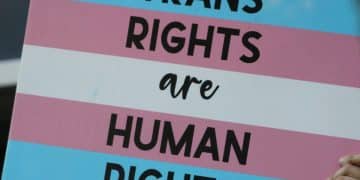
Scottish courts further denigrate rights for trans people with prison ruling

Scotland’s highest civil court has ruled that guidance allowing some trans women to be housed in women’s prisons was unlawful.
This is undoubtedly another setback in an increasingly hostile environment for trans people across the UK. It is incredible how fast the legal arguments fall in line once political appetite changes.
And now that fascism is creeping across the UK, clearly the most vulnerable communities are facing the sharpest end of oppression.
Human rights for some
The Court of Session ruled that Scottish prison guidance was unlawful because it allowed some trans women to be accommodated in the women’s estate following individual assessments.
Campaign group For Women Scotland welcomed the judgment. They hailed it as a ‘victory.’ Now, you would be forgiven if you thought this is a group that campaigns for women rights. But just one Google search later, you will realise that this is a strictly anti-trans group cosplaying as campaigning for women’s rights.
The immediate debate on the internet has focused on prisons, biology, safety, competing rights, and so on. Yet history teaches us that societies rarely reveal themselves through how they treat the powerful. They reveal themselves through how they treat those with the least power.
And prisoners occupy a unique position in that regard.
A prisoner has already lost their liberty. They are entirely dependent on the state for their safety, dignity, and wellbeing. If rights mean anything at all, they mean everything in places where power is most unequal.
This is why human rights frameworks exist in the first place.
The European Convention on Human Rights (ECHR) was not written to protect popular or powerful people or groups. You don’t need to safeguard the rights of majorities. Rights are only truly important when they apply to people who are unpopular, misunderstood, feared, or politically inconvenient.
The Scottish government itself argued that a blanket approach could interfere with Article 8 rights — the right to respect for private and family life. Whether one agrees with that argument or not, the fundamental tension here — that extends far beyond this particular case — is how can human rights be at the mercy of the whims of those who are in power or the social appetite of the day?
Aren’t human rights universal?
Colonial systems of past and present have long answered that question with a firm “no”.
Throughout history, colonial power has depended on categorisation. Some people were considered fully entitled to rights and protections. Others were not even considered as people.
Colonised populations, political dissidents, prisoners, migrants, minority groups, etc… frequently found themselves excluded from the protections that supposedly applied to ‘everyone’.
Even if the language has been polished and whitewashed over time, this very logic remained remarkably consistent.
A category is created. The category all of a sudden becomes a ‘problem’. Exceptional measures are introduced to tackle that problem. The exception gradually becomes normal. Then you repeat. You then might want to introduce identity politics so that those ‘categories’ remain as such and never morph into one, solidified, united body acting in solidarity and for their real interests.
Conquer and divide.
There are many differences between trans prisoners and colonised peoples. However, the underlying mechanism of oppression is the same.
A small and politically vulnerable group becomes the subject of endless public debate. Their lives are discussed more often than they are listened to. Politicians speak at them, not to them. Their rights become contingent upon public approval and appetite. Even their humanity becomes negotiable.
The trans prisoners barometer
Now in order to test whether rights can survive periods of anxiety and political/social pressure prisons, again, provide perhaps the clearest measure.
They are places where the state exercises extraordinary power over human beings — in every single way. Also, they are places that are forsaken by society’s values and morality — society’s commitment to dignity and fair-play.
So this new ruling matters because it forces us to confront the question about what kind of society to we want to be.
This has not resolved disagreements about sex and gender. It has prompted us to pose uncomfortable questions about ourselves and about what we stand for. Will we protect those who are vulnerable? Or will we move aside, nod and obey orders?
Human rights are easy to defend when they apply to powerful groups. Henry Nowak’s example is a case in point. The whole country turned upside down not because an innocent man was stabbed and killed. This happens almost 45 times every day in London alone. But the whole country turned upside down because Nowak was white — and it’s easy to defend white people because they are the powerful majority.
Once a state becomes comfortable taking one group’s rights away on a whim, it never stops there.
The category may change. The justification might change.The target might change. The principle? Never!
The real debate sparked by this ruling is therefore about whether rights remain protected when the people claiming them are unpopular and not politically powerful.
Because a society ultimately reveals itself by how it treats those with the least power.
Are we governed by humanity and compassion? Or by fear and hate? This latest ruling, in a flurry of transphobic rulings, suggests the latter.
Featured image via Oxford Human Rights Hub
Leave a Reply