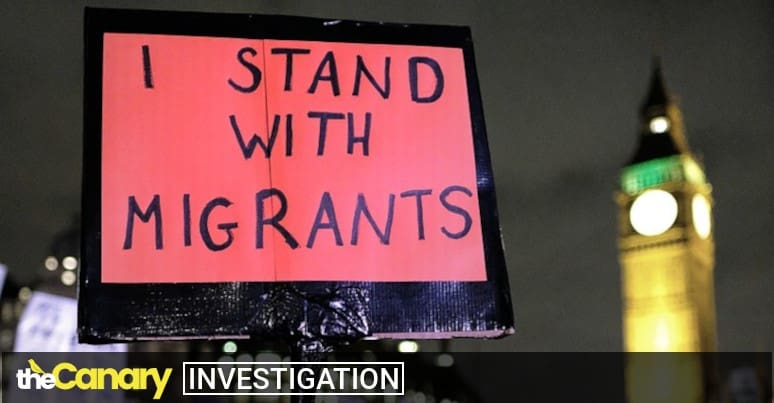
Migrant and disabled people are targets of the same hostile politics

Disability welfare cuts and immigration pledges are part of the same odious project — two sides of the same coin — weaponised by the by the Labour-led government to oppress migrant and disabled communities.
The problem is that disability rights arguments are failing to recognise shared experiences of oppression for the disabled and migrant community. This plays right into the hands of the government.
This under the radar benefits cut reminds us why disability justice must centre migrants’ rights
Labour’s racist, ableist anti-immigration ‘compromise’
With the government now under the steer of former Manchester Mayor and Blairite Andy Burnham, the new prime minister has wasted little time signalling that his premiership will not break from some of the party’s most performatively cruel policy plans.
Some of the cabinet hanger-ons, like home secretary Shabana Mahmood and Department for Work and Pensions (DWP) boss Pat McFadden, already show the new head of government gearing up to deliver on more of the same. Only now, it’s under the veneer of his artfully constructed ‘progressive’ persona.
The public already got a hint of what this might look like for Mahmood’s hostile immigration reforms. Notably, the government could exempt migrant care workers and those who arrived since 2021 from its plans to double the time it takes to obtain indefinite leave to remain.
For the xenophobic fascists to the right of the party, these plans were of course not racist enough. For the liberal fascists (marginally) more left inside the party, these might just hit the goldilocks zone of ‘not too racist’. And as such, they’ll vote it through the Commons.
What’s clear is that its immigration reforms will immiserate the lives of migrant communities across the UK. Disabled migrants particularly will face the desolate and deplorable reality that the state safety net will not support them.
These are racist hostile environment policies – and at the same time – these are also ableist and disablist welfare cuts.
Migrant and disabled communities are fighting the same war
The system vilifies and excludes disabled people and migrants using much of the same necrocapitalist rhetoric. Therefore, for disabled migrants at the dual end of this, and subject to further marginalisations. The state works overtime to mark them as expendable.
What Labour’s compromise options — and its vicious anti-immigration reforms more broadly — boil down to is that migrant belonging is conditional on their utility to capitalist production. In other words; their citizenship, security, and permanence in the UK.
It’s evident in every reference Labour’s proposals make to economic ‘contribution’. Incidentally, there are no fewer than 72 references to that in its earned settlement plans. Each ‘deserving’ category of migrant it singles out for its racist, classist conception of the ‘good immigrant’, namely, those with higher English proficiency, higher earners, and those in senior positions of public service, makes this abundantly clear. It’s apparent in the way it’s now also considering exempting migrant care workers from its doubling of ILR.
And this economic contribution refrain is one disabled people in the UK will be painfully familiar with. Labour has constructed its whole programme of sweeping disability benefit cuts around the idea of economic contribution and support only for ‘deserving’ disabled claimants. Of course, it’s the DWP that gets to define what that ‘deserving’ looks like. And with its grim history of benefit cut deaths, austerity and profitability will trump disabled people’s lives and dignity.
Unsurprisingly, this rhetoric is emerging from all the same establishment circles that close ranks around profit. It’s a back scratching ecosystem of DWP policy advisors, right-wing think tanks, and the cesspit corporate media.
The point being, disabled people and migrants are fighting the same oppressors. They’re battling the same capitalist system and the same weapons they use to marginalise and disenfranchise.
Falling into the contribution trap
But while it might be the right-wing, this Labour government, that are punching down on both communities, the disability rights movement (and the left more broadly) must also be careful not to unintentionally capitulate to its framing around migrant rights issues.
Take Labour’s potential ‘compromise’ around care workers. Notably, Mahmood has reportedly weighed up exempting over 600,000 migrant care workers from its ten-year ILR wait.
It’s common for people on the left to cite care workers and NHS workers to rebut right-wing anti-migrant bigotry. But in doing so, it ties migrant worthiness to economic value and usefulness to capitalist production. It justifies the political class exploiting certain categories of migrants that ‘contribute’ economically through tax or otherwise in capital-enabling socially reproductive work.
And social care can be one area disabled people’s rights and migrants’ rights can intersect. Closures or restrictions on visas for care workers have been an instance where successive governments’ attempts to restrict freedom of movement have had repercussions for both communities.
Enhancing the credibility of the system
However, when disabled people push back against these, it must not be in a way that subordinates migrants’ rights to disabled people’s needs. Articulating migrant care workers’ necessity for disabled care users must include challenging the systems that devalue and exploit migrants. Otherwise, it puts migrant rights and personhood second to disabled people’s.
Without calling for migrant rights above and beyond what exists, it merely advocates for maintaining visa schemes that commodify Black and brown bodies in a racialised hierarchy of labour that mirrors colonial systems and racist colonial stereotypes of labour.
These permit entry to the UK on precarious migration statuses. In particular, these are statuses that exploit Global South and Eastern European workers. It pushes them to do the undervalued, low-paid, gruelling physical labour and socially reproductive work. And at the same time, these visa arrangements deny them full access to the colonial ‘core’. Or, in other words, ILR and citizenship.
Disability rights scholars Rebecca Yeo and Robel Afeworki Abay have described how, often, the purpose of Home Office “action to reduce restrictions” in the asylum system is to:
enhance the credibility of the system.
So as the Labour government float these possible exemptions, the disability rights community must not lend it any legitimacy. It’s not enough alone to advocate for migrant care worker visas that plug the gaps in a broken care system. Because meeting disabled people’s care needs cannot come at the cost of marginalised migrant lives.
Entertaining anything less than a full dismantling of the disabling, extractive, and deadly hostile environment would betray everything the disability rights movement is meant to stand for.
Featured image via the Canary
Leave a Reply