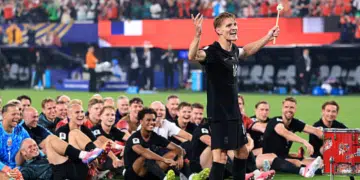
Norway steals the limelight at the World Cup with Viking rituals

The Norwegian national team’s appearance at the 2026 World Cup was not merely a return after a long absence. Rather, it has felt like the reclaiming of a whole identity, bringing the fans back to the forefront – this time with a different face and a louder voice from the stands.
Whenever the team achieved a positive result, a now-familiar scene would unfold: hundreds of supporters sitting in tight rows, swaying in unison, as if rowing together in a single ship navigating the tournament’s waves. A simple scene in appearance, yet it quickly became a defining feature of this summer’s World Cup.
World Cup fans delight
The idea was not born solely on the football pitches, but sprang from the depths of Norway’s historical memory, where the Vikings are not merely an ancient symbol, but part of a national narrative that remains present in the public consciousness.
The fans have reinterpreted this legacy in their own way, transforming ‘rowing’ into a language of celebration and a collective message stating that the team does not play alone, but is driven by an entire crowd moving in the same direction, with the same spirit.
As this phenomenon has spread, it is no longer tied to the result of a single match or a moment of victory, but has become part of the national team’s identity in the tournament.
The players at the heart of the action
What is new about this story is that the line between the pitch and the stands has begun to blur.
Following their recent victories, the Norwegian players were seen joining their fans in the same celebration, led by captain Martin Ødegaard, whilst Erling Haaland joined the scene with a smile that seemed almost like a tacit acknowledgement that what was happening was more than just a fleeting celebration.
Those moments have given the national team a different dimension: a side that seems at peace with itself, and a fanbase that does not merely offer support but actively shapes the narrative.
More than a passing fad
What sets this phenomenon apart is that it did not remain confined to the pitch. In the streets, at transport hubs, and even in public squares both inside and outside Norway, the same scenes were repeated, as if the idea had stepped out of its sporting context to become a temporary yet striking collective behaviour.
As the national team continued on its journey, it became clear that the ‘Viking Ship’ was no longer merely a metaphor, but a complete embodiment of a team that draws its strength from its unity, and from a fanbase that has found in football a space to redefine itself.
In a tournament brimming with stars and stories, Norway succeeded in telling its own tale: not just a story of goals, but a story of fans who decided to be part of the game, rather than mere spectators.
Featured image via the Canary


Leave a Reply