National threats bill clears Parliament amid criticism, awaits Royal Assent

The National Security (State Threats) Bill has completed its passage through Parliament and now awaits Royal Assent.
Lords amendments to protect humanitarian workers and journalists from its new offences were accepted, providing some relief, but most criticisms against the Bill still stand.
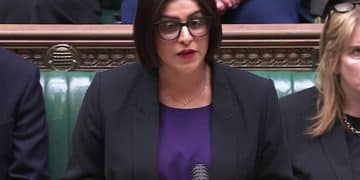
Sarah Champion MP, from the International Development Committee, welcomed the Government’s decision to introduce express defences for humanitarian organisations but expressed regret that ministers stopped short of a full exemption.
Johnson and Corbyn raised concerns about journalists
Kim Johnson (Labour) and Jeremy Corbyn (Your Party) raised significant concerns about the legislation’s potential impact on journalists in the final debate on amendments.
Johnson warned that under the legislation as drafted, “journalists could still face a prison sentence of 10 to 14 years for working with or even approaching sources in hostile Governments.”
Johnson went further, urging the Government to “consider pausing the legislation so that we can go back to the drawing board.”
Labour’s Dame Angela Eagle rejected Johnson’s remarks, saying that amendments accepted offered enough defences and exemptions for journalists and aid workers:
…the Government’s position remains that the Bill should not criminalise legitimate humanitarian aid work or the important work of journalists and diplomats, and it remains our view that the Bill does not have that effect.
The Government also supported amendments 3 and 5, which were tabled by Lord Anderson. These amendments were based on the advice of Jonathan Hall KC and also had the support of Lord Carlile. They add a reasonable excuse defence in new section 17C of the 2023 Act for obtaining, accepting or agreeing to accept information from a designated body. This means that where a person has a reasonable excuse for receiving information from a designated body, they benefit from a defence. This might include, for example, a journalist conducting an interview or a charity receiving information on the location of landmines. The Government considered the case for exempting humanitarian NGOs from the offences, but we were advised by our operational partners that this would provide a loophole that hostile actors would seek to exploit, which in turn could make the NGOs themselves a target for infiltration.
National Security Bill — Controlling information
NGO CAGE International has also criticised the bill. It said that the bill is about who gets to control information for those looking for information beyond the government’s own version of events.
The National Security (State Threats) Bill is, at its core, a bill about the control of information. It uses the threat of a fourteen year sentence to shape what people are permitted to read, share, and think about, particularly where doing so runs against the government’s own… pic.twitter.com/o3KYliXONa
— CAGE International (@CAGEintl) July 8, 2026
It said:
The National Security (State Threats) Bill is, at its core, a bill about the control of information. It uses the threat of a fourteen-year sentence to shape what people are permitted to read, share, and think about, particularly where doing so runs against the government’s own account of events.
CAGE has warned that the National Security (State Threats) Bill grants the Home Secretary unchecked designation powers with no judicial oversight.
The group says this follows a familiar pattern of mission creep seen with stop and search, surveillance laws, and the Special Immigration Appeals Commission (SIAC) system.
CAGE also points to the inconsistent treatment of groups like Palestine Action as evidence that such unaccountable discretion is open to misuse.
National Security Bill — Shielding Israel
The Bill is primarily targeted at the Iranian Revolutionary Guard Corps (IRGC), and that proscription of the IRGC has been “a long-standing goal of the Israel lobby,” according to Tribune.
I wrote this for @tribunemagazine on the draconian National Security (State Threats) Bill being rammed through Parliament this week, and the threat it poses to reporting from conflict zones that doesn’t conform to the government’s approved narratives: https://t.co/LIxxzyELrh
— Tom Blackburn (@malaiseforever) July 2, 2026
The publication points to an April meeting between representatives of the Board of Deputies and Jewish Leadership Council with Foreign Secretary Yvette Cooper, where they made this demand in person.
Tribune also notes that Labour MPs who have spoken in support of the Bill include Luke Akehurst, a former director of We Believe in Israel and arms companies lobbyist.
RT ban by EU a similar move — Murray
Former diplomat and human rights activist Craig Murray described the bill as “terrifying legislation.”
Murray drew a parallel with recent European Union legislation, noting that the European Court of Justice has ruled that reposting anything from banned media organisations is now a criminal offence in the EU.
He said:
If you repost anything at all from Russia Today, for example, if you’re on Twitter and you see a clip of something on Russia Today, someone saying something, you think that’s good, and you repost it, that will be a criminal offence in the European Union.
EU approves law to prosecute anyone who shares video from Russia’s RT…https://t.co/juZaRCrBk9
— SKWAWKBOX (@skwawkbox) July 5, 2026
Even with all these criticisms, the bill will receive Royal Assent later today.
Featured image via the Canary
Leave a Reply