World Cup visa chaos as journalists are blocked from entering the U.S.

The World Cup is supposed to be the moment the world comes together. Instead, with less than a week to go, the United States is facing mounting accusations that it is shutting the world out.
The International Sports Press Association (AIPS) has formally written to FIFA, warning that “many” Iranian and African journalists have been denied visas needed to cover the 2026 tournament on U.S. soil.
The letter sent June 5 and published on the AIPS website, was addressed to Bryan Swanson, FIFA’s director of media relations, and Jochen Steinhoff, FIFA’s head of media operations & services. And its message was blunt.
AIPS president Gianni Merlo wrote:
We find ourselves facing a long-standing and unacceptable problem for us journalists: the denial of entry visas to regularly accredited colleagues.
He went further, saying the issue is widespread and worsening:
There are many cases: Iranian colleagues, African colleagues, some of whom have been given single entries, so if their team goes to play in Canada or Mexico and they follow it, they can no longer return to the States. The cases are countless and, I repeat, unacceptable.
For a tournament marketed as the most inclusive in history, the optics are disastrous.
World Cup chaos
Merlo’s letter cuts at the heart of the contradiction: the U.S. is hosting a global event while enforcing some of the strictest immigration policies in modern American history.
Politicians always say that sport unites and builds bridges between young people in countries in conflict, but in this case, we are going in the opposite direction.
He warned that blocking journalists undermines the very image FIFA claims to champion:
We believe it is important to allow colleagues to attend the event and work, because their presence will be crucial to the image of sport and what it represents, especially in a country like the United States of America, where freedom of the press is a must.
The practical consequences are already being felt. Some journalists have lost money on flights they can no longer use. Others face the prospect of being locked out of the U.S. mid‑tournament if they follow their teams to Canada or Mexico.
Merlo explained:
We’re already significantly behind schedule, and many colleagues have already lost the opportunity to use plane tickets booked on time, and they’ll also face significant additional expenses.
FIFA responds by passing responsibility back to governments
FIFA confirmed it had received the AIPS letter. A spokesperson said only that:
the ability to enter host countries are ultimately consular and immigration matters.
In other words: FIFA are trying to dodge any blame for this.
But that stance is becoming increasingly difficult to defend. Multi‑entry visas are essential for journalists covering teams that move between the three host nations. Ivory Coast, for example, will play in Philadelphia, then Toronto, then back to Philadelphia. Senegal finish their group in Toronto and may need to return to the U.S. for the knockouts. Tunisia start in Mexico before heading to Kansas City.
If journalists can’t follow them, fair coverage simply collapses.
The timing of the dispute is awkward. AIPS and FIFA have long maintained a close working relationship. In April, dozens of AIPS representatives visited FIFA’s headquarters in Switzerland. AIPS even awarded FIFA the Best Press Facilities Award for 2025, praising its media operations during the Club World Cup in the U.S.
At that event, Swanson told delegates:
We appreciate and respect the important work of the media. We understand journalists have a job to do in covering FIFA’s activities and we do what we can to support you… All we ever ask is to be reported on with fairness and balance.
Those words now ring hollow for the reporters who cannot even enter the host nation.
The Trump factor
The visa crisis cannot be separated from the political climate. Since returning to the White House last year, President Donald Trump has reinstated and expanded travel restrictions affecting several World Cup nations.
The U.S. has active travel bans on nationals from Iran, Haiti, Senegal, and the Ivory Coast. That is four countries that have qualified for the tournament. Additional visa bond measures apply to Algeria, Cape Verde and Tunisia.
Athletes, support staff and immediate family members are exempt. Fans and journalists are not.
This is the core of the crisis: the World Cup is being hosted by a country that is simultaneously restricting entry to the very people who make the event global.
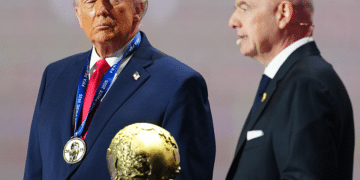
The situation also places FIFA president Gianni Infantino under renewed scrutiny. In December, he controversially awarded Trump a FIFA Peace Prize. And only this week, after meeting Trump, Infantino posted on Instagram:
America is ready to welcome the world for the FIFA World Cup 2026, I thanked (Trump) and his Administration for their continued support of this truly global event.
But Infantino’s past statements now haunt him. In 2017, during the U.S. bid to host the tournament, he said:
Any team, including the supporters and officials of that team, who qualify for a World Cup need to have access to the country, otherwise there is no World Cup.
Trump himself wrote to Infantino in 2018 promising that:
all eligible athletes, officials and fans, would be able to enter the United States without discrimination.
Those assurances now look a lot like lies.
A U.S. State Department spokesperson said
The United States is well prepared to welcome legitimate travelers from around the globe for the largest and greatest FIFA World Cup in history.
But the statement also made clear that security takes precedence:
The Administration will not waver in upholding U.S. law and the highest standards of national security and public safety… We adjudicate each visa application on a case-by-case basis after rigorous review and thorough vetting.
That leaves journalists, especially those from countries under travel restrictions in limbo. Clearly, the US’ definition of “legitimate” differs from the rest of the world.
A total disaster before it begins
The World Cup is meant to be a celebration. Instead, the conversation is dominated by who can’t get in.
The AIPS letter is more than a complaint, it is a warning. If journalists cannot enter the United States, the world cannot see the World Cup. Coverage will be uneven, distorted, or absent entirely for nations already underrepresented in global media.
The symbolism is stark, a tournament branded as “uniting the world” is being undermined by the host nation’s own policies.
FIFA can insist immigration is not its responsibility. The U.S. can insist security comes first. So unless the two sides find a solution, the 2026 World Cup risks becoming the most politically fraught, least accessible tournament in modern history.
A global event cannot function if the world cannot attend.
Featured Image via Jia Haocheng – Pool/Getty Images
Leave a Reply