Arab teams offer a mixed bag at the World Cup

The first round of the 2026 World Cup revealed that Arab football is no longer merely a spectator when it comes to the major powers, but at the same time it showed that the gap with the world’s elite remains evident for some teams.
Amidst results that sparked optimism and others that called for urgent reassessment, the Arab teams presented a mixed picture that held many implications ahead of the tournament’s continuation.
World Cup: strong start
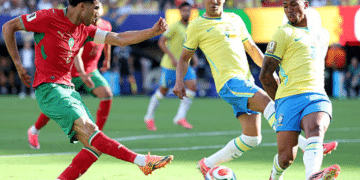
Morocco was the biggest Arab winner and perhaps one of the biggest beneficiaries of the entire opening round. The draw against Brazil was not merely a positive result, but a continuation of an upward trajectory that began at the Qatar World Cup in 2022. The Moroccan team played with the confidence of a side that believes in its ability to take on the big names, and succeeded in imposing its style against one of the most successful teams in history. The point earned by the Atlas Lions may seem ordinary on paper, but in practice it confirmed that Morocco is fast becoming a fixture on the world stage.
The Egyptian national team, for its part, put in a performance that reflected the experience of a side that knows full well how to handle major fixtures. The draw with Belgium did not come about through complete retreat or a purely defensive approach, but rather through a clear balance between tactical discipline and the ability to threaten the opposition. Egypt emerged from the first round with a clear message: they will not be mere passers-by in the tournament.
As for Saudi Arabia, they continued to cement their image as a team capable of surprising everyone at major tournaments. The draw with Uruguay gave the greens a huge morale boost and confirmed that the team possesses the organisation and character to compete with the big names. Most importantly, the result kept their fate in their own hands ahead of the next two matches.
Meanwhile, the Qatari national team succeeded in confirming the progress it has made in recent years. The draw against Switzerland earned Al-Anabi a valuable point and demonstrated a greater ability to cope with pressure compared to the previous edition. The performance was not perfect, but it was enough to confirm that Qatar is now better prepared to take its place on the world stage.
The disappointment of the opening match and the quest for redemption
Despite the 1–4 defeat to Norway, the Iraqi national team was perhaps the Arab side that came away with the greatest morale boost despite losing. The scoreline seemed harsh, but the details of the match told a very different story. Iraq showed attacking courage and clear character at various stages of the match, and managed to hold their own against a side featuring some of Europe’s top stars. Defensive errors cost them dearly, but the performance offered positive signs to build on, particularly as the team appeared capable of creating chances and refusing to give up despite falling behind.
As for Jordan, they faced their first-ever World Cup qualifier against Austria. Despite the defeat, the ‘Al-Nashama’ put in a creditable performance for a side embarking on a new experience at this level. The gap in experience was evident at crucial moments, but their fighting spirit and discipline have given the Jordanian side a foundation from which to build in the coming rounds.
Algeria faced one of the toughest possible tests against Argentina. The 3–0 defeat highlighted the gulf in class against a world champion of exceptional quality, but at the same time it left the Algerian side needing to quickly regain their composure, as the upcoming matches will be even more crucial in determining their fate.
Tunisia’s shock and the sacking of the manager
Meanwhile, Tunisia were the most worrying story of the first round. The heavy 5–1 defeat to Sweden was not merely a stumbling start, but a technical earthquake that prompted the Tunisian Football Federation to act swiftly and make a change to the coaching staff by appointing the Frenchman Hervé Renard.
The decision reflects the scale of the shock caused by the match, but it also reveals a clear desire to salvage the campaign before it is too late. All eyes will be on the reaction of the ‘Eagles of Carthage’ in the second round to see whether the change is capable of putting the team back on track.
With the first round now over, it is fair to say that Morocco has deservedly taken the lead in the Arab scene, whilst Egypt, Saudi Arabia and Qatar have strengthened their chances and demonstrated their ability to compete. Conversely, Tunisia, Algeria, Jordan and Iraq have entered a phase of real testing; the difference, however, is that some defeats have exposed a crisis, whilst others have revealed a project capable of rising to the challenge. Between these two extremes, the second round looks set to paint a clearer picture of the future of the Arab dream at the 2026 World Cup.
Featured image via the Canary
Leave a Reply