How Football Unites Communities Across the Globe

Football has never been merely a sport. It is a dialect spoken without grammar, a story told without words, a gathering that happens wherever space is found and a ball can be willed into motion. From the narrow alleys of Buenos Aires to the open plains of Kenya, from the beaches of Brazil to the cement courtyards of Somalia, football has slipped past borders, conflicts, and languages. It brings people together not by erasing differences, but by giving them a field on which they can coexist.
Shared Spaces in a Fractured World
The modern world is full of political, cultural, and economic borders, yet football moves with an ease that mocks division. In Europe, local clubs have long been the heartbeat of their cities. The rise of community-centered projects, such as the “Football for Unity” initiative during UEFA EURO 2020, worked with refugees and local youth groups in more than ten countries, creating safe spaces where newcomers and residents could play together. These gatherings were not about winning titles; they were about building belonging.
In South America, football famously bridges social gaps. In Rio de Janeiro’s favelas, community tournaments organized by NGOs help keep teenagers away from gang influence. In Colombia, programs like “Gol y Paz” use football matches to foster dialogue among youths from neighborhoods historically divided by violence.
Football as a Cultural Bridge
In Africa, football carries a deeper hum. There, one can easily feel a sense of shared rhythm that links cities, villages, and diaspora communities. When the 2010 World Cup came to South Africa, it became the first World Cup hosted on African soil, and the continent celebrated together as if one nation. The sound of vuvuzelas echoed from Johannesburg to Cairo, from Dakar to Mogadishu. It was less a tournament and more a reunion.
In North Africa, derbies such as Al Ahly vs Zamalek draw not only Egyptian supporters but millions of viewers across the Middle East and the African diaspora. These rivalries, fierce as they are, still form part of a larger cultural fabric that binds people who may never meet, yet share the same pulse on matchday.
Technology and the New Shared Arena
Today, the stadium is no longer the only place where football brings people together. Technology has built a parallel world where fans gather, debate, and celebrate as if they were seated on the same wooden bench. In East Africa, mobile platforms now shape how communities follow global football. Somali fans widely use download MelBet apk, which allows supporters to track match rhythms, interpret odds, and engage responsibly with competitions ranging from local derbies to Champions League nights.
These platforms do more than display scores. They create a shared digital lodge, a place where people who may be separated by distance or circumstance can still feel part of the same unfolding story.
When Communities Become Choirs
Football’s ability to unify becomes clearest in moments of tension or uncertainty. After the 2023 earthquake in Turkey and Syria, clubs across Europe organized charity matches and donation drives, raising millions for relief efforts. Across Italy and England during the COVID-19 pandemic lockdowns, it was observed that fan groups could organize and coordinate community food deliveries to home,s thus proving that fandom can carry responsibilities beyond the stadium walls.
Extraordinary unifications of nations are witnessed within Africa during big tournaments. When Morocco made it to the semi-finals in the 2022 World Cup, breaking a record high for any African country, then from Casablanca to Kampala and entire regions, shared celebrations were witnessed. The moment became part of a continental narrative, binding millions in the same breath of pride.
Digital Communalities in the Modern Era
And then there are the community spaces that exist in pixels rather than plazas. Across Somalia, for instance, football forums and fan groups pulsate with conversation and connection. On MelBet Instagram, supporters trade predictions, discuss lineups, and celebrate wins with humour, music, and local flavor. These digital gatherings, far from replacing physical communities, have expanded it, offering safe, open rooms where passion can be shared freely.
Such forums show that football’s unity is not built solely on geography. It grows from the stories people tell, the rituals they practise, and the small joys they recognise in one another.
A Game Without Borders
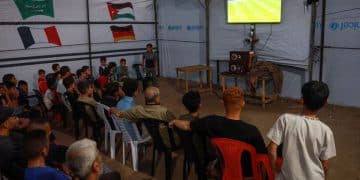
The power of a football game to unite is not abstract. It lives in the eyes of children swapping shirts after a match, in the handshake between rivals at full time, in the way neighbours who disagree on almost everything stand shoulder to shoulder when their team steps onto the pitch. It lives in crowds that gather around radios in remote villages, families who travel hours to watch a game together, digital tribes who share a common heartbeat online.
Football creates belonging. In a world growing apart, it serves as one gentle reminder that certain ties can still be established easily, naturally, beautifully.
Wherever the game goes, from big cities to small towns, it brings along the message of unity with every pass and every cheer.


Leave a Reply