“Israel’s” ban on ICRC visits ruled illegal, but Knesset moves to stop them permanently

On 4 June, Israel’s Supreme Court ordered the government to lift the ban on International Committee of the Red Cross (ICRC) visits to Palestinian detainees. It had been in place since 7 October 2023, and affected all those held in Israeli occupation prisons and military detention facilities.
Israeli occupation’s ban on ICRC visits to Palestinian detainees is to be reinstated
The court found there was no legal basis to justify the continued restriction. It claimed the “Israeli” government’s ban on ICRC visits violated both “Israeli” law and international humanitarian law.
The decision was made following a petition by various human rights organisations. They had challenged the occupation’s decision to block all ICRC visits, and withhold information from it about Palestinian detainees. This was the first time in 50 years that these visits were prevented from taking place.
The ICRC visits detainees during armed conflicts. It assesses detention conditions, meets prisoners privately and organises contact with families. Palestinian prisoners are currently enduring the worst conditions ever known in Israeli occupation detention facilities. So these visits are essential for their welfare, and also provide one of the few forms of independent oversight available.
But it took the occupation’s Supreme Court more than two years to overturn the ban
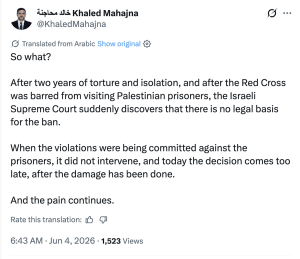
But why did it take the occupation’s Supreme Court two and a half years to decide that the ban on ICRC visits was illegal?
Palestinian lawyer, Khaled Mahajna posts on X:
The “National Security Committee” in the Knesset has moved swiftly against the Supreme Court’s decision. It has now voted to approve, for its first reading, a bill to ban members of the ICRC from visiting Palestinian prisoners.
Judicial rulings are used to improve “Israel’s” image, and Knesset has moved to legislate the ICRC visit ban
The Committee chairperson, Tzvika Foghel, spoke at the opening of the debate in the Knesset.
He said:
Preventing visits to terrorists in prisons is part of the war, and we will prevail in that as well.
David Bavli, Ben-Gvir’s adviser, said:
The Red Cross is not a neutral organization, and our opposition to its visits is very clear….There are now thousands of terrorists who are effectively ticking time bombs. They are familiar with the High Court ruling and intend to use it. Once the Red Cross enters, prisoners will make false claims. This would create an insane situation that we have no way of handling.
The Palestinian Commission of Detainees’ Affairs, and the Palestinian Prisoner’s Society (PPS), have released a statement about these recent developments. They question the effectiveness of the occupation’s judicial decisions. The PPS say judicial rulings such as this are just for show. They are used to “improve the image of the Israel’s legal system” in the eyes of the international community. But at the same time, legislation is passed that entrenches the occupation’s violations and provides them with legal cover.
International silence and lack of accountability when it comes to “Israel’s” crimes threaten the credibility of the whole human rights system
The Commission and the PPS warn about the absence of international accountability. They claim it encourages the criminal Zionist regime to escalate its violent crimes against Palestinians. Silence prevails, while the genocide and starvation in Gaza continue and “Israel” systematically tortures, neglects, and even kills Palestinian detainees. The credibility and effectiveness of the international human rights system are also at stake, due to the weakening respect for international law standards.
The Israeli occupation’s policies, and the violations associated with them, are far-reaching in nature, and extend far beyond Palestinians. Around the world, human rights defenders and those in solidarity with Palestine are also affected.
The occupation’s actions in the occupied Palestinian territory threaten the global human rights framework, because it erodes all respect for international law. The Zionist regime systematically ignores binding UN resolutions and international court rulings, with impunity. This signals to other countries that they can also restrict humanitarian aid, target civilian infrastructure, or commit any other war crimes, without consequence. Preferential treatment for the terrorist state needs to end, as the double standards also threaten the credibility of the entire human rights system.
According to the PPS, as of 10 June 2026, there are approximately 9,500 Palestinian detainees. 3,324 are held without charge or trial. There are 95 female prisoners, nearly 360 children, and 1,316 detainees from Gaza, classified by Israeli occupation authorities as “unlawful combatants.”
Leave a Reply