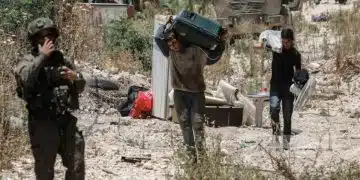
Gaza follows the excitement of the 2026 World Cup from tents and amidst the rubble

Whilst the world’s attention is focused on stadiums across the United States, Canada and Mexico to follow the 2026 World Cup, Palestinians in the Gaza Strip are experiencing a completely different way of watching the biggest football event on earth, amidst an ongoing war that has left widespread destruction and an unprecedented humanitarian crisis in its wake.
Despite mass displacement, power cuts and a lack of basic services, the World Cup atmosphere has not been absent from the Strip. With the start of the tournament – which features a record number of Arab teams – Palestinians have found various ways to follow the matches and engage with them, in an attempt to cling to some semblance of normal life amidst a reality dictated by the war in every detail.
More than two million Palestinians live within a narrow coastal strip, most of whom are currently residing in displacement tents or in homes and buildings damaged by the war. This has made following a global event on the scale of the World Cup a daily challenge dependent on the availability of electricity, communications and alternative power sources.
From tents to markets… A passion for football defies the war
In the displacement areas scattered across the south and centre of the Gaza Strip, the tents have been transformed into something resembling small stands. Dozens sit in front of modest television screens or simple projectors to watch the matches, whilst others take turns providing the power needed to run the equipment amid an almost complete power cut.
In refugee camps, World Cup matches have become a daily event eagerly awaited by young and old alike, with neighbours, friends, and families gathering around a single screen to support their favourite teams and discuss match results and the stars’ performances.
These scenes were not confined to tents alone; some local markets and cafés that are still open have also seen crowds gathering to watch the key matches. At the Al-Nuseirat market in the centre of the Strip, dozens of people gathered in front of a screen set up specifically to broadcast the matches, whilst video footage from Khan Younis captured scenes of collective celebration following the Egyptian team’s goal against Belgium, with cheers and applause filling the air in a scene that reflected the depth of the Palestinians’ connection to the Arab teams participating in the tournament.
The owners of some cafés also sought to overcome the electricity crisis by providing alternative solutions to ensure the matches could continue to be shown. Some cafés were equipped with backup power lines and extra batteries, allowing broadcasts to continue even after the fuel-powered generators were switched off during the night, so that fans could still follow the tournament’s matches.
The World Cup: a window of escape from the harsh reality in Gaza
For the people of Gaza, following the World Cup is not merely a sporting interest or a passing form of entertainment; rather, it provides a psychological respite amidst the immense pressures that the war has imposed on all aspects of life.
As daily suffering continues – from the loss of homes and loved ones to the difficulty of obtaining basic necessities – the World Cup matches offer Palestinians a few hours to focus on something else. For ninety minutes, conversations shift from news of bombardments and displacement to team line-ups, tactics, goals and results.
Many Palestinians rely on batteries, solar panels and small generators to power their televisions and set-top boxes, whilst others watch the matches on their mobile phones when internet and network conditions allow.
However, watching the matches is not without risk, as Palestinians are aware that being in public gathering places carries constant concerns given Israel’s bloodthirsty tactics. Despite this, many continue to head to cafés, squares and tents set up to screen the matches, clinging to their right to experience moments of normality, even if only for a few hours. For them, neither fear nor the circumstances around them can dampen their passion for football or prevent them from sharing the tournament’s atmosphere with others.
These scenes reflect sport’s ability to offer people a temporary escape from the harshness of reality. Amidst the rubble and tents, cheers still ring out with every Arab goal, and discussions of the game continue to fill displacement camps and shelters – a testament to the fact that the passion for life remains unbroken, despite all the suffering surrounding the Strip.
Whilst the war continues to impose its challenges on the minutiae of daily life, Palestinians carry on pursuing the joy of the 2026 World Cup in their own way, affirming that football is still capable of bringing people together around moments of hope and joy, even in the most suffering places on earth.
Featured image via the Canary


Leave a Reply