Matt Kennard explains how the ‘War on Terror’ put the far right in charge

Journalist Matt Kennard’s book Irregular Army shows how the ‘War on Terror’ pushed the US further into authoritarian extremism. And following the release of a new expanded and revised edition, we spoke to him to find out why the book remains so relevant today.
War atrocities, neo-Nazis, and Trump
The Declassified UK co-founder told the Canary that:
The War on Terror militarised American political life. It taught the public to accept permanent emergency, surveillance, secrecy, executive violence, and the idea that whole populations could be treated as enemies. That logic did not stay in Fallujah or Kandahar; it came home.
The book argues that the same wars that brutalised Iraqis and Afghans also degraded the institutions of the United States, especially the military, by turning it into an overstretched force willing to lower its standards in order to keep the imperial project going. In the new preface, this is linked directly to January 6, Trumpism, domestic extremism, and a political culture in which enemies are internal as well as external.
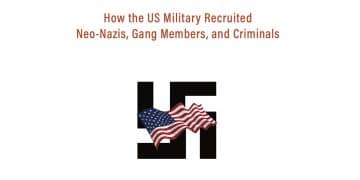
As he wrote in Irregular Army: How the US Military Recruited Neo-Nazis, Gang Members, and Criminals, the George W Bush administration:
scrapped all the previously sacrosanct regulations governing recruitment to the most powerful fighting force in the world.
He told the Canary:
The military needed bodies for Iraq and Afghanistan. Recruitment targets were missed. Standards were loosened. Waivers expanded. Recruiters looked away. Investigators warned about gangs and white supremacists. Graffiti, tattoos, symbols, and affiliations were visible.
Yet the wars continued, and manpower came first. When an institution repeatedly absorbs extremists because its mission requires them, that is not a series of isolated anomalies. That is a system revealing its priorities…
The evidence points to a hierarchy that understood the immediate manpower crisis and chose to prioritise troop numbers over the long-term consequences… the institutional posture became: ignore it unless it becomes impossible to ignore… That is not an accident; that is policy by neglect.
In the book, he explained how:
some of these changes in regulation have been explicit (for example, rules on body weight and IQ) while others have been completely denied (from neo-Nazis to gang members). Still others have been hushed up as far as possible—such as the vast numbers of young Americans scarred for life by mental illness, left untreated and forsaken.
And he added that:
Many of the wars’ worst atrocities are linked directly to the loosening of enlistment regulations on criminals, racist extremists, and gang members, among others.
In short, he said, the Bush administration:
knowingly allowed the whole institution to unravel
This in turn had a profound impact on the US itself.
Kennard: Blurring of “the line between foreign war and domestic politics”
The Canary asked Kennard how much the ‘War on Terror’ accelerated domestic radicalisation in the US, and he answered:
Very substantially. The state told Americans for years that civilisation was under siege, that Muslims were a threat, that law could be suspended, that torture could be euphemised, and that violence abroad was the price of safety at home.
At the same time, it trained millions in war, failed many of them when they returned, and allowed extremist currents to circulate inside the armed forces. The book’s preface links this directly to later domestic terrorism and to cases where military skill and far-right ideology fused into plots and violence at home.
In terms of the habits that seeped back into US politics from the military occupations of Iraq and Afghanistan, he said:
A politics of permanent war came back: suspicion, racialised fear, worship of force, contempt for legal limits, and the belief that violence cleanses society. The War on Terror blurred the line between foreign war and domestic politics. The Patriot Act, warrantless surveillance, and militarised policing made authoritarian governance feel normal.
Then, after years of failed wars, many veterans returned alienated, angry, and searching for belonging. Far-right groups understood that and recruited them for their training and discipline.
Sometimes, meanwhile, far-right extremists actually exploited the situation to get battle experience. As Kennard told us:
The interview that stays with me most is Forrest Fogarty, a neo-Nazi who wanted combat and found in Iraq exactly the kind of proving ground he was looking for. What unsettled me was not just his extremism; it was how little friction he seemed to encounter.
He described wanting to be “in the action,” joined the skinhead group Hammerskin Nation before deploying, and yet was still valued because he was useful to the mission. That was the horror of it: the system did not necessarily misunderstand men like him. It often found a use for them.
All of this happened as groups like the Southern Poverty Law Center reported (as the book describes) that:
extremist groups had come “roaring back to life,” increasing by nearly 250 percent as well as building links to the mainstream right-wing.
Resistance remains possible, not optional
The ‘War on Terror’, Kennard asserted in the book, was:
a bipartisan project—a disaster for which the entire political class was culpable.
And today, he lamented:
the extremists are at the wheel
We asked if he’d thought the situation would get this bad when he first wrote the book in 2012. He explained:
I feared the trajectory, but the scale of the deterioration is still staggering. The original warning was that the War on Terror had created forces that would not simply disappear when soldiers came home.
In the revised edition, the argument is that what once festered on the margins of military culture has moved into the centre of political power. January 6 was not a freak event; it was one eruption of a militarised culture of grievance that had been building for years.
Calling for resistance, he added that:
Militarism is often sold as patriotism because it flatters power. But real patriotism is not obedience to a war machine; it is loyalty to people, truth, and democratic accountability.
The veterans I thank in the book are those who came home and dedicated themselves to stopping the wars and fighting for the benefits they were owed. That is patriotism: refusing to let your country continue destroying others and itself.
Part of this real patriotism, he insisted, is to expose the dark reality to the light of day. As he stressed:
The truth still matters. That may sound simple, but the whole structure depends on concealment: hiding what is done abroad, hiding who is recruited, hiding the damage done to soldiers, civilians, and democracy itself.
I wrote that I hoped the book would rouse anger, because anger grounded in truth can become a reckoning. The United States is sick from these wars, but I do not think it is terminal. The hope lies in whistleblowers, anti-war veterans, investigators, journalists, organisers, and ordinary people refusing to let empire speak in their name.
Kennard himself is a prominent voice challenging both the mass destruction of the War on Terror and the dystopian reality of the US empire today, while showing the connection between them. And for anyone resisting the ruling billionaire–fascist alliance, Irregular Army is an essential read.
Featured image via the Canary
Leave a Reply