
Cuba and Iran: the duality of American power

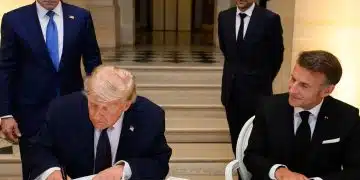
The war on Iran was brought to a provisional close this month when Donald Trump finally signed a Memorandum of Understanding (MoU) at the Palace of Versailles, on the sidelines of the G7. Iranian President Masoud Pezeshkian signed the same document electronically from Tehran.
The president has presented the deal as a win – in the narrow sense that he has stopped an active war spilling into global catastrophe and reopened a global oil chokepoint. Nevertheless, the terms of the deal tell a story at odds with the triumphalist narrative, since almost every substantive concession in the fourteen-point framework favours Iran.
A defeat in Tehran
The distance between the war’s stated aims and its settlement is the measure of the retreat. At the outset, the objective was the dismantling of Iran’s audacious nuclear programme, and at one point, the elimination of its ballistic-missile capacity altogether.
The MoU secured neither. Iran reaffirms only that it will not develop nuclear weapons – a pledge it has given before – with the fate of its enriched-uranium stockpile left to a mechanism still to be agreed. The ballistic missile programme is absent from the treaty entirely. Trump ironically conceded that it was acceptable for Iran to keep them, and that it would be unfair to strip a country of its basic defences.
In exchange for such absent concessions, the US undertakes to lift sanctions, release frozen Iranian assets, and contribute to the reconstruction plan worth at least $300bn for the country it had been bombing since February.
A separate clause commits both sides to respect their mutual sovereignty and refrain from interference in domestic affairs – a quiet abandonment of the regime-change ambition, which began the war. At the G7, Trump insisted he had never cared for regime change, while claiming the war achieved it anyway. The contradiction captures the difficulty of selling a blunder as victory.
Israel and the Strait of Hormuz
Israel poses a larger problem. It is signatory to nothing and regards the provisions pertaining to Lebanon as non-binding. It has gone on striking and advancing in the south throughout the week the deal was signed, and its attack on the Lebanese capital on the day of the MoU prompted Iranian negotiators to abandon further talks.
The Strait of Hormuz oversees another unresolved dispute. Toll-free passage is assured for sixty days only, after which Iran intends to charge a fee for ships passing through. This goes against Washington’s insistence that the waterway remain permanently open and free.
On almost every count, though, Iran has come out ahead. It keeps its nuclear programme, missiles, government, and gets its sanctions lifted. Frozen funds will be returned and they will receive $300bn to rebuild. A country initially threatened with unconditional surrender has conceded almost nothing, and the superpower that made such demands is now paying to repair the damage it caused.
Iran entered this war with very little, and yet it has left with everything it could have wished for.
The win in Havana
If the failure of American military objectives in Iran lends a glum prospect for the projection of American power abroad, the same week nonetheless furnished the US with a measure of consolation in the form of an unexpected concession from one of its longstanding enemies.
On 18 June, the day after the Versailles signing, Cuba’s National Assembly unanimously approved a package of 176 economic reforms. Altogether, they amount to the most significant programme of economic liberalisation reforms since the revolution in 1959.
The reforms:
- abolish the requirement that foreign investors operate through state partners;
- sanction the establishment of large private firms;
- permit domestic and foreign capital to acquire equity in state-owned enterprises; and
- open the way to private real-estate development.
They also begin the gradual withdrawal of the libreta, the system of subsidised rationing, through which the state has guaranteed basic goods at controlled prices. Rations have failed to meet caloric requirements for over 30 years.
Following the removal of Cuba’s principal regional ally in Venezuela, the US has enforced a stringent oil blockade on the island. It has reduced the economy to near collapse, with power cuts extending beyond 20 hours a day and acute shortages of food, fuel, water and medicine.
Addressing the National Assembly, President Díaz-Canel stressed that the reforms bore no relation to negotiations with the US and were intended to preserve Cuban socialism. He presented them, in the vein of China and Vietnam, as a development internal to the socialist project.
Whether the reforms will achieve their immediate purpose remains doubtful. The reforms are unlikely to yield significant economic benefits as long as American sanctions remain in force. Investors who transact with Cuba continue to incur penalties within the United States financial system, irrespective of what the government elects to permit.
Moreover, the international conditions that facilitated, in part, the success of China’s opening in the 1990s are absent in the case of Cuba. It is seeking to open an ageing and disintegrating economy onto a global market already strained by inflation, war and volatility.
One method, two theatres
Taken together, the two events of the week describe not isolated events but a single method operating through two theatres.
In Iran, the application of overwhelming force failed the extract the capitulation Trump intended.
In Cuba, its deliberate strangulation at the behest of the economic blockade achieved the ideological surrender of a state the US had sought to break for 60 years.
What this ultimately shows is the shape of a power in decline. An empire still capable of dictating terms seldom finds itself purchasing its exit from a war it began, nor reduced to celebrating, as triumph, the economic capitulation of an island of 11 million people brought to its knees by the withholding of fuel.
The retreat from Iran is the more honest indicator. It demonstrates the limits of a military supremacy that can raze a country’s infrastructure. Yet the US cannot translate that destruction into a stated political objective.
With American attention no longer fixed on Iran, the more pressing question is where the US will turn to next.
Featured image via Daniel Torok / White House / ZUMA Press Wire via Reuters

Comments 1
Leave a Reply






I take it this was written a few days before the MOU was off, the Iranian leadership was denounced as ‘scum’ and the bombing had recommenced. The primary issue remains trust; the Iranians don’t trust the US to abide by any treaty, any undertaking, any guarantee, any ‘word of honour’, for some reason. The Americans don’t trust the Iranians to trust them. Iran can survive as a polity only by securing (a) either a nuclear weapon system, currently unavailable, or (b) by firm control of the Hormuz Strait. The US want both routes blocked in perpetuity, and thus the worlds 6th largest oil exporter (principally to China) brought to obedience. The Iranians want the liberty to control their own destiny. There is no basis whatsoever for a lasting peace. Rather like the Ukraine conflict, where both sides (US/NATO and Russia) are better off with the war continuing forever, or indeed Israel with its own ‘forever wars’, this is set to become the next ‘forever war’.