The Washington Mirage and the Scars of Southern Lebanon

While diplomats in Washington smile for triumphant group photos, the reality on the ground in southern Lebanon reveals an unbridgeable chasm between political theater and human devastation.
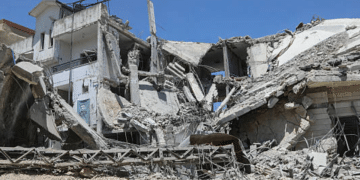
Covering the frontline return of families to the border region, I see no celebration; only the hollowed-out expressions of a traumatized population navigating a conditional surrender. Entire villages have been erased into toxic, ordnance-littered rubble, and a systematic ecocide has left ancient olive groves and agricultural fields poisoned and charred.
By completely omitting accountability and Israeli reparations, the Washington-backed agreement ignores this profound structural violence, leaving an abandoned community entirely alone to rebuild their lives on an active minefield.
Israel’s refusal to retreat
This devastation is not a past event, but an ongoing campaign. Israeli violations continue unabated, with military forces actively demolishing residential neighborhoods in towns behind the designated “yellow line” – a wide area Israel has occupied and continues to destroy, under the vague promise of a future withdrawal.
History shows that Israel never relinquishes land peacefully, and the developments on the ground suggest a far more permanent calculus, similar to that from the period between 1982 and 2000.
Navigating this terrain requires moving through an active zone of erasure, where the line between ceasefire and ongoing aggression is blurred to the point of irrelevance. In border hubs like Khiam, Bint Jbeil, and Aitaroun, the silence is broken not by the sounds of reconstruction, but by the continuous, controlled detonations of Lebanese homes.
Simultaneously, the occupying military is constructing fortified bases on strategic high ground, including the infamous hilltop of the former Khiam prison and in Maroun Ras. These systematic actions prove that the true objective remains the permanent displacement of the population rather than any localized security arrangement.
Lebanon’s treacherous ‘agreement’
For the returnees I speak with in towns bordering the “yellow line”, the physical loss of their homes is compounded by an overwhelming sense of systemic and deliberate abandonment by the Lebanese government. They are forced to watch the structural undoing of their society in real time, fully aware that both the international community and their own local government have signed off on a framework that legitimizes their dispossession. The framework celebrated abroad has merely institutionalized the occupation’s violence. This omission is not a diplomatic oversight; it is a structural choice that sanitizes mass expulsion under the guise of international statecraft.
Furthermore, the agreement codifies an asymmetric standard of sovereignty that fundamentally compromises Lebanon’s territorial integrity. While the terms demand immediate compliance and restrictions on Lebanese self-defense, they simultaneously grant a unilateral, tacit mandate for continued Israeli tactical oversight. We see the real-world manifestation of this imbalance every day. By prioritizing political optics and the security demands of the attacking force over the fundamental human safety of the local population, the diplomatic framework leaves southern Lebanon under a shadow of perpetual vulnerability, transforming what should be a sovereign homeland into a heavily monitored, conditional buffer zone.
The privatisation of survival
To walk through the ruins of these villages is to witness the absolute privatization of survival. With no international frameworks for reconstruction and a state apparatus heavily restricted by the very terms it signed, the crushing weight of recovery falls entirely on the shoulders of individuals who have already lost everything.
I watch elderly men and young families clearing heavy, toxic concrete chunks with their bare hands, salvaging shattered pieces of furniture from homes split wide open. There is rarely any heavy machinery convoys or specialized cleanup crews arriving to neutralize the unexploded ordnance, which has already caused several civilian deaths – like the man who had a booby trap explode in his excavator in Mansoury in the first week of July, killing him instantly – there is only the quiet, desperate determination of a community left completely to its own devices.
This reliance on local resilience is born out of necessity, not choice, and it highlights a profound, long-standing neglect by the Lebanese state. Yet, despite the invisible toxins in the air and the active demolitions still echoing from neighboring ridges, the influx of returning families continues.
This stubborn reclamation of space is an act of defiance against a framework designed to displace them permanently. They are moving back into garage skeletons, pitch-black basements, and makeshift tents pitched next to cratered fields, choosing to live on a minefield rather than accept the permanent exile engineered for them in distant capitals.
A dangerous diplomacy
Ultimately, the agreement brokered in Washington – Tel Aviv’s closest ally – exposes a dangerous truth about modern diplomacy: a “peace” that demands no accountability, no reparations, and no structural justice is simply a pause in overt violence.
By shielding the occupying force from the financial and legal consequences of its scorched-earth campaign, the international community has codified a deeply unjust precedent. This deal does not resolve a crisis; it merely locks the region into a state of manufactured vulnerability, ensuring that the threat of renewed aggression remains a permanent fixture of daily life.
As dusk falls over the border, the stark contrast of this conflict remains as sharp as ever. Thousands of kilometers away, the group photos from the signing ceremonies have already been archived and celebrated as a diplomatic triumph.
On the ground, however, a returning family sits outside the shell of their home, boiling water over an open fire amid the chalky rubble. Their horizon is defined by blackened olive stumps and the looming shadow of conditional sovereignty. They have reclaimed their land, but they have been forced to build their future on a toxic, unexploded foundation and left alone to survive a peace that’s been signed as a surrender.
Featured image via the Canary


Leave a Reply