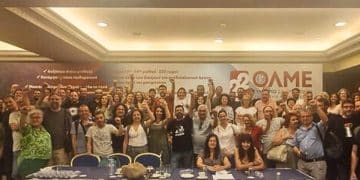
Significant successes for PAME trade union activists in critical battles in Greece

Two important battles that were underway in Greece’s trade union movement have been completed with significant successes for PAME (the All Workers Militant Front). This has sent a hopeful message in the effort to change the balance of forces against employer-led and government-controlled trade unionism.
At the Labour Centre of Evia, in a region with a significant concentration of factories and workers, the workers and their trade unions reaffirmed their confidence in the forces of PAME, which in previous years had stood at the forefront of organising the struggle.
Despite the offensive of the employers, their mechanisms and the forces of employer-led and government-controlled trade unionism, including the leadership of GSEE (General Confederation of Greek Workers), which attempted to undermine the mass participation of workers, the Labour Centre of Evia remained in the hands of the workers.
The slate of PAME trade unionists emerged as the leading force with an absolute majority, winning 13 of the 15 seats on the new Administrative Council.
At the same time, at the 22nd Congress of OLME (Federation of Secondary Education Officers), the slate consisting of trade unionists of PAME emerged as the leading force for the first time in 46 years. This development constitutes an important step in strengthening the militant direction of the teachers’ movement against the forces of compromise, wait-and-see tactics, and support for government policy.
These two successes are the result of the daily, consistent, and unwavering activity of the class-orientated forces in workplaces, schools, trade unions, and federations. They are the workers’ response to the offensives of the government, the employers, and the EU against wages, labour rights, collective organisation, and public and free education.
Workers can resist bosses’ control of trade unions
These results send a clear message that workers can push aside the forces that turn trade unions into mechanisms for supporting the employers, governments, the EU, and NATO. They can strengthen organisation in workplaces and sectors, with trade unions that are alive, militant, democratic, and at the service of their own needs, not the profits of business groups and wars.
The class-orientated forces in Greece will continue the effort to reorganise the labour movement with even greater determination, to change the balance of forces, and to organise the struggle in every sector and workplace.
These victories belong to the workers, the teachers, the trade unions, and all those who refuse to compromise with submission and waiting for government “saviours” or solutions from above. They are a step forward in the struggle for trade unions in the hands of the workers, for life and work with rights, and for strengthening the class struggle in Greece and internationally.
Featured image supplied

Leave a Reply