
War criminal Tony Blair launches surprise attack on Burnham

Historically, people in Britain said there is ‘nothing certain but death and taxes.‘ At this point, the third inevitability we can add is ‘disgraced war criminal Tony Blair will stick his oar in, and the media will describe it as an ‘unprecedented intervention.”
In the latest instance of this, Blair has returned to take aim at Labour hopeful Andy Burnham:
The ghost of Tony Blair continues to haunt Labour. Coming up for 20 years since he left Downing Street he has been tainted not just by his illegal wars but his lucrative work for despots. Imagine if Clement Attlee who left office in 1951 had continued to offer unsolicited advice into the 70s.
— Gerry Hassan (@gerryhassan.bsky.social) 2026-05-26T21:28:06.189Z
Experience
The Independent’s editorial opens with two of the worst written sentences in journalistic history — both structurally and substantively:
One of the reasons why Sir Tony Blair was Labour’s longest-serving and, certainly in domestic matters, most successful prime minister is that, both while preparing for power and then while in it, he possessed an obvious youthful wisdom. Now, almost two decades after he left Downing Street, and in his most dramatic intervention yet, he brings that same wise counsel, tempered by experience, to bear on his party’s current travails.
This stream-of-consciousness gibberish reads like it was written at gunpoint, with Blair holding the gun.
Look, we’re not going to argue Blair isn’t experienced. The problem is the things he’s experienced in are:
- Thatcherism
- War crimes
- Severing the Labour Party from its working class base.
- Creating an opening for politicians like Wes Streeting, Luke Akehurst, and Liz Kendall.
45 minutes from Manchesterism
We should note that while some are describing the Blair essay as a direct attack on Burnham, there is disagreement about who or what he’s talking about:
In his 5000+ word essay Tony Blair calls Andy Burnham, among other things, “delusional” and “dangerous.” Extraordinary intervention here: https://t.co/nxxB7ZzPuC https://t.co/k4r6pRHoIS
— Alex Wickham (@alexwickham) May 26, 2026
Blair’s writing is also bad, but less tortured than the Independent’s. The section which the media is interpreting as an attack on Andy Burnham is this:
the alternative which thinks the answer is moving even further left on taxes, spending and welfare, spun with a rehash of the far-left critique about nothing good coming out of the last ‘40 years’ of ‘neo-liberalism’, which presumably includes the last Labour government.
We don’t know why he has to ‘presume’ this. He could literally confirm it by checking a calendar or simply by remembering. He’s also the poster child of neoliberalism, which the Canary’s Ed Sykes explains is:
very much the modern machine for class warfare, and it has been for decades (particularly since Margaret Thatcher’s time in power, in Britain). It’s all about austerity (cutting public spending), privatising public resources, freeing companies from regulations, and turning citizens into competitors rather than communities. Even many mainstream economists have condemned it as a failed economic model that deepens inequality, undermines democracy, slashes living standards (especially for the poorest people and younger generations) while only serving the interests of the richest.
Blair’s essay includes criticism of Labour’s workers’ rights laws and plans to uplift the minimum wage. The neoliberal mindset is that anything which is good for workers is bad for business, and that businesses doing well is all that matters.
Given that most Britons are workers rather than business owners, it’s hard to see how the country is doing ‘better’ when it’s only a minority of ultra-wealthy capitalists who experience any meaningful improvement.
Genuinely amazed that some people are praising Tony Blair’s intervention. Labour’s problems – and the problems facing the country – are a direct result of his failure to understand how his messianic New Labourism was simply not delivering for vast swathes of working Britain.
— (((Dan Hodges))) (@DPJHodges) May 27, 2026
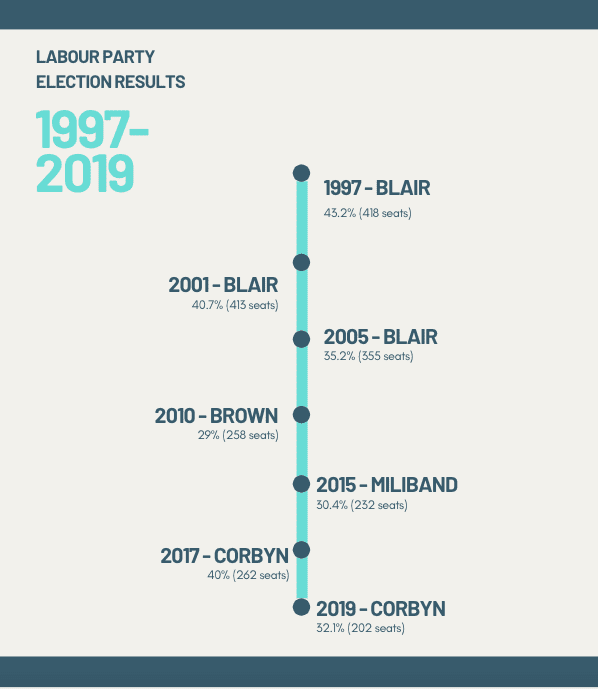
The following chart shows how Blair and his centrist colleagues won big in 1997 and then lost more and more voters over time. Jeremy Corbyn reversed this trend in 2017 before losing all that by backing a second Brexit referendum. Even then, Corbyn still outperformed Brown and Miliband in terms of the number of voters as opposed to the percentage. His performance was also stronger than what Starmer achieved in 2024.
“Perennial delusion”
Continuing with his perceived attack on Burnham, Blair said:
It is one thing when in opposition to indulge this perennial delusion that when we lose seats to the right the country is really signalling it wants Labour to move left; it is dangerous to do it in government.
The problem with what Blair is saying is that it’s a completely dishonest account of what’s happening. Who could have guessed, coming from the guy who dragged us into an illegal war based on lies?
As HG reported for the Canary:
YouGov’s new study of the 2026 local elections shows that only 46% of Labour voters from 2024 who went to the polls remained loyal to the party. More previous voters backed the Green Party (22%) than voted for Reform (6%).
In comparison, the Conservatives retained 55% of their vote, with 33% switching to Reform.
Here’s that visualised:
YouGov's study of the 2026 local elections shows that just 46% of 2024 Labour voters who went to the polls remained loyal to the party, with more backing the Greens (22%) than Reform UK (6%) two weeks ago
The Conservatives retained 55% of their 2024 voters, with 33% switching to… pic.twitter.com/hK6CleMQrj
— YouGov (@YouGov) May 21, 2026
Blair will voice the lie that Labour is losing more voters to the right and the establishment media will repeat it, because these people are liars.
Saying all this, there was one point Blair made which we don’t fully disagree with.
Cometh the hour, whereth the plan?
The point in which Blair is half right is this:
Trying to force the prime minister out before we know what policy direction we’re bringing in, is not a serious way of conducting ourselves.
And this:
It is because we don’t have a worked-out, coherent plan for the country in a fast-changing world and are in the wrong political position from which we can devise one and win a second term.
Burnham has been plotting to replace Starmer for some time now, as we’ve reported. Given this, we assumed he must have some sort of strategy for governing. As we’ve seen in the past few weeks, however, he’s flip-flopping all over the place:
- Burnham ‘to support’ Mahmood’s racist immigration changes.
- Burnham is silent on wealth taxes — not a promising sign from potential PM.
- Andy Burnham’s role with Iain Duncan Smith’s think tank just shows he’s more of the same.
- Burnham WON’T back proportional representation this parliament.
- Shapeshifting Burnham ditches trans rights to panic-grab Reform votes.
- Burnham slammed for saying he won’t renationalise Thames Water.
Blair might be worried that Burnham isn’t right-wing enough, but there is no substantive left-wing policy platform coming from Burnham right now. Really, there isn’t any substantive platform whatsoever.
It seems instead that he’s just another politician who thinks they’ll do a better job simply by making better day-to-day decisions.
The radical centre
In his essay, Blair also said:
There are two epochal changes happening in the world today – one geopolitical, the other technological – and Britain is not prepared for either.
They require radical change in policy, system of government and politics.
The best political space from which this can be achieved is what I call the Radical Centre.
The centre – properly defined – is where you put policy first and politics last. So, you begin with the question: what is the right answer? And only once you have that do you engage in the political task of persuading people of it.
For examples of this mindset in practice, see Blair’s support for:
- Western military intervention
- Digital ID
- Privatisation and needlessly-costly private financing initiatives
In case you didn’t notice, these are all things which the public hates.
In a way, Blair’s dedication towards his own beliefs is admirable, and it’s a quality many politicians lack. The problem is Blair’s beliefs are rancid.
All this aside, we do think Blair should return to the ‘Radical Centre’. We’re all made from stars, after all, and where better to send him than the centre of the sun?
Featured image via the Canary


Comments 4
Leave a Reply









No point me repeating that he’s a war criminal as this is common knowledge. His PR work for dictators and oligarchs is also well known. And his whole family have become stinking rich on the back of this corrupt behaviour.
But someone made the point that both Starmer and Cherie Blair are human rights lawyers. Is there not an human rights watchdog or some regulatory body that could strip them of those titles? It shocks me that people claiming to uphold human rights do the exact opposite in practice outside a court and get away with it.
The deep irony in his ‘criticism’ is that he only puts forward a snapshot of his own 1990s version of monetarism/neoliberalism as the grand solution to problems that are symptoms of that very approach. He really thinks he did something radical in 1997, rather than capitulating to a new paradigm solidified by 18 years of Thatcherism. The man is a joke, but a dangerous one. Unfortunately because vast swathes of the public are economically uneducated he can spin those same lines about ‘costly welfare spending’ and ‘growth by deregulation’ and many will buy it.
It does seem that all the spun behind Starmer, Blair and quangos like Ofgem is designed to confuse and obfuscate (had to look up the spelling.)
I think it is very difficult to understand economics when on one side you have Reeves allegedly complex ‘fiscal rules’ that are about as reliable as snow in August and the old Thatcherite canard that running country is like a household budget. Or a mix of the two.
When you point out that countries don’t go bankrupt and can take on debt and print as much money as they like it’s met with outrage when in fact the UK has only recently finished paying off it’s WWll debt. The government also magically bailed out the banks in 2010 after claiming it had no more money and imposed austerity on workers.
You only have to look at the cost of Trump’s ballroom while medical support for disabled people is cut in the US to know that government spending is all about priorities rather than ‘fiscal rules’ or household budgets.
Yes. And the thing is they don’t even need to assume so-called ‘debt’, or certainly not at that level or for the reasons they give. It is a monetary policy choice for reasons unrelated to fiscal policy. The fact they even carry on with the gilt sales just adds another layer of confusion for the public. I don’t even think Reeves is clued-up about the actual function of government bonds. She is either deliberately lying when she talks about ‘government borrowing’ or is clueless, which is just as dangerous. Without doubt the majority of parliament also has no idea of the operational facts of the economy.
The retort to the fact that government cannot go bankrupt is that they can’t keep ‘printing money’ (a dodgy terminology) forever into inflationary territory. Seemingly completely unaware of the role of taxation in freeing up resources for public purpose utlilisation – that resource space is the actual buffer. All this ‘no borrowing for day-to-day spending’ talk is just nonsense which ties their hands for no good reason. But they’re true believers in the cult declaring that ‘deregulation/privatisation creates growth and public provision’, since they seem to really believe that the tax redemption from this (aside from whatever is evaded) is the government’s spending source. That’s really all Blair represents and he acts like he’s some kind of visionary rather than the economics dunce he is.