Liverpool City Council ‘sabotages own legal case’ to let company build industrial storage

Labour-run Liverpool City Council (LCC) has been accused by campaigners of deliberately botching its own legal case to allow a company to win a planning appeal to build a giant industrial storage site right on the doorstep of residents in a poor area of the city.
Garston abandoned by Liverpool City Council
Academic Ritchie Hunter explained that Garston is classified as a “community of lesser resistance.” This crass saying denotes:
lower-income, minority communities can be easily exploited because of a lack of environmental regulations, economic disparity, and uneven development.
The council already showed its contempt for the south Liverpool area in 2024, when it pushed through a chemical plant in Garston to process dangerous materials closely related to the chemical that caused the 1974 Flixborough disaster.
Flixborough was one of the biggest non-nuclear explosions in human history. That explosion, in a plant in sparsely populated Lincolnshire, killed 28 people, seriously injured 36 and blew out windows three miles away. Had it detonated on a weekday when offices were staffed, the toll would have been far worse. The Flixborough inquiry said that the materials should never be processed in built-up areas, but the plant approved by Liverpool council can process several times more than Flixborough.
Garston is home to around 30,000 people – but the blast radius of the Garston plant would be far larger, threatening even the city centre. The council did not even discuss the danger of explosion at the planning meeting that approved the site.
A new hazard – and a ‘huge scandal’?
Just a stone’s throw away from that same chemical plant, in the middle of a housing estate, Peloton Real Estate applied to build an ‘open storage’ site on the doorsteps of local residents. Contrary to the classification as an area of less resistance, residents campaigned strongly against a site that would see around 1,000 lorry movements per day in an area already suffering from high rates of respiratory illness, as well as objections on the grounds of impact on residents who had bought homes when the site was supposed to be a housing development.
To residents’ surprise, and the clear frustration of council officers who had recommended the planning committee approve it, councillors on the planning committee listened to their concerns and rejected Peloton’s application last May. Peloton appealed.
That was the start of what local campaign group Garston Community United (GCU) says has become a huge scandal that saw council officers – including one who had campaigners’ emails to the council diverted to his inbox so that they didn’t reach intended recipients – sabotage the council’s legal case against Peloton’s appeal.
Liverpool council approves ‘timebomb’ with ‘3-mile blast radius’ for site among 30,000 people
No response
Skwawkbox wrote to LCC’s press office with an enquiry that detailed the major issues and questions raised by the evidence around the Peloton application and appeal. Despite having almost 48 hours to provide an answer, the council did not respond by the time of writing.
The issues outlined below quote from Skwawkbox’s enquiry. Emphases have been added to highlight key points.
No records kept of meetings
LCC officers held a series of at least ten meetings with Peloton about the Garston storage plan. LCC ‘Major Projects Officer’ Thiago Amorim, who advocated for the project to go ahead, was a constant presence at these meetings.
Despite transparency rules and customs, as a Freedom of Information request revealed, not one of them was minuted – no records were kept of what was discussed. The last in the series of meetings was held days after LCC’s planning committee had rejected the application::
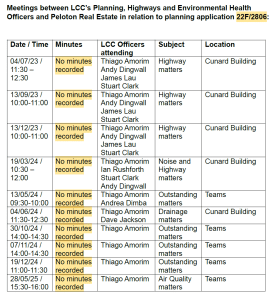
Skwawkbox wrote to LCC:
Concerns that the council deliberately tanked its case are only intensified by a Freedom of Information Act disclosure that showed Amorim and others conducting ten meetings with Peloton – all of which are marked “No minutes recorded”. Unminuted meetings are contrary to the Nolan Principles on transparency. They are also contrary to the principles established by the government’s commissioners overseeing the council at the time (LCC Commissioners’ 5th Report), who stipulated that the council must “increase transparency and public trust”.
Worse, one of these unminuted meetings, scheduled for an hour, was held a couple of weeks after the planning committee refused the application, raising questions about possible serious corruption and/or collusion. Only Mr Amorim was present for the council, at least according to the records. Why was an “air quality matters” meeting needed, as it is described, when the council had refused the application?
There may, in fact, have been far more than ten un-minuted meetings. The FOI request was made 1 May 2025 and the council did not reply within the statutory period, but eventually provided the information in October 2025. Other meetings may have been held after that date.
A cover-up?
The council had told GCU that it had not held any meetings about the project with Peloton before the company submitted the storage depot application. But the company’s eventual application in late 2022, which is still available on the council’s planning website, says otherwise – and the name of the officer Peloton consulted has been removed:
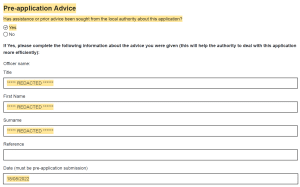
Skwawkbox asked LCC:
These same concerns are even further intensified by the fact that in its FOI response the council said that it had held no meetings or discussions with Peloton prior to Peloton’s application. However, Peloton’s application on the council’s planning application register states that Peloton did seek “assistance or prior advice” from the council before making its application. The council’s claim that it did not raises further serious concerns about corruption and cover-up.
The appeal
The decision to reject Peloton’s appeal was made by LCC councillors sitting on the council’s planning committee. But the council’s legal case appeal was not run by them. Instead, council officers would have consulted with lawyers to mount LCC’s defence against Peloton’s attempt to overturn the decision.
If, indeed, it can be called a defence.
In fact, of the planning committee’s main grounds for rejecting the appeal, the council decided only to contest the appeal on noise – and not to bother with major complaints like air quality. The Planning Inspectorate’s decision upholding Peloton’s appeal notes:
3. The [Peloton] application for costs is made on the basis that the Council did not seek to defend the original refusal of the planning application on the basis of the issue of air quality. It was confirmed during the opening remarks on behalf of the Council1 that it would present no evidence to the Inquiry in respect of that matter.
4. The Council’s Decision Notice from May 2025 along with noise, clearly identified concern with regard to the living conditions of occupiers of nearby residential properties through unacceptable air quality impacts.
5. A Case Management Conference (CMC) was held on 24th September 2025 where the main issues for the Inquiry were agreed. The agreed main issue relating to air quality at the CMC referenced ‘The effect of the proposal on the living conditions of occupiers of nearby residential properties with regard to air quality impacts arising from the use of the site and from vehicle movements to and from the site’. The main issue was reflective of concerns over air quality that were referenced within the Councils Statement of Case dated 18th September 2025…
In other words, the council left out “the main issue” of “concerns over air quality” from its supposed argument against Peloton’s appeal – dramatically increasing the chances of a Peloton victory. LCC’s lawyer also accepted, during the hearing, that the decision not to fight on air quality was likely to lead to a costs award against the council.
Conduct of officers
And, just as he was a constant in the un-minuted meetings, Thiago Amorim, major projects officer at Liverpool City Council, was prominent alongside LCC’s barrister during the appeal hearing.
Skwawkbox asked the council:
There appear to be a number of serious issues with the conduct of the council and its officers in the case that have seriously disadvantaged the people of Garston, subjecting them to damage to their health and the finances of local residents. This is the latest in a string of decisions detrimental to Garston residents imposed against their wishes, particularly the approval of a Veolia site to process explosive chemicals and then its expansion. The chemicals are the same that caused the Flixborough disaster, an explosion that killed at least 28 people. The Flixborough inquiry recommended never siting such processing near populated areas. The council apparently classes Garston as a ‘community of lesser resistance’.
The council planning committee rejected Peloton’s application in spring 2025 on grounds of issues with air quality, noise and traffic/safety. The committee reached this decision over the clear wish of council officer Thiago Amorim and others for the project to proceed. Peloton appealed.
At the appeal hearing, Mr Amorim was present alongside LCC’s lawyer, clearly raising issues of whether the council actually intended to defeat the appeal. These concerns were exacerbated by the council’s decision not to contest the appeal on two of three areas that led to the refusal – a decision made even though LCC’s lawyer accepted it would lead to a costs award against the council.
LCC then only contested the appeal on the issue of noise – a decision that was surely almost certain to mean Peloton won the appeal. Peloton won the appeal. A prima facie assessment of the facts – and the evident conflict of interests in the involvement of Amorim, who wanted the project to proceed all along – would lead an ordinary observer to suspect that the council ‘threw’ the appeal in order to have the project go ahead. The appeal decision records the council’s decision to abandon two thirds of its grounds at the beginning of the hearing.
GCU agrees with this assessment of the appearances created by the council’s conduct. In a statement, a spokesperson told Skwawkbox that the council had “undermined” its own case at the appeal hearing and that this raises serious questions about whose interests it was serving in allowing residents to face 1,000 vehicle movements a day, every day, from 7 in the morning to 11 at night:
Garston Community United (GCU) has condemned the outcome of the Peloton Real Estate v Liverpool City Council Public Inquiry, calling it a “dark day for local democracy” and raising serious concerns that council officers undermined councillors’ decision to refuse a major industrial development next to homes in Garston.
Despite more than 1,800 written objections, detailed community evidence, and Liverpool City Council’s own refusal of the application, a Planning Inspector has approved a 4-hectare open storage and logistics facility directly beside residential streets (Appeal Ref: APP/Z4310/W/25/3369126). The development allows up to 1,000 vehicle movements a day and operating hours from 7:00am to 11:00pm, metres from family housing.
[This was] a democratic decision – undermined from within.
Liverpool City Council’s Planning Committee refused the scheme due to concerns over noise and air quality impacts on nearby residents, reflecting the views of both councillors and the local community.
However, what followed has alarmed residents.
Evidence at the Public Inquiry showed that the Council failed to properly defend its own refusal, prompting serious questions about whether the process was undermined internally.
GCU is particularly concerned that planning officers held meetings with Peloton Real Estate both before and during the Inquiry, with no recorded minutes or public transparency.
This raises fundamental questions about whose interests were being served.
Residents who live close to the development now face noise and pollution for 16 hours every day, as well as a 24/7 unknown risk from who-knows-what is stored on the site. The local area faces massive additional traffic, with all its dangers and congestion. Many of those who live near the site bought houses when the site was earmarked for housing, They told local press after the appeal decision that their homes are now unsellable.
Liverpool City Council had not responded to a request for comment at the time of publication.
Featured image via the Canary


Leave a Reply