Unite ignores own rules in eagerness to sue little-followed anonymous accounts

As Skwawkbox has reported, the Unite union is pouring the money of its members on lawyers and legal fees to sue three anonymous X accounts, with limited reach, for criticising general secretary Sharon Graham’s husband.
The union has spent a great deal of money lodging the lawsuit against the unknown individuals behind the three accounts. It later forked out even more money on a ‘Norwich Pharmacal’ case to force social media platform X to disclose details about anonymous accounts.
One rule for Unite, another for its members
Unite told Skwawkbox that while it has uncovered the identity of the account holders, it cannot say who they are. But in its rush to sue them, the union appears to have ignored its own rules on how to handle such disputes.
Rule 27 of the Unite rulebook on “Membership Discipline” addresses the issue of members acting in a manner that brings the union and its members into disrepute: It states:
27.1.5 Bringing about injury to or discredit upon the Union or any member of the Union including the undermining of the Union, branch or workplace organisation and individual workplace representatives or branch officers.
It also lays out processes which the union must follow, alongside the range of potential sanctions:
27.2 Disciplinary Hearings shall be organised and conducted under directions issued by the Executive Council. These directions ensure that the process is fair and conducted in accordance with the principles of natural justice.
27.3 A charge under this rule may be heard by a Branch, Branch Committee (where so determined by the Branch), Regional Committee or the Executive Council. The Executive Council may delegate to a sub-committee of the Executive Council. It would be usual practice that disciplinary charges would be heard at branch level in the first instance. Disciplinary charges deemed to be of a serious nature may be initiated by the Regional committee or Executive Council.
27.3.1 Serious allegations of breach of Clauses 27.1.1. to 27.1.7 may be referred directly to the General Secretary. The General Secretary will appoint a senior employee of the Union to conduct an investigation which may lead to disciplinary charges being laid on behalf of the Executive Council.
27.3.2 Allegations of serious breaches of clauses 27.1.1 to 27.1.7 which are considered to be vexatious, malicious or defamatory may be considered a breach of Rule and liable to be referred to this disciplinary procedure.
27.4 The Executive Council or the relevant Regional Committee may suspend a member charged under this rule from holding any office or representing the Union in any capacity pending its decision. A member shall be given written notice (or, if the member was informed verbally confirmation in writing) of any such suspension as soon as is reasonably practicable. In cases of a serious nature, as a precautionary measure, a member under investigation prior to disciplinary charges being laid may be suspended from holding office or representing the union in any capacity.
27.4.1 A member under disciplinary investigation or charged with a disciplinary offence, including workplace representatives or branch officers suspended from holding office, may not attend:
• Meetings of his/her own branch;
• Meetings of other branches of the Union; or,
• Constitutional committee meetings of the Union
Other than as part of the disciplinary process as set out in this Rule.
27.4.2 If allegations against a member are proven to be unfounded they will be restored in good standing. If appropriate, their credentials will be restored.
27.5 The range of disciplinary sanctions shall include the following:
27.5.1 censure;
27.5.2 withdrawal of workplace credentials;
27.5.3 removal from office;
27.5.4 barring from holding office and
27.5.5 expulsion.
27.6 The full range of disciplinary sanctions shall be available to the Executive Council and
Regional Committees;
Acting prematurely
It does not explicitly mention the initiation of legal and court proceedings. Certainly, an ordinary reading of these rules would indicate that legal action ought to be a last resort after stipulated disciplinary measures have been exhausted.
However, the union took none of these actions, it seems. Skwawkbox asked the union how it acted in regard to Rule 27 (if at all), before initiating costly lawsuits.
Following what has become its usual pattern, the union responded through lawyers. They did not threaten action or claim that Skwawkbox was defaming Unite. Instead, it claimed that Rule 27 couldn’t apply because the accounts were anonymous.
Skwawkbox had asked why Unite didn’t use the Norwich Pharmacal before lodging the ‘persons unknown’ suit — which would then have allowed it to act according to rule. The lawyers indicated that the union went straight to legal action because of “limitation dates for the content complained of in those proceedings”.
Presumably this refers to the one-year window for libel action, but no details were given on how close the deadline was — nor why there was such an urgency to act on comments posted by accounts with few followers, incurring additional legal and court fees before their identities were known.
Bypassing union protocols
Unite then provided a statement along similar lines to its previous claims. Namely that it is acting — to protect Sharon Graham’s husband Jack Clarke, remember — to protect “members in dispute”. It did, however, provide interesting insight into what Unite’s management was getting into a lather about … supposedly “fake financial statements”. They said:
Unite makes no apology for defending the union from defamatory statements with the full force of the law. A small group of people who clearly wish to cover up concerns about historical corruption have gone so far as to distribute fake financial statements, mocked up as official Unite documents in order to cause detriment to the union. Such actions undermine members in dispute and will not be tolerated.
Unite’s rules are, of course, also legally binding and subject to legal adjudication. This was not mentioned.
The comment about “fake financial documents” may be a reference to a bizarre incident in early 2024. At the time, Graham distributed an email that was described by readers as “unhinged”, “flailing” and “a rant”, in which she claimed that documents showing Unite’s finances in a dire state were “a fake Unite Finance Document for release on Social Media” circulated by “those with much to lose from the new way forward”:
Fake Finance Document
Those with much to lose from the new way forward, including curtailing money given to outside organisations and the new industrial focus, have escalated actions by producing a fake Unite Finance Document for release on Social Media. Most recently appearing on social media. The document was headed “Unite Finance Report” and mirrored (down to the same font and layout) Unite’s usual finance report style. This had the sole aim of discrediting the leadership but most importantly it undermined the Union. It stated that the Union’s financial position was in difficulty since the General Secretary election. This is untrue and is now being dealt with legally.
However, the document appeared to have been taken from Unite’s official ‘Sharepoint” system. If it was a forgery, it was a thorough one at that.
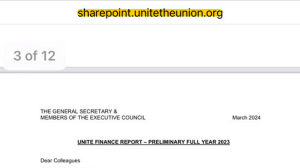
The case against ‘persons unknown’ was filed in October 2025, more then eighteen months after the circulation of the finance report, outside the one-year window, unless a similar set was posted later.
The context of the criticisms aimed at Clarke and Graham is crucial to understand why union members are angry — as well as the lengths Graham and Unite have gone to protect Clarke.
Destruction of evidence
In 2018, before Graham became Unite general secretary, she asked colleagues to destroy evidence of bullying and misogyny gathered by staff working under him in his previous role. In December 2024, Graham’s lawyers admitted that, following her take-over, the union did destroy the evidence.
During Graham’s tenure as general secretary of Unite, she has been constantly surrounded by allegations of abuse and anti-union behaviour. This includes her conduct in yet another dispute by staff complaining about the behaviour of her husband and his allies.
BDSU staff have been in dispute with the union and Clarke over alleged bullying and abuse by Clarke and his cronies. As already noted, these are far from the first such allegations against Clarke. Staff have also accused Graham and her management team of employing intimidation, suspension and anti-union tactics against the staff in the dispute, outraging Unite’s National Industrial Sector Committee (NISC) for the print and graphics sector and the leaders of two unions representing Unite staff and officers.
Yet more allegations
So bad has this alleged conduct been that more than 90% of Unite staff working at the union’s Holborn HQ voted for strike action. Three – some say four – of the five women who worked in Clarke’s department since Graham formed it and put him in charge of it have left, with union sources saying that they also alleged bullying and abuse. The Unite union staff branch unanimously condemned Unite’s abuse of its staff and the influential Officers National Committee (ONC) has accused Graham of using Murdoch-esque anti-union tactics against workers and against Unite officers trying to unionise and take collective action.
And on the executive council, Graham’s allies used expensive lawyers and legal process to block the removal of the chair – a Graham factionalist whose handling of key issues led to him losing the confidence of many ‘exec’ members – a tactic the union has used repeatedly, at huge cost to members.
Yet while Unite has spent members’ cash on two separate, simultaneous legal actions involving three little-followed X accounts, no legal action was ever attempted against Skwawkbox’s reporting on Clarke’s bullying and misogyny, or Graham’s attempts to destroy incriminating evidence. The legal period in which Unite could do so has long since expired.
Featured image via Unite union


Leave a Reply