
New EHRC guidance both clarifies and complicates the legal rights of trans people

There is a familiar refrain that follows my partner and I as we navigate the UK’s public bathrooms. As a gender-nonconforming couple, we’re painfully aware of the transphobic discourse that overshadows our daily lives. Approaching a set of bathrooms whilst out and about, and not wanting to draw more attention to ourselves, one or both of us will groan, before announcing with resignation:
Time to do ‘gender’…
It will be a situation familiar to many trans people. The so-called ‘bathroom ban’, fought for by anti-trans activists, has become notorious for making the lives of cis and trans people alike more complicated. Not only is it an infringement on the human rights of trans people themselves, but it inevitably leads to the policing of people of all gender expressions. Cis people too find themselves viewed with suspicion and even harassed for not looking a ‘certain’ way.
It is a situation unlikely to change in the near future. A new ‘code of practice’ document released by the Equality and Human Rights Commission (EHRC) has set out new (but no less convoluted) guidance on how public institutions and services are to cater to those with ‘protected characteristics’ and avoid discrimination.
Despite its claims to provide clarity with regards to various “everyday situations”, it’s a total mess of legalese that fails in simplifying the lived experiences of cis and trans people in the UK today.
Responses to the update
In an explainer video posted on their website, EHRC chair Mary Ann Stephenson says:
The code outlines how the Equality Act 2010 works in relation to the provision of services, public functions, and associations and explains the steps that should be taken to ensure people are not discriminated against.
The document itself claims to be:
based on the principle that people with the protected characteristics set out in the [Equality] Act should not be discriminated against, harassed or victimised when using any service provided publicly or privately.
TERF groups have already claimed a tentative victory in response to the new guidance.
Lobby group Sex Matters argues:
Nothing in the code of practice changes the Equality Act 2010. What it does is provide detailed, practical guidance on how to interpret the act.
In particular, the group claims that previous guidance on the Equality Act:
was ambiguous about the relationship between the protected characteristics of sex and gender.
For example, the old guidance suggested that:
a service provider … should treat transsexual people according to the gender role in which they present.
This notion of “presentation” was underpinned by the principle of “self-identification”. Regardless of how a service provider visually perceives a person’s gender, they should defer to how that person identifies themselves.
Sex Matters argue that the “new code of practice has removed that error”, leading trans advocacy group TransActual to conclude:
The newly published EHRC Code of Practice leaves trans people in the UK today with less rights than they had prior to last year’s Supreme Court ruling.
But does it really? The new guidance certainly gives TERFs more ammunition in their never-ending lawfare campaigning against people who are just trying to live their lives, but claims that it removes previous errors of interpretation around certain social interactions appear to be overstated.
Summarising analysis from the Good Law Project, which argues that the “updated code of practice rows back on some of the most harmful elements in the previous draft”, trans rights lead Jess O’Thomson explains:
It’s good to see clear guidance that associations can be for multiple protected characteristics – so you can have an organisation for both cis and trans women. And the suggestion of checking people’s birth certificates before they can use the toilet has been axed.
But it still treats trans people as a third sex, suggesting they should be made to use separate spaces – entirely ignoring the harm this causes, and human rights law. We will keep fighting this discriminatory approach.
‘Biology’ as a euphemism
The problems that persist with the new guidance all come down to different interpretations of sex and gender. In short, the guidance seeks to clarify the legal definition of these terms, and how public service providers can navigate the EHRC’s legal framework in a variety of hypothetical scenarios. What the document provides, then, is legal cover for individuals and organisations. But it remains the case that the law does not neatly cohere with (nor determine) the lived experiences of those concerned.
For example, what does it mean when the guidance says it uses “the expression ‘biological sex’ to describe the sex of a person at birth”? To cut through the vague euphemism, it means the bathroom you use should be determined by what genitals you have. As a foundation that is supposed to alleviate the complications of ‘perceived’ gender expression, it doesn’t hold up under scrutiny.
Many intersex people, for example, have testified to invasive and discriminatory medical treatment on the basis that their “sex at birth” is no less determined by a medical professional’s perceptions. It has long been the case that people born with ambiguous genitalia are subjected to decisions made about their bodies by doctors, who even encourage parents to consent to surgeries that can ‘correct’ their child’s genitals and make them look more ‘normal’.
Outside of medical professionals and intimate partners, however, who else is going to be interacting with our genitals during the day-to-day? Certainly not a random Starbucks employee! It is for this reason that so many of the hypothetical situations listed in the new guidance unavoidably fall back on other people’s perceptions of an individual’s gender expression – despite Sex Matters suggesting this ‘error’ has been removed.
As it turns out, you can’t just legislate away the complexities of social context and cultural interpretation…
The absence of trans testimonies
Contradictions continue to hamper this most irrational of debates because, alongside what is visible, many of the things that determine our gender cannot be seen. And this isn’t simply limited to a person’s genitals.
Speaking personally, as a trans woman, my hormone profile is not that of a biological man. A combination of testosterone blockers and hormone replacement therapy has fundamentally changed my inner emotional landscape. As far as outward appearances go, I continue to be misgendered often. But many of the women in my family present as more ‘masculine’ than most anyway. In fact, compared side by side, I’m the spitting image of the woman that gave birth to me.
Too much information? Yeah, probably! The EHRC’s new guidance goes to great lengths to try and ‘clarify’ how businesses and public bodies can avoid falling foul of the UK’s discrimination laws, but the fact remains that people’s lived experiences are more diverse than the law could ever truly account for. This is a problem that the EHRC – whenever it does decide to listen to trans people – cannot avoid. As a result, ‘clarification’ paradoxically means even more ‘complication’.
Prioritising the legal definitions of sex and gender over and above the reality of trans lives will always be reductive, further entrenching a ‘hostile environment‘ for trans people. But that is precisely what lawfare-waging TERFs want. The more convoluted the law, the colder the chilling effect on LGBTQ+ people’s freedoms of movement and expression.
At the end of the day, it’s not the law that needs to be changed, but the general attitudes towards trans people in this country. The law may influence this, but the problems have taken root far deeper than statutes.
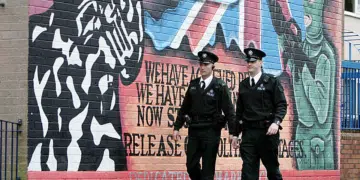
Featured image via Getty/Ian Forsyth


Comments 2
Leave a Reply








I think it’s a version of or extension to bigoted ideas about so-called “predatory” gay men. Wasn’t there a similar prejudice towards Lesbians joining women’s groups years ago?
I find it ironic that, while trans people are now being treated as a third sex by the supreme court, the minority of intersex people who actually don’t want to be bullied into performatively pretending to be men or women are still told by the gov and the NHS that we’re delusional and are expected to accept repeat failed forced cosmetic mutilations as somehow reasonable in order to prevent a slippery slope. I assume the bottom of said slope a society without sexism or medical abuse where I can focus on things that actually matter.
This is the country where two thirds of children in care homes are abused, and the same country that admits killing thousands disabled people to reduce welfare costs while also blocking the right to assisted death for those who don’t want to suffer being tortured. The UK is simply not a civilised or serious country and almost everybody feels betrayed, abandoned, and on their own because nobody cares and the government is incredibly corrupt and stripped of wealth assets. Nobody has any hope or goals for anything beyond getting some kind of emotional revenge against society, hence transphobia, hence racism, hence Reform, etc.