The 2026 World Cup is on the verge of breaking own goals record

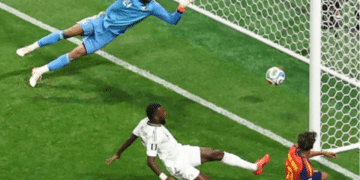
Own goals have become one of the most striking phenomena of the 2026 World Cup, with eight own goals scored in the tournament’s opening days alone – a figure that puts the current edition on course to break the record set at the 2018 World Cup in Russia.
The US team benefited more than any other from this phenomenon after their opponents scored two own goals in two consecutive matches against Paraguay and Australia – a development that highlights the significant impact such goals are now having on match results.
The list of players who scored own goals included Paraguay’s Damian Popadia, Switzerland’s Miro Mohaim, Egypt’s Mohamed Hani, Iraq’s Ayman Hussein, Jordan’s Yazan Abu Al-Arab and Qatar’s Mohamed Al-Mannai. Plus, Australia’s Cameron Burgess and Saudi Arabia’s Hassan Tambakti.
World Cup: Why has the number of own goals increased?
The rise in the number of own goals may seem a natural consequence of the increased number of matches, with the schedule now comprising 104 matches instead of 64.
However, this factor alone does not explain the rise in the average number of own goals per match, as technical analyses and European media reports suggest that developments in modern playing styles have played a key role in this phenomenon.
Modern football relies more than ever on quick transitions and direct attacks, forcing defenders to race back to their positions and attempt to deal with dangerous balls whilst under intense pressure. Furthermore, quick, low crosses into the penalty area have become a key attacking weapon for many national teams.
In such situations, defenders do not have enough time to make the ideal decision, so any attempt to clear the ball carries the risk of an own goal.
The match between Belgium and Egypt provided a clear example of this, when Mohamed Hani attempted to clear a dangerous cross from Thomas Meunier whilst under pressure from Romelu Lukaku, only for the ball to end up in the Egyptian net.
Similarly, the own goals that the US team capitalised on against Paraguay and Australia resulted from rapid crosses into the penalty area, forcing defenders to intervene under extremely difficult circumstances.
The 2026 World Cup is chasing the 2018 record
With seven own goals scored just over a week into the tournament, the all-time record of 12 own goals set at the 2018 World Cup in Russia is now under serious threat.
The Russia World Cup tops the list of tournaments with the most own goals, with 12, followed by the 1998 World Cup in France with six, and then the 2014 World Cup in Brazil with five.
The 1954 Switzerland and 2006 Germany tournaments each saw four own goals, whilst three own goals were scored at the 1974 West Germany, 1978 Argentina and 2002 South Korea and Japan World Cups.
By contrast, the 1938 France, 1966 England, 1986 Mexico, 2010 South Africa and 2022 Qatar tournaments each saw two own goals, whilst only one own goal was scored in the 1930 Uruguay, 1970 Mexico, 1982 Spain and 1994 USA tournaments.
As for the World Cups in Italy 1934, Brazil 1950, Sweden 1958, Chile 1962 and Italy 1990, there were no own goals at all.
With the bulk of the tournament’s matches still to be played, the current edition looks set to surpass previous records, as teams continue to rely on a fast-paced style of play and dangerous crosses – factors that keep defenders constantly on their toes, facing the threat of conceding goals.
Featured image via Siphiwe Sibeko/ Reuters


Leave a Reply