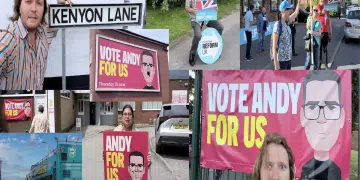
Makerfield: Here’s what really motivated voters

The medium-sized town of Ashton-in-Makerfield, its ~70,000 voters and its historic by-election will forever be remembered in British political history for ridding us of Keir Starmer. And a good riddance it is!
Who comes to replace him may be marginally better, more of the same, or far worse.
It seems unimaginable at this point that Andy ‘U-Turn’em’ Burnham will be a significant break from the Labour mold. (See: trans existence, hostile immigration policy, water nationalisation, electoral reform or Gaza’s genocide.)
Regardless of what Canary reporters make of Burnham, we find ourselves naturally sympathetic with the 55% of voters who backed him to crush Reform UK and its extreme splinter group, Restore Britain. Their resounding defeats, with a good measure of spatting thrown in, is an enormous win for Britain.
Many of those I spoke with resonated with Andy Burnham personally. Some favour his northern aura-production PR, his record as King-in-the-North metro mayor, or him as a tool to defeat Starmer. Perhaps they hope Starmerism will die with him gone, though empty 2024-esque “change” messaging suggests not.
Other people I spoke with were far more hostile to Labour overall.
Many, perhaps rightly, see Labour as a had-their-chance-and-blown-it party. But their only viable alternative was Reform, which is a worrying state of affairs.
To hear what Ashtoners really thought, I spent several days talking with them.
Makerfield resident: ‘I’m sick of it’
Regardless of political preferences, the resounding mood from conversations on the high street and outside polling stations before, on and after 18 June 2026, was being fed up. Just plain annoyance at the circus and theatre of it all, being used as pawns in a political game played — in reality — hundreds of miles south.
“I’m sick of it,” one man said outside a polling station opposite Labour’s campaign headquarters. Another man walking out of the station with him simply said:
I’ll be glad when it’s over.
Another voter didn’t stop but repeated:
I want it all to be over!
At least he’s got what he wanted for the time being.
Others told us they’d had constant knocks on the door, leaflets, or questions from journalists. Some said they’d been in heavy arguments with friends and family about the high-stakes political choice before them.
Hopefully some respite has fallen on Makerfield now — and hopefully they see something of their MP before he makes his ambitious bid to become PM.
I asked one woman, who was rushing, what she hoped for. She replied:
For a better future.
‘F*ck Labour’
Much of the political commentariat likes to opine about such a policy or politician with this or that theory, or argument or “take”. They/we make a living out of constantly developing and re-writing political analysis. Few really cut through to the heart of the matter or sheer political disappointment as a disillusioned Wiganer.
Despite Burnham’s obvious personal support among Makerfield’s voters, there was a strong contingent of people voting explicitly against Labour. One man summed up that general sentiment:
F*ck Labour — that’s all I’ve got.
One man had a much more specific reason for voting against Andy Burnham. He blamed Burnham for the £104 million clean air zone tax on pollutant vehicles that was “imposed” on Wigan before Burnham “backed down” in 2022. The cameras are still up, he noted.
This resident despised how Burnham had “lied through his front teeth” about the wasted taxpayer money and that Robert Kenyon was the only one who could keep Burnham out.
Some were clearly voting for what they believed was an anti-migrant platform, whether Reform or Restore. I had one woman say to me:
Just sort it all out. It’s atrocious.
Then, under her breath, she added:
…and get rid of all of these immigrants. They’re everywhere.
Another woman expressed a similar worrying view.
I asked her: “All of them?”
“Yes.”
She was accompanied by an apologetic-seeming Labour voter, about the same age, but with less horrible opinions on migrants.
One particularly repetitive, and especially drunk, Reform banner-waver with a Guinness tin in his hand sniffed me out as a lefty journalist. At a snooker club that became a de facto Reform campaign base, he said:
You’re a shit-bag…what you’ve said there, you’re “left”…Your lot are ruining the country, you need to get home and pay attention to what they’re doing…sort it out.
Misinformed leaders leave people ‘fearful’
Others were actively voting against Reform, put off by their boisterous campaign style. One woman said that Reform was “quite in your face” on results day with all their flags and car horn honking and (I’d add) drinking.
I met one extremely relieved older female voter the day after the results came in who said she’d “taken to prayer” for the ultimate nights before voting. She was actually sympathetic to Kenyon, who she believed was manipulated by a bunch of southern Reform millionaires. (He’s still a confessed sexist, however.)
Then, a lesbian couple. Outside a polling station, I asked if they’d like to share any hopes or fears.
We’re fearful…everyone’s entitled to vote, but we put such big decisions in the hands of very misinformed people, like my mum.
Her partner joined in the conversation:
We tell her about these things they’ve [Reform] said, about women’s protections and rights and so on, and she says, “But they won’t do that”. All she talks about is “the boats” — OK, but what about everything else? There are no boats in Makerfield!
We’re getting married next year and she’s dead excited — she’s not homophobic at all — but we say, if it was in five years under a Reform government, you just don’t know.
One woman expressed that, despite diverse opinions everyone’s entitled to, the “important thing” is to vote. I encountered a similar respect for the process in Gorton and Denton, even among those with strong beliefs.
For me, it’s all we do in between voting that matters more — politics goes on between the ballots. It’s an organisation that serves people’s interests, a community group, a shared space, a clean park.
Perhaps, if people remembered that more, it wouldn’t all feel so desperately high-stakes when it comes time to vote.
Featured image via the Canary/Cameron Baillie


Leave a Reply