I am driving down a country lane in Oxfordshire when two warplanes pass low across the sky. Somewhere, the radius of British military reach has been extended, but as they disappear from sight over the surrounding fields, I cannot follow them further. The details of their missions are withheld under the terms of national security.
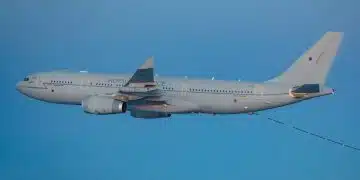
The two planes come from RAF Brize Norton. They will eventually return there. Their tail numbers – ZZ338 and ZZ343 – are administrative identifiers attached to the RAF Voyager fleet. These Voyagers leave Oxfordshire, pass through other RAF bases abroad, and reach a country in West Asia unimpeded. They do not release munitions; their function is air-to-air refuelling. Nevertheless, without them, the bombs would fall differently, constrained by time and fuel, limited operationally in range.
My stomach turns. There is no sound of bombing, no declaration of war, no announcements on the radio. I think about what it costs – not in the fiscal sense, although it costs my taxes too, but in the harder currency of complicity. What does it mean to live in a country whose wars are conducted at such a distance, managed so that they barely disturb my afternoon drive?
Operation Rough Rider
The Voyager fleet I watched cross that field flew at least 25 times in support of the USS Harry S. Truman and its carrier strike group between March and May 2025.
On 15 March 2025, Donald Trump launched Operation Rough Rider, resuming US strikes on Yemen and breaking the pause that had held since the Gaza ‘ceasefire’ on 19 January 2025. It followed Operation Poseidon Archer – a year-long US-UK campaign under Biden and Sunak, running from 12 January 2024 until that ‘ceasefire’. Poseidon Archer killed 21 civilians in twelve months. This death toll was matched by the Trump administration within the first 48 hours of Operation Rough Rider.
The given reason for the operation was to protect global shipping from the Houthis through the Bab el-Mandeb Strait – an oil chokepoint carrying roughly 10–12% of world trade. But the Houthis had not targeted a merchant vessel for four months before the campaign began, having paused their Red Sea operations in November 2024.
On 7 March 2025, the Houthis issued a four-day ultimatum to Israel to lift its blockade on Gaza, which was preventing food, aid and medical teams from entering the strip. The group’s leader, Abdul-Malik al-Houthi, said in a video statement:
We give the entire world notice: we are granting a four-day deadline.
Trump’s war on the Houthis
President Trump’s position on the Houthis was clear. Two days after he was sworn in, he signed an executive order redesignating the Houthis as a foreign terrorist organization (FTO). His first administration had applied the FTO label on its last full day in office in January 2021, which Biden had reversed within a month. The designation was back. Eight days after the ultimatum, Trump vowed to “completely annihilate” the Houthis. Britain followed.
Over 53 days, the US carried out 339 strikes. At least 238 civilians were killed, including 24 children; 467 were injured, including 31 children. The UK provided air-to-air refuelling for the aircraft involved.
Embarrassingly, for a military with a $1 trillion budget, the Houthis downed at least 7 MQ-9 Reaper drones during Operation Rough Rider, each worth $30 million. The Houthis are not a militia to be bombed into submission; they are a political force enmeshed in Yemeni society, their support for the Palestinian cause having deepened that entrenchment on the ground further. Similar to Iran, you cannot bomb that out of existence. An insurgency always wins by not losing.
What the UK gives the US
Starmer’s government signed on to a far deadlier deal than Sunak’s without a parliamentary discussion. Starmer did so, moreover, as a favour to an administration whose senior officials, Secretary of War Pete Hegseth and Vice President JD Vance, had recently described European allies as “pathetic freeloaders”.
“Pathetic freeloaders” at least implies that Britain takes from the relationship without giving. The truth is far less comfortable. The United States military operates 22 sites across Britain, whose total replacement value the US War Department estimates at $15.6 billion.
This figure does not include the overseas RAF bases that the US accesses. RAF Diego Garcia, in the British Indian Ocean Territory, was surveyed by the US Navy in the 1960s as a prospective base. In order for the US to occupy the island for military purposes, Britain forcibly expelled and displaced the indigenous population in its entirety. Around 1,500 Chagossians were forced to leave the islands they had inhabited for generations, all to lease the island back to the US. It is from RAF Diego Garcia that B-2 Spirit stealth bombers flew during Operation Rough Rider. RAF Voyager flew others from RAF Akrotiri in Cyprus.
What we have given to the US – our bases, our airspace, our silence, our strengthening of imperial power repackaged as an alliance – is significant. What the UK receives from the US – beyond the experience of geopolitical volatility and complicity in war crimes – is not yet obvious.
British assaults on Yemen
Operation Rough Rider resulted in a strike on the fuel storage facility at Ras Isa Port in April. 84 civilians were killed, including three children, and 150 injured. The strike was one of the worst for civilian harm on record. In a decade of monitoring by Yemen Data Project, only three air raids have been recorded as causing more civilian harm. All of these took place during the seven-year Saudi-led civil war, which began in 2014 and led to Yemen becoming one of the world’s worst humanitarian crises.
Operation Rough Rider was not Britain’s first stain on Yemeni suffering; it was a continuation. As Campaign Against Arms Trade reported, every day Yemen was hit by British bombs, dropped by British planes, flown by British-trained pilots, maintained by thousands of British contractors operating inside Saudi Arabia. The Ministry of Defence (MoD) has said that UK forces supplied routine allied air-to-air refuelling support to aid the self-defence of US forces in the region.
On 28 April 2025, a US strike hit a Houthi-run detention centre in northern Yemen, killing 68 people, mostly African migrants, and injuring 47 others. RAF Voyager plane ZZ338, which I saw fly across that field in Oxfordshire, flew to Cyprus, then to Yemen, during this operation.
Iona Craig, who runs the Yemen Data Project, tracked the RAF flights used in Operation Rough Rider. Her data records ZZ338’s involvement in strikes on residential areas that caused 53 civilian casualties. This plane, admired by aviation heads and documented by spotters, assists the US in airstrikes on homes where families burn alive – 10 dead, 22 injured.
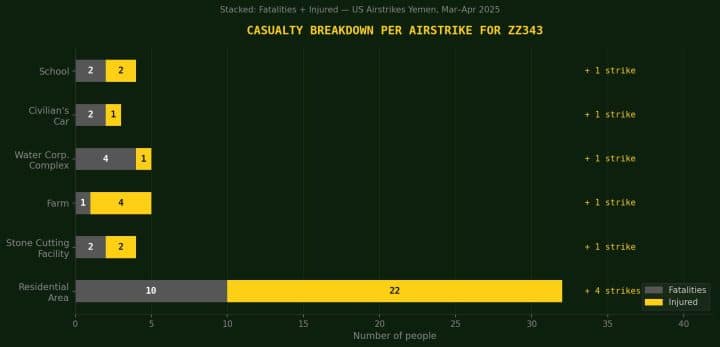
Yemen Data Project and Iona Craig
UK-Israeli Collaboration
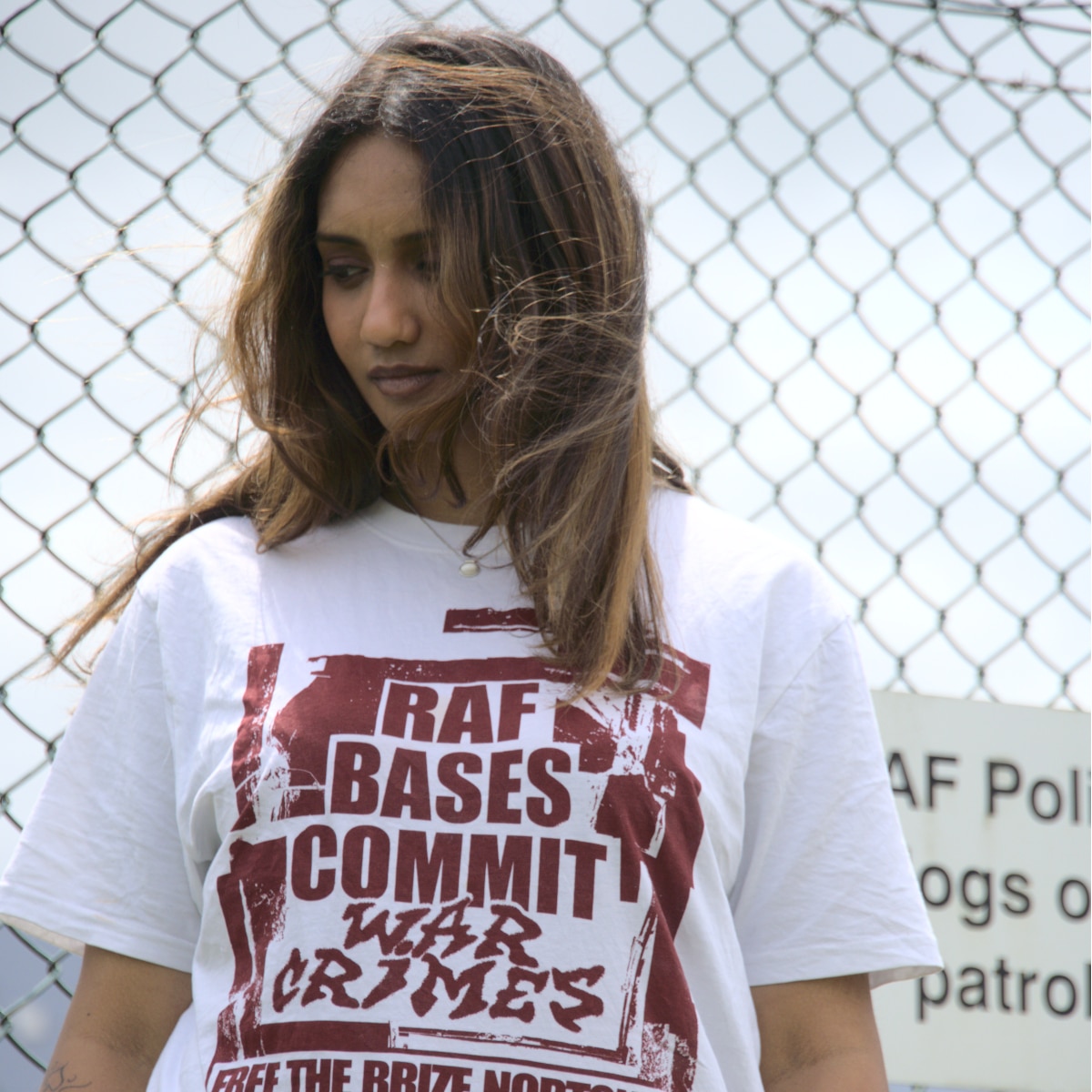
In the early hours of 20 June 2025, two activists from Palestine Action broke into RAF Brize Norton and sprayed ZZ338 and ZZ343 red. The MoD claims the paint caused £30 million worth of damage, but ZZ338 was back in the air ten days later. Six people have since been arrested in connection with the action. Their trial is set for January 2027, which means five of them will have spent 18 months incarcerated without a trial. They are the first-ever activists to be charged and held under the National Security Act.
This same base in Oxfordshire, RAF Brize Norton, was receiving Israeli Air Force KC-707 Re’em refuelling aircraft on at least nine occasions between September 2024 and June 2025, according to flight data revealed by Drop Site News. These tankers keep Israeli F-35s airborne over Gaza long enough to complete their bombing run.
One of those planes was over Gaza four days after leaving Oxfordshire, on the night a residential complex in Beit Lahiya was bombed, massacring 73 Palestinians. The Labour government will not say why Israel is allowed in our airspace and on our RAF bases, whilst simultaneously committing crimes against humanity. The MoD calls this “routine”.
Is this how you keep British citizens secure? The MoD cites national security, but the British state decides what you are permitted to know about what is being done in your name. Is this the security on offer? I would rather do without it.
The opening account of two warplanes spotted over Oxfordshire is fictional; the data provided is not. Written in collaboration with Amu Gib. Featured image via Royal Air Force.


Leave a Reply