
Why are climate activists protesting a climate conference?

Activists disrupted the opening of the Exeter Climate Forum conference on 29 June 2026 in protest of the event being sponsored by Howden – an insurance company whose clients include fossil fuel companies.
Conference disruption
It’s a warm Monday morning, which feels like a relief after the past week of baking heat.
It’s also the first day of a three-day climate conference at the University of Exeter. As the meeting gets underway, I hear faint drumming from outside. Then, a group holding banners reading “Stop Insuring Climate Chaos” and “Howden Insurance: Climate Criminals” take centre stage.
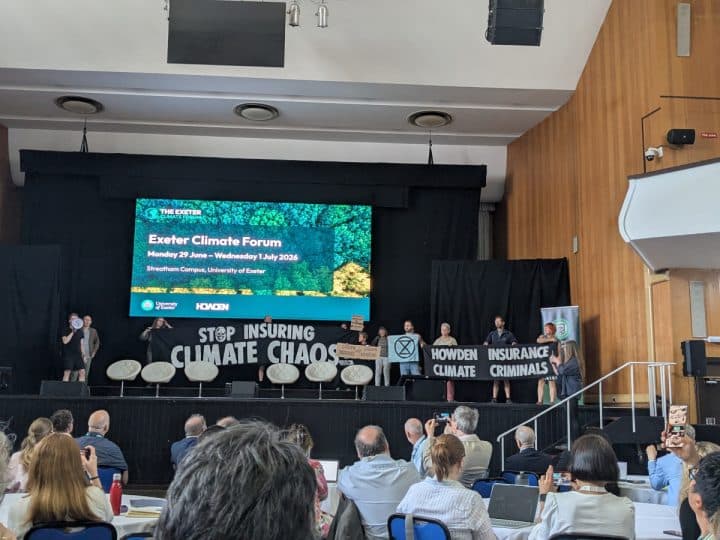
Speaking through a megaphone, Jonathan Parker, who later told me they’re studying for a masters degree in global sustainability solutions, explained to the audience what brought them to confront Howden’s sponsorship in this way.
Parker said:
This conference is being sponsored by Howden – a major oil and gas insurer. Insurance is an essential part of the fossil fuel industry and having fossil fuel companies at a climate science conference is an obvious contradiction. It undermines the entire credibility of this conference: they’re not serious about climate action.
The activists emphasised they had tried to engage with the university’s leadership and conference organisers about the sponsorship, but felt they had been repeatedly ignored and dismissed. They felt they were left with little choice but to disrupt the conference.
I look around the room and the audience is mostly silent. It’s hard to gauge what the academics and industry figures think of the protest or the reasons why it’s happening.
University officials tell the activists that they have made their point and have been heard. After 15 minutes or so, the activists leave the stage chanting about climate justice and action. Security guards escort them from the building and the conference continues.
Climate contradictions
Shortly afterwards, I slip out of the first lecture to hear what the activists have to say at the rally they’re now holding outside the conference centre.
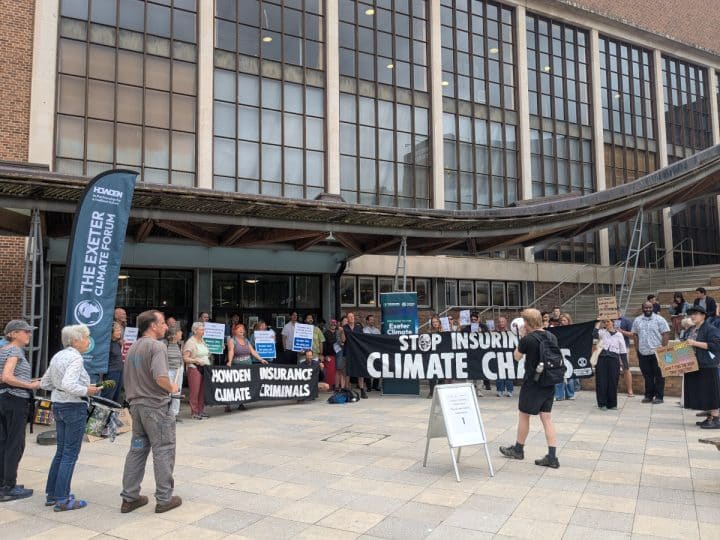
I hear concerns from Exeter students and staff about how corporate money, including from fossil fuel companies such as Shell, influences the university and its ability to respond effectively to the escalating climate crisis.
The conference is also happening in the wake of proposed job cuts at the university, likely to affect humanities and social sciences most.
The rally hears heartfelt testimonies from academics with long careers in climate science and social change, who now find their jobs at risk at an institute whose leadership in these areas is widely praised.
There’s clearly a great deal of pride in and commitment to the climate work that the university is part of, but I also heard a deep sense of frustration and betrayal expressed.
A speaker from Extinction Rebellion Exeter said:
While the Uni sells its soul and our futures to fossil fuel companies and insurers, they’re announcing sweeping cuts to staff in the humanities, showing clearly where their priorities lie.
Institutional inertia
As the rally ends and activists disperse, I head back inside to the conference.
Over lunch, there are tentative discussions about the protest we all witnessed. Like many others who are here, I’m attending this conference because I really, really want to be an effective collaborator in enabling genuinely transformative climate action across society.
But as this morning’s protest brought into sharp focus, there are so many ways our institutions and systems constrain, delay, complicate and stifle that action. Whilst opinion about the protest’s tactics was divided, I didn’t hear much to defend the conference’s choice of sponsor.
As the meeting gets back “on track”, my hope for the next few days is that we don’t spend yet another conference analysing the escalating global problems at the expense of acting creatively, effectively and more bravely to respond to them together.
Video and images via Abi Perrin

Comments 1
Leave a Reply








A climate conference is unlikely to achieve anything.
“The profits of fossil-fueled capitalism not only insulate the super rich from the effects of climate change but render them indifferent to the democratic sentiment of those who are affected. The ruling class stands to lose between $1.4 and $2.4 trillion in stranded fossil fuel assets and investments in a move to a net-zero emissions society. A comparison of the time and resources spent by the European governments on each confirms that they are more prepared to contemplate war with nuclear-armed Russia than such a transition.
Safeguarding human life on earth means seizing power away from these arsonists by expropriating the oligarchy and toppling capitalist governments in a world socialist revolution.
The international working class—the overwhelming majority of the world’s population and objectively unified by global production—is the sole force capable of bringing an end to the profit drive of the bourgeoisie and the anarchic competition for control of the world markets and resources that threatens the destruction of humanity and the planet itself through climate catastrophe and nuclear war.”
(‘Europe’s record heatwave: Climate catastrophe or world socialism’, World Socialist Web Site 30 June2026)