Reform UK’s Braverman believes the UK should be compensated for its colonial pillages

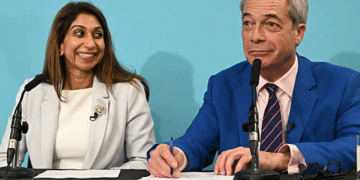
Reform UK’s far-right MP Suella Braverman claims the UK should receive reparations for its “investment, effort and contribution” to the colonies.
This appalling suggestion came after Labour MP Bell Ribeiro-Addy posted on X about Jamaica making the (long overdue) case for reparations “directly to King Charles”.
Apparently, countries that had their resources, wealth, and labour exploited or stolen have no right to reparations, but those who capitalised upon it should be reimbursed because “the British Empire did so much good for the world”.
Correction: the British Empire stole an extraordinary amount of wealth from the countries it colonised. It committed numerous atrocities and genocides around the world during its bloody reign. If anyone should be paying reparations, it’s Britain – not demanding them.
It’s long past time we give something back to help repair the damage the Empire inflicted, especially across the Global South.
Former British Home Secretary Suella Braverman has called for Britain’s former colonies to pay reparations to London for the "investment, effort and contribution" she claims the empire made in building themhttps://t.co/Z1RTRiZr3B
— Middle East Eye (@MiddleEastEye) July 6, 2026
Braverman is a rancid colonialist
Braverman’s intervention is a reminder of how little humility there still is among many in the UK about where so much of our wealth and privilege came from. The British Empire didn’t build itself through hard work – it was built on plunder, exploitation and extraction across huge parts of the world.
Many countries in the Global South are still dealing with the long-term consequences of that history. So now that calls for reparations are becoming louder, it’s telling that some on the right would rather paint Britain as the victim than reckon with the damage the Empire caused.
This, it shouldn’t need to be said, is absolute bollocks.
Originally, Labour MP Ribeiro-Addy posted:
Later this year, Jamaica will take the case for reparations directly to King Charles, lodging a formal petition.
It is getting harder and harder for British institutions to maintain their favoured tactic of simply ignoring calls for repair.
Disgusted at this support and recognition for the right of Jamaicans to seek redress, Braverman said:
The British Empire did so much good for the world.
Of course slavery was abhorrent but to expect the British people of the 21st century to pay for actions that took place in the 18th century has no basis in law.
If the government is seriously thinking about this then former colonies should pay the British back for the considerable investment, effort and contribution that this country made which laid the foundations for many flourishing democracies today.
Conveniently, Braverman makes no mention of what happened when the “abhorrent” slave trade and, later, slavery itself were abolished. It wasn’t the enslaved who were compensated – it was the slave owners. They received such vast sums to cover their supposed financial “losses” that the British government borrowed heavily to fund the payouts.
The debt from that borrowing was paid off by taxpayers for generations, with the final payments only being completed in 2015. Thus, ordinary people effectively spent almost two centuries paying to compensate slave owners, while enslaved people received nothing.
This has disgusted many on the platform, with Stand Up To Racism pointing out on X:
Suella Braverman’s statement is a sick joke.
Britain’s empire exploited & oppressed countries around the world.
The empire did it to make enormous profits for the kind of millionaires & billionaires who are now funding Reform UK. https://t.co/ViVDKknVCh
— Stand Up To Racism (@AntiRacismDay) July 6, 2026
Nothing ‘post’ about colonialism
The West loves to pat itself on the back for changes it was ultimately forced to make. When countries won their independence and joined the Commonwealth, many claimed Britain had entered a ‘post-colonial’ era.
But plenty of scholars and critics argue that’s far too simplistic. They point to the continued global reach of powerful British companies that grew during the height of empire, such as HSBC and Unilever, arguing that exploitation didn’t disappear – it just changed form.
From that perspective, we’re not living in a post-colonial world at all, but a neo-colonial one. That’s what makes Braverman’s claim that the British Empire deserves to be compensated for its “efforts” so staggering. It reflects not only a woeful lack of humility, but also a fundamental misunderstanding of the Empire’s legacy.
The "coloniser as a service-provider" school of stupidity https://t.co/QSCJGi7fku
— Marc Owen Jones (@marcowenjones) July 6, 2026
The World History Journal writes:
As the empire expanded, British colonial policies evolved to ensure that colonies existed primarily to serve the economic interests of the mother country. This approach not only regulated trade but also suppressed local economies, ensuring that Britain remained the ultimate beneficiary of colonial wealth.
The foundations laid during this period propelled Britain into a new economic order, establishing it as a dominant player on the global stage.
That dominance hasn’t disappeared – it has simply evolved, reinforced by US power and Western hegemony more broadly.
Nowhere is this more apparent than in the selective application of international law. When Western states breach it, accountability is often weak or absent. But when states in the Global South or the Middle East do the same, international law is far more readily invoked to isolate, sanction, and punish them.
"The British Empire did so much good for the world" https://t.co/XOHKvED1kV pic.twitter.com/oCpL5CjOIA
— Hughes-on-the-Wold (@NotThatHughes) July 4, 2026
The ‘Empire’ is still going – in the hands of billionaires
In Lori Lee Oates review of ‘Empireworld: How British Imperialism has shaped the globe”, she wrote:
By way of example, Sanghera discusses corporations such as British Petroleum (BP) that “grew out of the Anglo-Persian Oil Company, which was founded by the British when oil was discovered in Iran” in 1909, and the Hong-Kong and Shanghai Banking Corporation (HSBC) which he says was “established in 1865 to facilitate British imperial trade”.
These corporations were critical to the extractive economics of empire. He maintains that British Airways “was formed from a combination of the British Overseas Airways Corporation (BOAC), British European Airways (BEA) and Imperial Airways, which offered routes to imperial territories” (13).
Transnational travel was an important aspect of being able to extend imperial reach and trade, as was also accomplished by the steam ships and railroads that we have come to associate with empire.
The Empire didn’t disappear – it just changed its business model. The extraction, exploitation, and profiteering didn’t stop. It simply took new forms, allowing Britain and the wider West to keep benefiting from countries whose wealth had already been plundered.
That’s exactly why calls for reparations aren’t going away. Many countries are still living with the consequences of colonialism while Britain continues to enjoy many of its rewards.
So, for Braverman to claim that Britain is somehow the victim is beyond tone-deaf. It also shows just how little humility there is when it comes to confronting the true legacy of the British Empire.
Featured image via the Canary

Leave a Reply