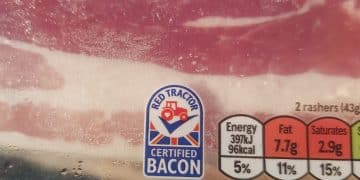
Government urged to end animal welfare labelling confusion on meat products

Animal welfare charity FOUR PAWS UK is calling on the government to back mandatory animal welfare labelling legislation. It has published a report that reveals widespread confusion on supermarket shelves and growing public demand for a simpler, more transparent system.
A special event in parliament on 9 July launched the report. It included a pop-up supermarket aisle where parliamentarians saw how regulated welfare labels could transform the way we shop.
The report highlights a fragmented labelling landscape. Shoppers currently have to navigate a patchwork of assurance logos and welfare claims. And there’s often no clear information on how animals were bred, reared or slaughtered.
FOUR PAWS UK found that consumers are increasingly expressing concern for animal welfare. But they don’t have the tools needed to make informed choices between products. Unlike price or ingredients, animal welfare cannot be verified at the point of purchase. And this means consumers must rely entirely on the information presented on packaging.
Terms such as “farm fresh” and “responsibly sourced” can appear reassuring. But they provide little tangible information about stock density, housing conditions, access to pastures, or other factors that have a meaningful impact on an animal’s quality of life.
Method of Production labelling
FOUR PAWS UK argues the solution is mandatory Method of Production (MoP) labelling across all animal products. Under the proposals, labels would clearly identify the housing systems in which animals were kept and be supported by validated welfare indicators. This would create a consistent and trustworthy framework for consumers, retailers and farmers alike.
The report cites evidence from the egg sector that demonstrates how clear MoP labelling can improve consumer understanding. This has influenced purchasing decisions, contributing to the long-term shift away from caged egg production.
There is also strong public support for reform. A 2025 FOUR PAWS UK survey found that almost 80% of respondents support MoP labelling on animal products sold in supermarkets. The same research found four in five people also support banning cages for farmed animals. And two-thirds support ending barn systems where animals are raised exclusively indoors.
Emily Wilson, head of programmes at FOUR PAWS UK states:
Most people assume the information on a food label tells them something meaningful about the life an animal led. Too often, that simply isn’t the case. When shoppers are standing in front of a supermarket shelf, they should be able to tell, at a mere glance, the difference between one product and another.
The public have made it clear that animal welfare matters to them, but are being asked to make decisions on inconsistent, confusing and misleading claims. Consumers deserve honest, straightforward information.
Farmers who are already investing in higher welfare deserve recognition for the standards they’re setting. Most importantly, animals deserve a system that encourages a better standard of life.
Liberal Democrat MP Alistair Carmichael is chair of the Environment, Food and Rural Affairs select committee. He wrote the foreword for the report, hosted the launch and chaired an expert panel discussion with representatives from farming, certification and retail sectors. He added:
People have a right to know how the food they buy was produced. The current landscape is clouded with marketing spin and meaningless messages, which only do a disservice to shoppers and the many farmers who are already investing in raising standards.
The government has an opportunity to deliver a practical reform, with benefits for consumers, producers and animals alike.
The market has failed so the government needs to step up
FOUR PAWS UK is calling on the government to bring forward mandatory MoP labelling legislation. And it’s urging MPs from all parties to support measures that improve transparency, reward higher welfare farming and give consumers the information they are demanding.
Voluntary approaches alone cannot deliver the consistency and market-wide coverage needed to drive genuine change. While assurance schemes do play an important role, coverage remains uneven and significant gaps exist across imports, processed foods and food service settings.
Without a common standard, farmers investing in better standards have to compete on a Wild West-like playing field, against products using ambiguous welfare claims. We need to level this playing field and bring in mandatory legislation that applies consistently across domestic and imported products, processed foods and food service settings.
You can download and read the report in full here. For more information email [email protected]
Featured image via the Canary
Leave a Reply