
Police repression of UK protests is now “routine” — new report finds

An annual ‘State of Protest’ report on the policing of demonstrations says the repression of dissent in Britain in 2025 has not only become worse. In fact, it is now increasingly routine. This is not just in London. It applies more widely across England, Wales, and Scotland.
Policing protests
The report, How Repression Became Routine by the Network for Police Monitoring (Netpol), says that protests are increasingly policed as threats rather than an exercise of fundamental democratic freedom and expression.
Netpol was set up in the aftermath of G20 protests in London in 2009. Its work challenges police tactics, intrusive police surveillance and the expansion of public order powers.
The report concludes that new and overlapping laws have contributed to the normalisation of surveillance and confrontational policing. There is also a growing tendency to treat protest as a security issue. As a result, the report states that punishment has also been normalised. The impacts are disproportionately felt by marginalised groups.
Speakers at the report’s launch included Palestine Action co-founder Huda Ammori, and NHS doctor and campaigner Ayo Khalil. He was racially profiled and arrested at a prisoner solidarity protest outside HMP Bronzefield in December 2025.
Police impunity
Netpol also reported that the public’s ability to scrutinise police powers has been weakened. Their reporting suggests that journalists and legal observers documenting police violence and repression are operating in an increasingly unsafe environment.
This aligns with the appalling but entirely unsurprising claim that human rights legislation makes policing “untenable,” Met Police commissioner Mark Rowley has claimed.
He laid out his position in a recent LRB interview:
There will always be a bit of grey at the margins of legislation[…]but the current public order legislation has far, far too much grey.
It was designed in the 1980s in a different time and has had the Human Rights Act overlaid over the top of it, which creates such complexity for the decision making of police officers and the Crown Prosecution Service.
Commenting on the police’s remit, Rowley said:
It’s not for me to say how permissive or restrictive they should be, but as a police officer, me and my colleagues just want clarity.
Repressive policing, Britain’s new norm
The report’s finding imply that repressive policing—far from being ‘drift’ or isolated to some police forces—is recognised as a standard “routine” practise. “Layered legislation,” as Rowley alludes, create a legal situation that is not just open to interpretation but is also confusing and open to abuse. Consequently, this makes it equally difficult for protest groups to predict how demonstrations will be policed.
Typically, the Met force determines the application of the law. Other forces then adopt this into their practices. These are widely perceived by activists and excessive and draconian.
Powers initially applied to marches have been expanded to static protests including those held outside of weapons factories. Both are treated as a security threat rather than a human and civic right.
Additionally, politicians who talk about disloyalty or British values render racialised people at protests as ‘Other.’ This dog-whistling places minorities at greater risk of aggressive policing. For example, this was seen at the recent Quds Day demo. Legal observers and “journalists” specialising in civic protest movements are also at greater risk.
The report’s findings are based on deep-dive qualitative research on protest movements. It features interviews, testimonies, legal observer notes, court records, police and government data, media coverage, and twenty-one freedom of information requests.
The report went live on 25 March. In-person events will be taking place in April across Manchester, Brighton, and London to discuss its findings.
Kevin Blowe of Netpol said:
Last year we raised the alarm about state-supported measures designed to impose social control on protests on a scale reminiscent of the ‘war on terror’ two decades ago. A year on, we have now documented how these practices have become the norm.
Repression does not happen overnight: it creeps up on us gradually. Frontline campaigners and human rights are all now saying that attacks on protest rights are repressive. Yet the government plans even more new laws in 2026.
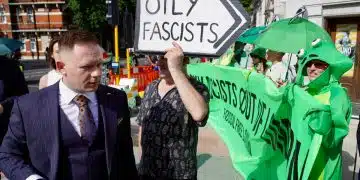
As well as new legislation, we are seeing a growth in police powers used as tools of surveillance, particularly against anti-racist and anti-fascist opponents of the increasing number of far right demonstrations across Britain against migrants.
Britain’s most senior police officer, Sir Mark Rowley, is now also seeking to further undermine human rights laws and crack down on protests even more in the name of ‘clarity’. Our research, however, found it is the excessive and arbitrary use of police powers, not the Human Rights Act, that appears intended to confuse and intimidate protesters and discourage them from exercising their rights.
The human cost
At the report launch, psychiatrist and medic Ayo Khalil spoke of the impact of these policing tactics, stating that given:
the state of our country, [the roots of depression, anxiety and other mental health problems] are in the seats of power and institutions [and] the state’s efforts to pathologise people who care. We are told we are the problem … The system does not value human life.
Khalil also pointed to the attempt by Starmer and the General Medical Council to treat doctors who oppose genocide as antisemitic.
It’s this constant push to treat opposition to genocide as a threat of violence or putting patients at risk. [Doctors] at protests outside hunger strikers’ prisons have even been choked unconscious… [yet] there is no accountability for the police officers.
Khalil noted a pattern in the violence used against protesters, particularly targeting their back, neck, and other areas during arrests. This elevates the risk of lasting injuries or even permanent disability. Families of people that have been injured or arrested also suffer from crippling anxiety and fear, which may pressure dissenters and dissuade them from future protests.
That said, Khalil told the Canary that the protest movement has been galvanised and redoubled its efforts in response to hostile policing. In response, the government has been trying to neutralise protest and its impact. Khalil also highlighted that prisons—in many cases—are run by private companies, holding hunger strikers using “systematic” violence, abuse and the withholding of rights as a further form of punishment.
What is protest if you can’t disrupt? The point of protest is to shake things up. If we allow ourselves to be reduced to a bit of noise in the corner, we will lose our potency and we can’t allow that… The British government is directly responsible for so many of these [wrongs] around the world.
Starmer’s protest U-turn
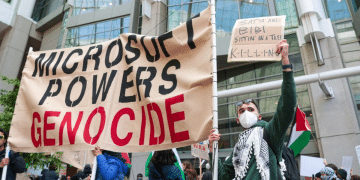
Ammori, whose legal success in obtaining a judicial review that reversed the ‘terror’ ban on Palestine Action (currently being appealed by the Starmer regime) said that direct action is essential to ending genocide. However, it inevitably triggered a backlash:
Even one day of a weapons factory being shut down is a victory… The proof is in the pudding and in the process we annoyed a lot of powerful people [especially those] sponsored and paid for by the Israel lobby. All that lobbying pressure built up and…it was very clear that the government had decided to prioritise the needs and interests of a foreign weapons manufacturer over the rights of its own citizens.
She added that the government had redefined actions as terrorism, even though they had already been convicted as breaches of the peace or criminal damage.
What is becoming more and more apparent was that the reason they arrested those people [the Filton 24] was because they needed those arrests to justify the ban on Palestine Action and their claims of terrorism. [But] when the cases went to trial, not a single one of them was convicted of a single offence. Those people were held without being convicted of a single offence [and] Sam continues to be held.
They tried to put these ridiculous charges against them and they couldn’t land a single conviction. And [The ban on protest supporting Palestine Action] made Palestine Action a household name.
Ammori said that because of this, if the government’s appeal fails and Palestine Action comes back, then:
It will come back stronger than ever before.
She condemned the government’s violence and denial of human rights, especially against hunger strikers. Additionally, she said that it’s “only a matter of time” before Palestine Action is back. She believes it will be more of a thorn in the side of the apartheid lobby than ever.
Feature image via Barold / the Canary


Comments 2
Leave a Reply





The fascist UK fake government – aka dictatorship are determined to prevent any protest action because this undermines their power and control over us. We are no longer living in a democracy wherein politicians are accountable to us rather these fake politicians are in the pay of zionist Israeli terrorist state and hence their institutional repression of any protest or dissent! It also explains why private corporate companies who now control prisons have been given right by the fascist state to inflict torture and male violence on certain prisoners who are deemed to be ‘dangerous and threaten national security’ because they oppose our fascist state!
UK no longer has a government rather we have a number of male and female politicians who are doing the bidding of their masters the zionist/fascist Israeli terrorist state!
UK no longer has a government rather we have a number of male and female politicians who are doing the bidding of their masters the zionist/fascist Israeli terrorist state!
Exactly, and thanks for pointing out its both male and female politicians. The Canary’s recent drift into Guardian daily misandry is wrecking what used to be an exellent and even-handed news site.