An anatomy of state violence: the protest at HMP Bronzefield

In the early hours of the morning of Wednesday 17 December, while most of Britain slept, a small group of protesters including MP Zarah Sultana assembled outside HMP Bronzefield, one of the largest women’s prisons in Europe. From 2am, the demand was singular and urgent: that Qesser Zuhrah, a 20-year-old Palestine Action activist and UCL social sciences student held on remand, receive immediate medical attention and be transported by ambulance to hospital.
Qesser Zuhrah
Zuhrah had been on hunger strike for 46 days, striking for immediate bail, an end to the ban on Palestine Action, the lifting of restrictions on activists’ communications, and the closure of Elbit Systems’ UK operations.
By the time of the protest, she was reportedly unable to stand, experiencing severe chest pain, breathlessness, dizziness and abdominal pain, and drifting in and out of consciousness, prompting serious concern that she was at risk of organ failure without urgent treatment. Among those present from the outset was Zarah Sultana, whose attendance underscored the seriousness of the situation as it unfolded.
What followed over the next twelve hours was not a protest in any conventional sense, but a confrontation with the realities of state power as it is exercised on the ground.
A protest at HMP Bronzefield
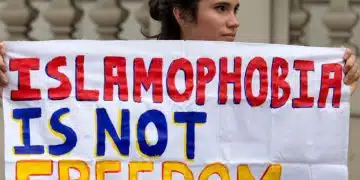
The protest began quietly. There was no spectacle, no attempt at provocation. Protesters gathered in the cold night air with placards, chants, and phone lights, attempting to draw attention to what they believed was a medical emergency unfolding behind prison walls. Qesser’s condition, as communicated by those in contact with her, was deteriorating.
Calls for an ambulance were repeated throughout the night and into the morning. Hours passed with no response. The protest was also attended by a Green Party peer, Baroness Jenny Jones, adding to the growing sense that the events at Bronzefield were being closely observed beyond the immediate protest.
This delay was not incidental. It reflected a more profound logic embedded in Britain’s carceral system, where incarcerated people, particularly women and migrants, routinely face medical neglect.
The refusal or failure to act swiftly transformed what should have been a routine medical intervention into a prolonged crisis. Protesters remained because the circumstances that brought them there had not been addressed. As the morning turned into early afternoon, police activity around the site intensified.
It was only in the early afternoon that an ambulance finally arrived. By this point, protesters had been present for around 12 hours. Exhausted but resolute, many believed their persistence had forced the authorities’ hand. Yet the arrival of medical assistance did not mark de-escalation.
Instead, as I witnessed directly, it coincided with a sharp and decisive escalation by the police.
Police activity increases
Almost immediately, officers moved to arrest Ayo, a junior doctor and the only Black person present at the protest. The arrest appeared arbitrary, unprovoked, and racially charged. There was no clear explanation given at the scene, nor did some visible act of violence precede it. What was evident, however, was the symbolism: the selection of a single body to isolate and serve as an example.
The arrest triggered chaos outside HMP Bronzefield.
Protesters responded instinctively, attempting to understand what was happening and to prevent what they saw as an unjust detention. Police reacted with force. Witnesses report that violence was overwhelmingly initiated and sustained by officers, not protesters.
People were pushed to the ground. The force deployed was grossly disproportionate, particularly given the demographic composition of those present, with a sizeable proportion of those present being women or disabled people.
At one point, an officer arrived at speed in an unmarked vehicle and drove aggressively into the protest area. Footage shows the car coming perilously close to a female protester, narrowly avoiding serious injury. The recklessness of the manoeuvre was striking.
Subsequently, the same officer was observed behaving in an openly antagonistic manner, repeatedly using unnecessary force and taunting the crowd. He repeatedly squared up to protesters, fixating on one man in particular, posturing and provoking rather than de-escalating.
His conduct bore little resemblance to the standards of restraint, professionalism, or neutrality expected of a police officer. Instead, it exemplified the personalised aggression that so often accompanies moments of unchecked authority.
The chaos continues
The image that emerged was stark: armed officers battering unarmed civilians whose only act had been to demand medical care for an incarcerated woman.
After Ayo was placed inside a police van, protesters regrouped outside HMP Bronzefield. Rather than dispersing, they formed a line directly in front of the vehicle. This act was deliberate and disciplined. It was not an attempt to free Ayo by force, but to halt the machinery of removal long enough to assert collective presence. The standoff lasted for hours, stretching into the late afternoon and early evening. The sun began to set. Tensions remained high, but the line held.
During this period, the police invoked Section 14 of the Public Order Act, imposing conditions on the protest and summoning reinforcements. Vans arrived. The police presence thickened. The implicit message was clear: compliance would be extracted, one way or another.
Eventually, negotiations took place. Protesters were told that Ayo would be taken to a nearby police station and released shortly thereafter. On the basis of this assurance, and in the face of an overwhelming police presence, the protest formally ended. People began to leave.
What followed exposed the hollowness of any claim that the police response had been about safety or order. Even as the crowd thinned, officers continued to harass individuals departing the area. The most egregious incident involved the arrest of a disabled man using a walking stick. He was accused of grievous bodily harm against a police officer.
The reality of what happened at HMP Bronzefield
Video footage of the HMP Bronzefield protest tells a different story. The man does not retaliate. He does not strike an officer. Instead, the footage shows an officer losing her footing after being pushed by another officer who was attempting to grab the disabled man. Nevertheless, he was still arrested. The inversion is telling: institutional violence is laundered through individual accusation, while evidence is disregarded.
This sequence of events reveals a pattern that extends far beyond HMP Bronzefield. First, care is withheld until pressure becomes unavoidable. Second, the moment of concession is paired with repression. Third, enforcement is selectively targeted. Finally, narrative control is asserted through charges that bear little resemblance to reality.
The arrest of Ayo cannot be understood in isolation, nor reduced to individual prejudice or error.
It belongs to a longer historical pattern in which British policing has functioned as a technology for managing populations deemed disorderly, excessive, or politically inconvenient, with racialisation operating not as an aberration but as a sorting mechanism through which authority is selectively asserted.
In the same way, the treatment of disabled protesters was not a breakdown of procedure but an expression of it: bodies marked as weak, slow, or non-compliant are routinely treated as expendable friction within an operational logic that prioritises control over care.
These outcomes do not arise from poor training or rogue behaviour, but from a system structurally oriented toward preserving the smooth circulation of state power by neutralising interruptions, translating collective challenge into individual culpability, and reasserting legitimacy through coercion once administrative responsibility has already failed.
A microcosm of the British state
What happened at HMP Bronzefield should be understood not as an isolated incident, but as a microcosm of the contemporary British state. A state that responds to demands for care with violence. One that sees solidarity as a threat. A state that polices protest not to preserve public order, but to preserve institutional impunity.
That protesters remained for over twelve hours, that they formed a line in front of a police van, that they refused to leave quietly even in the face of violence, speaks to something more profound than outrage. It reflects a growing recognition that the mechanisms meant to safeguard life and dignity increasingly operate in reverse. Where care fails, people intervene. Where institutions harden and ossify, people assemble.
The events at Bronzefield require scrutiny not merely of police conduct on the day, but also of the institutional conditions that made such an intervention necessary in the first place.
A prison system in which medical care must be externally enforced through prolonged physical presence and public confrontation has already failed in its most basic administrative function.
The relevant question, therefore, is not why people assembled in the early hours of the morning, but why the preservation of life within a state institution had become contingent on sustained pressure from outside it.
Featured image via the Canary


Leave a Reply