The Engineering of Vulnerable Lines
Tegart’s Wall and the Demographic Dilemma in the Upper Galilee (1925–1939)

Long before the contemporary landscape of concrete barriers and military zones reshaped Southwest Asia, colonial powers attempted to partition the Levant along lines that defied both human geography and physical terrain.
The northern frontier of Palestine, drawn by British and French cartographers, was not merely a diplomatic boundary; it became the testing ground for an early, catastrophic encounter between Zionist strategic ambitions, imperial panic, and the deep-seated demographic realities of the Upper Galilee.
Border Mirages and the Prelude of Blood in Jabal Amel
The demarcation of Palestine’s northern border following WWI was far from a mere engineering exercise to partition spheres of influence between Great Britain and France. It represented an early confrontation between the Zionist strategic vision and the enduring geographical and human realities of the Levant.
During the 1920 Franco-British negotiations, Dr Chaim Weizmann and his colleagues formulated their territorial demands primarily on economic grounds, specifically the control of vital water sources. Yet, military and security considerations heavily underpinned their perspective. The March 1920 Tel Hai incident, in which Joseph Trumpeldor was killed, constituted the very core of deep-seated Zionist security anxieties. While Zionists could not openly debate defensible terrain in the Upper Galilee – as Britain and France were formal allies – the issue of future national security was meticulously studied behind closed doors.
In November 1919, Colonel Richard Meinertzhagen, a staunchly pro-Zionist British Chief Political Officer, submitted a strategic border proposal to General Allenby. This proposal closely mirrored the Zionist approach to the “Deauville” proposal. Under the “Meinertzhagen Line”, Palestine’s northern defensive frontier would rest on the Litani River in the west and center, and along the high ridge dividing the Beqaa and the plains of Marj’ayoun in the east.
This line would have granted Palestine critical natural barriers to prevent future infiltration. Instead, London and Paris devised a fragile political border that proved easily penetrable by small armed groups almost whenever they pleased, owing to the complete absence of defensible natural obstacles.
An Oasis of False Calm and Omens of Sectarian Discord
Between 1924 and 1936, the frontier between Palestine and Lebanon entered a phase of profound tranquillity. The border was unfenced, virtually unguarded, and exceptionally peaceful. Amidst this superficial stability, earlier Zionist apprehensions regarding an indefensible border appeared obsolete, neutralized by close Franco-British relations and the flexible border arrangements of the 1926 “Good Neighbourly Relations” agreement. The Levantine border posed no significant trouble to either mandatory power, and crossing it remained a natural part of local economic life.
Despite this deceptive calm, South Lebanon witnessed unsettling events that carried omens of future misfortune for the region. These events concerned the arming of a local Christian militia in 1925 and its military employment against its Arab Muslim surroundings by the French Mandate authorities.
Commenting on these events, historian Stephen Longrigg warned that the result would never produce reliable substitutes, but would rather:
spoil the future by feeding grudges and sometimes vendettas between Christians and Muslims, from which the former had suffered in the past.
This crisis erupted when a violent Druze rebellion against France spread across the border into South Lebanon.
After occupying Hasbaya, Druze rebels advanced into Christian towns like Kawkaba and Marj’ayoun. Facing a critical military shortage in the south, the French colonial administration exploited traditional Maronite animosity towards the Druze by arming Christian villagers. The rebellion in Lebanon eventually collapsed when the Druze failed to seize Nabatieh and Rashaya, but the social scars cut deep.
South Lebanon’s Christians viewed the Druze incursion not as a political assault on France, but as a direct armed attack on their community. While rebels initially hoped for a “friendly Christian neutrality,” the violence perpetrated in Kawkaba rendered it impossible. Though the uprising never touched Palestine, it reinforced the tendency of the Christian minority on the Lebanese side to view politics through the lens of communal survival, legitimizing communication with non-Arab forces to secure assistance against other Arabs.
Furthermore, France’s employment of untrained Christian volunteers backfired, leading to the early loss of Marj’ayoun – a political disaster that exposed the futility of relying on sectarian militias.
By calling upon one community to take up arms against another, the Mandate authority intensified traditional blood feuds, working directly against its charter to educate populations in partnership toward self-governance. The events of 1925 confirmed the isolation of the Christian minority in South Lebanon, foreshadowing its ultimate collaboration with subsequent Israeli efforts to secure the northern border.
The Palestinian Flame and the Collapse of Tegart’s “Fence”
If the Druze rebellion provided crucial social lessons, escalating tensions between Zionism and Arab nationalism inside Palestine soon altered operational conditions along the border entirely.
In April 1936, a series of armed Arab revolts erupted in Palestine, driven by a desire for national independence and fear of the Jewish Nation. This Arab revolt garnered overwhelming popular sympathy in neighbouring states, rapidly transforming adjacent geographical zones into staging grounds and safe havens for resisters.
Within Lebanon, Bint Jbeil gained notoriety as the area
most widely used for the passage of aid, men, and material to the resisters.
Powerless to halt smuggling across an open border, British authorities appealed to French officials for urgent assistance. At this strategic juncture, the British discovered – as the Zionists would three decades later – that an effective military defence of Palestine had to begin deep within South Lebanon, because the political border was inherently exposed to infiltration from the north.
Equally, the British discovered that the authorities in Beirut were not keen to offer genuine help. A contemporary report noted that British efforts to obtain French cooperation failed because the French had surrendered too many administrative details to the Syrian and Lebanese states, whose sympathy with Palestinian nationalists and fear of internal backlash prevented them from taking action. France had no desire to ignite a new rebellion in an exhausted Syria, while Lebanese authorities preferred to ignore the exploitation of their southern regions to avoid provoking Arabist sentiments within their nascent state.
This stance compelled the British to act unilaterally. “Unofficial” retaliatory incursions were launched against Arab villages across Lebanese territory by Zionist gangs (Haganah), under the leadership and training of British Officer Orde Wingate. These raids served as a tactical school that helped future Israeli military commanders overcome reservations regarding the violation of Lebanese sovereignty.
In 1937, Inspector-General of the Palestine Police, Roy Godfrey Bullen Spicer, proposed sealing the land borders with physical barriers. Initially deferred due to cost, the accelerating deterioration of security brought the idea back in 1938, upon the recommendation of Sir Charles Tegart, security advisor to the Palestine government. His proposal was formally accepted on 1 May that year.
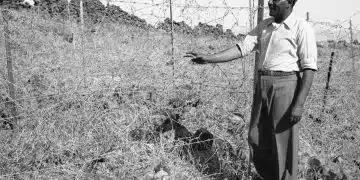
A contract worth £90,000 was awarded to the Zionist-affiliated Soleh Boneh company in Haifa to build an engineered barrier along Palestine’s borders with Lebanon, Syria, and Transjordan. Along the Lebanese frontier, specifications demanded a barrier of two or three thick barbed-wire fences, with the gaps packed with tangled concertina wire. Guarding was conducted via existing border posts alongside additional pillboxes built in sensitive pedestrian crossing zones. Before completion, the structure became known colloquially as “Tegart’s Wall”.
Built in haste during May and June 1938 to prohibit the movement of individuals, the wall failed catastrophically. Instead of enhancing security, it transformed into a flashpoint that spread rebellion throughout the border zone. Arab villagers on both sides united in a violent campaign against the wall and the British security forces trying to guard it. The fence provoked the wrath of the villagers because it severed shared agricultural lands, interfered with customary grazing routes, and erected an artificial barrier to centuries-old trade.
Controlling the constant sabotage became so difficult that a special force of 800 rural mounted police was deployed at the end of June. However, this force was no match for the fury of the Lebanese and Palestinian locals, compelling the authorities to impose suffocating curfews on Arab villages in the Acre and Safad districts, though to little avail given the intensity of the resistance.
Lessons of Geography and Interconnected Ethnicities
These disastrous consequences prompted Great Britain to redouble political pressure on France to finally agree to dispatch one thousand personnel – comprising four squadrons of mounted cavalry and two mechanised cavalry squadrons – to patrol the Lebanese and Syrian borders.
Though belated, this joint effort succeeded in temporarily impeding raids. Ultimately, however, it was political manoeuvres and British concessions to Arab demands in the White Paper of 1939 – rather than extraordinary security measures – that restored relative calm. Tegart’s Wall was swiftly dismantled due to its futility and the inability of forces to protect it from destruction.
Zionist military thought emerged from the experience of Tegart’s Wall with three fundamental lessons that shaped its future strategy:
- Zionist anxieties regarding the geographical deficiencies of political borders were validated; British sovereignty and lines drawn on paper were insufficient security guarantees against a northern frontier penetrable at every point. This reinforced the dogmatic dimension in Zionist thinking, which viewed the Litani River as a security imperative – acting as a formidable, natural defensive barrier – rather than merely an economic asset for water.
- It became evident that the ethnic and demographic homogeneity of the border region’s population rendered security control impossible. During the 1930s, Arabs constituted approximately 90% of the population of the Safad district and 99% of Palestinian Acre – holding 82% of the land in the former and 97% in the latter until 1944 – whereas the total Jewish population in both districts did not exceed 10,000 by 1946. This cross-border familial interconnectedness exposed an enduring security nightmare for Zionism: unless this ethnic homogeneity was broken by expelling the population or replacing them with a different population possessing an alternative national loyalty, no non-Arab authority in Jerusalem would ever succeed in effectively sealing the northern border.
- The utilisation of Lebanese territory as a safe haven, coupled with the initial absence of cooperation from Beirut, provided a lesson for the future. Britain was incapable of penalising Beirut due to its nominal alliance with France, but the future Zionist state would find no embarrassment in adopting retaliatory policies and devastating offensive military operations within Lebanese territory when confronting Arab resisters – an approach that rapidly crystallised with the outbreak of the WWII.
Featured image via Flashbak
Leave a Reply