
Netpol protest policing report reveals ‘How Repression Became Routine’

On 25 March, police monitoring group Netpol released its annual protest report. Building on the foundation of the 2024 report ‘This is Repression’ — the latest version is entitled ‘How Repression Became Routine’ (2025). What’s more, it makes for chilling, but sadly familiar, reading.
The Canary sent Skwawkbox out to report on the launch event itself. You can read his article here, which also serves to introduce the report. Likewise, you can read the full report here.
In this article, we’ll take a bit of a closer look at the report itself, along with its main findings.
Core findings
With the 2024 report already having concluded that Britain exists in a state of repression, Netpol stated that:
Between July 2025 and February 2026, Netpol conducted in-depth qualitative research within protest movements, drawing on interviews, testimonies, legal observer notes, court records, police and government data, media coverage and 21 Freedom of Information requests.
Our findings show that repression has become routine in British protest policing: new and overlapping laws, combined with a growing tendency to treat protest as a security issue, have normalised surveillance, heavy-handed policing, and punishment, with harm concentrated on marginalised groups. Protest is increasingly policed as a matter of threat management rather than democratic expression.
Netpol produced the 2025 report with the help of the Article 11 Trust. Back in 2020, the charity was set up with the aim of defending the rights to freedom of assembly, as set out under Article 11 of the European Convention on Human Rights.
The 2025 report broke its core findings down into five overarching points:
- Officers are exercising powers beyond and ahead of gaining the lawful authority to do so.
- The police are using layered legislation to confuse and control protestors.
- Security logics now dominate protest policing.
- The restriction of protests has spread out over a wider geographical area.
- The gap in police accountability is widening.
Power beyond authority
The new report highlighted the fact that police forces, and especially the Met, have made unlawful use of their powers. More specifically, they’re exercising powers like ‘cumulative disruption’ conditions before they’ve even passed through parliament.
Police already have powers to impose conditions on protests that cause “serious disruption to the life of the community”. These were put in place by the Public Order Act 1986.
However, the forthcoming Crime and Policing Bill proposes to amend this to allow police to consider ‘cumulative disruption’, ie. the effect of repeated protests. This would effectively allow officers to treat multiple minor protests in the same manner as larger ‘disruptive’ protests.
Netpol stated that it had seen evidence suggesting that:
these trailed powers are already being used, despite provisions not yet having been passed into law. In May, for example, the Met used Public Order powers to block International Jewish Anti-Zionist Network (IJAN) protests, citing the ‘cumulative impact’ of weekly protests. Similarly, in
November, the Met forced Palestine Solidarity Coalition (PSC) to change the route of its planned march, citing the “cumulative effect of [PSC] protests”.
Likewise, the report also found that police continued to use powers even after they’d been appealed. In particular, the monitoring group cited police use of the repealed ‘more than minor’ threshold for serious disruption.
Layered legislation
Next up, the police abuse of layered legislation. Forces across the country have access to a wide array of powers granted by multiple pieces of legislation. Officers are using these layered powers to confuse and control protesters – and also to maximise their intelligence gathering and data capture.
The report explained that:
Because these powers overlap, it is often unclear which rules apply and why, even before any enforcement action takes place.
As a case study, Netpol cited what it called the “34-60aa-50-35 dance”. This was a specific and targeted weaponisation of layered legislation noted by legal observers in Bristol. In sequence, it goes:
-
Section 60aa (Criminal Justice and Public Order Act 1994) requires the removal of face coverings and creates a pretext for stopping people without reasonable suspicion
-
Section 34 (Anti-social Behaviour, Crime and Policing Act 2014) provides authorisation for police to disperse protesters for up to 48 hours, effectively criminalising protesters for assembling once deemed as ‘likely’ to cause disorder. This, in turn, sets the precedent for the steps that follow.
-
Section 50 follows, criminalising non-compliance and providing an easy arrest mechanism while also acting as an intelligence-gathering model which allows police to identify movement actors.
-
Section 35 (Anti-social Behaviour, Crime and Policing Act 2014) is then evoked, allowing the police to clear out protesters once data collection has been completed.
Security logics
Chillingly, the report also found that national security and counterterrorism logics are now embedded in routine protest policing. This means that authorities are framing dissent is framed as an existential security threat. These ‘exceptional’ concerns allow them to ‘justify’ the use of repressive tactics.
Netpol stated that:
We have seen the unprecedented application of counter-terrorism legislation – in particular, the Terrorism Act 2000 – largely in response to Palestine solidarity protest, including to proscribe direct action group Palestine Action.
This legislation was ostensibly drafted to tackle extreme threats to national security. However, we’re now regularly seeing it weaponised against demonstrators going about what was once ordinary protest activity.
Even the National Security Act 2023 is now being used against protesters and journalists, marking the even greater application of national security powers against political dissent.
Geographical spread
Across Britain, the use of powers to restrict assemblies shot up by 230% over 2024 – 2025. What’s more, where this repression was once largely limited to London (and the Met), it’s now spreading.
In part, this is a reflection of the fact that the protest landscape itself is seeing a lower proportion of large-scale national marches. Instead, “sustained, local and site-based assemblies” are dominating the scene.
Until March 2025, the Met was the only force to impose wholesale restrictions on marches. However, this year’s restrictions on assemblies were far less localised. The report explained that:
This pattern indicates the widening geographical spread of public order policing through restrictions placed on static and sustained protests outside weapons factories, local government buildings and hotels homing refugees.
Widening accountability gap
Finally, whilst police powers have grown in number and scope, there’s been no corresponding growth in accountability. Instead, the public’s powers to scrutinise and restrain the police have grown weaker. Legislative and policy changes are also undermining accountability and routes to redress policy repression.
Meanwhile, pre-emptive approaches to policing are on the rise, enabled by vast surveillance networks. By its nature, these pre-crime tactics are opaque and difficult for the public to scrutinise.
Likewise, the danger for journalists and legal observers – the people documenting police repression – is increasing. This reduces accountability by eroding methods of evidence collection. The report stated that:
We spoke to one legal observer who had been stopped by the police on fabricated charges, noting that
police harassment had forced them to take a step back in 2025, while another was arrested at the national PSC demonstration in January 2025.We have also received a number of reports of police violence against legal observers, ranging from being caught in kettles, to being pepper sprayed, to being shoved into objects and vehicles. One legal observer told us that they no longer give too much thought to being pushed by police due to experiencing this kind of force as a regular occurrence over the summer of 2025.
Conclusion
Whilst the findings of the report detailed a chilling escalation of repressive policing, Netpol took care not to end on a hopeless note. Rather, they emphasised the fact that the public is resisting, and we have not yet given up—and the movement is growing:
Despite the trends identified in this report, repression has not yet silenced dissent. Instead, solidarity with protest movements throughout 2025 strengthened, with steadfast resilience shown by those protesting for Palestine and communities defending themselves against far-right and anti-migrant demonstrations.
Crucially, the ability to protest has been upheld by those who build and sustain the infrastructures of resistance, amid depleted resources and increasingly complex legal and political environments. However, with the passing of another year, the stakes of exercising the right to protest have once again increased. It is vital that we reject the idea that repression is inevitable before the dwindling space to dissent disappears.
The UK government, and the police along with them, have built a state in which repression has become routine. However, the public has—time and time again—met them head-on. The state is witnessing first-hand that we cannot be legislated into submission, and that we will not let go of our rights and freedoms without a fight.
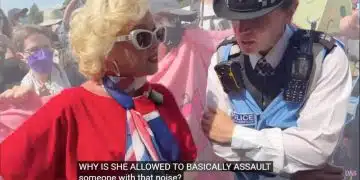
Featured image via the Canary


Comments 1
Leave a Reply








Facts prove UK is now a fascist state owned and controlle by the boy dictators currently residing at number 10 and Parliament! The police are thugs routinely committing male violence against peaceful protesters and of course these boy police thugs are not being charged with assault!
‘National security’ is now the common excuse fascist Starmer and his zionist/fascist cronies cite as justification for persecution and denial of our rights! ‘National security’ should mean no individual male political or political party has the right to impose draconian laws restricting/denying female and male citizens’ rights to hold the so-called ‘elected’ politicians to account!