Scotland sticks wi’ SNP: making sense of Holyrood’s election results

From the perspective of an England-based, Westminster-weary journalist with family ties to the country, Scotland’s political culture often feels like a breath of fresh air.
There are a number of once-commonplace issues and policies that still resonate strongly in Scotland, which are considered somehow beyond the pale in Westminster: free university tuition; free prescriptions; accessible and affordable public transport; etc.
Thatcher’s ghost surfaces in conversations to this day (“she stole our oil and gas and sold it off to her mates,” I was told at a Glasgow Southside bus stop). Brexit lingers for many as evidence of the divergent aspirations of Scots from those to their south.
That the SNP emerged and consolidated its power as a soft-left, progressive party with social democratic and sovereigntist principles should perhaps not surprise too many. After all, it displaced a much-despised, Blairite-Mandelsonian Labour Party.
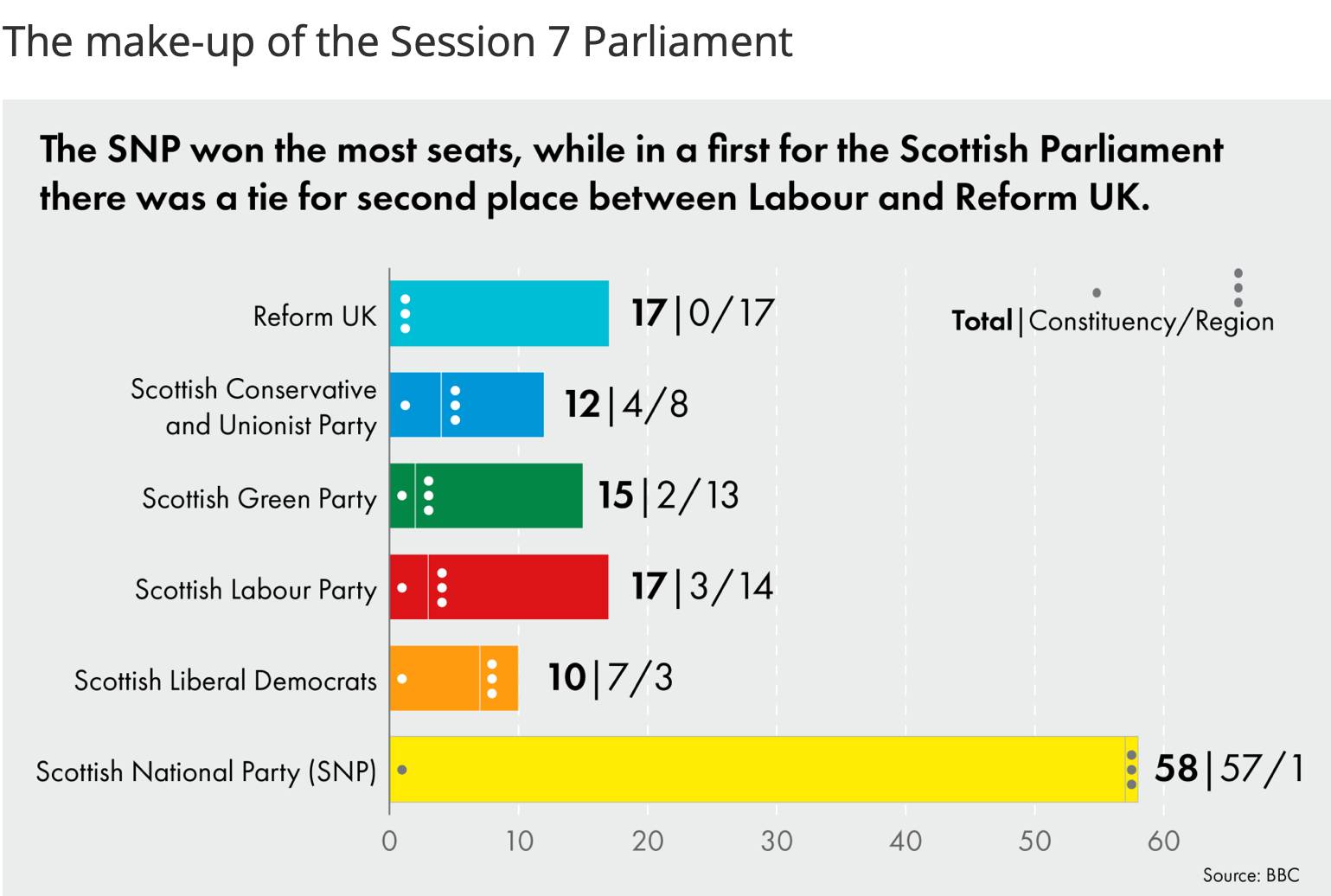
What is more surprising is that they’ve now managed to secure five consecutive terms. It’s the first since John Swinney took over after a tumultuous post-Sturgeon period for the party and Humza Yousaf’s apparently directionless leadership.
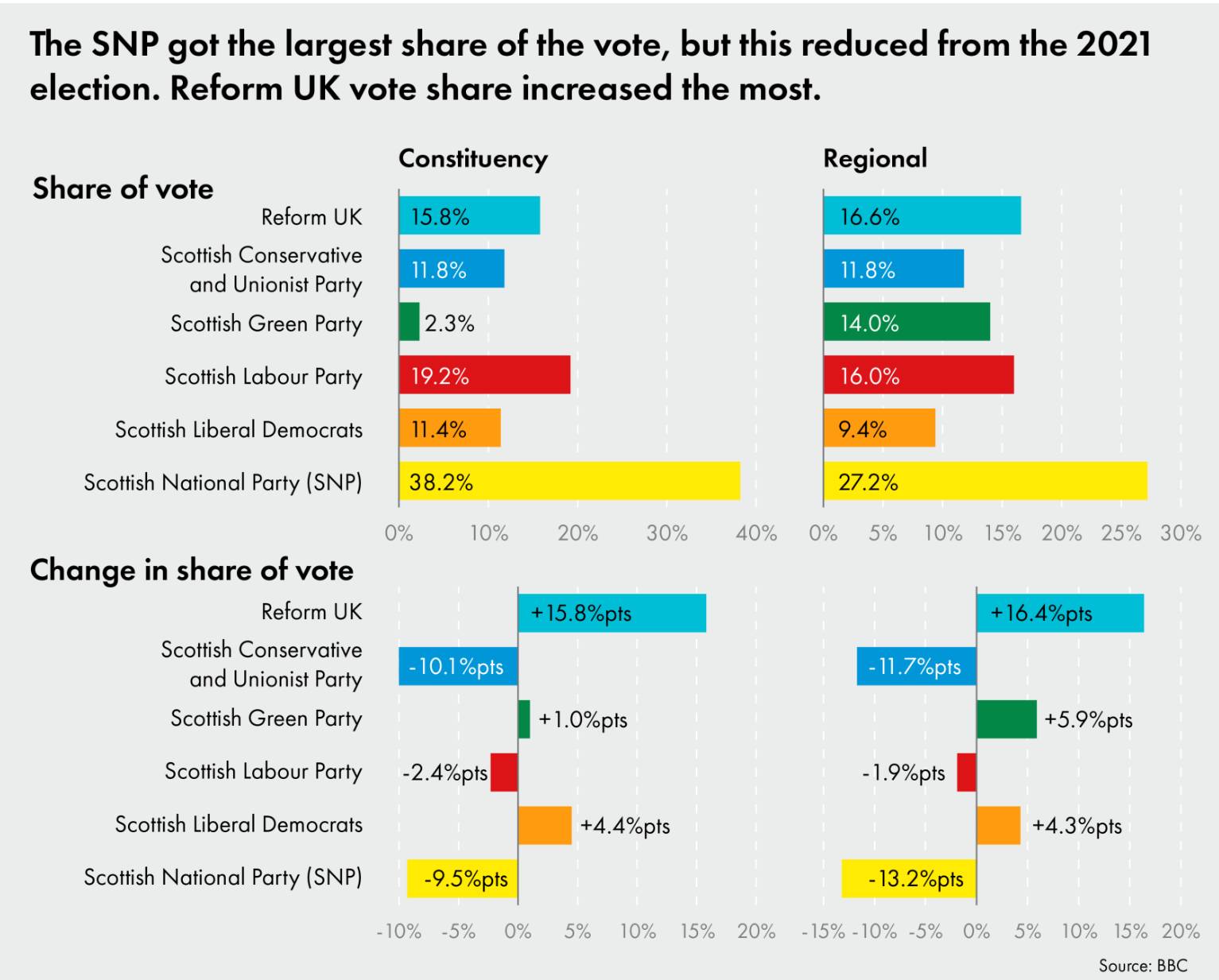
All the same, the SNP are down six seats on 2021 and voter turnout was only 53.4% — a full 10% drop since 2021 — signalling some dissatisfaction with the status quo.
As expected, other previously marginal parties are making big changes, while the Tories haemorrhaged support and Scottish Labour struggled to cling on.
Fracturing political dynamics
The most impressive result is unavoidably Reform’s jump from 0% to around 16%. While it’s not likely that Reform stand any serious chance of being in power in Scotland, nor working with an SNP-led government, their aggravating presence will doubtless be felt.
It’s likely that a good many of Reform’s votes came from the Tory party, which lost well over half of its vote share, from 28 seats down to 12. Anas Sarwar’s Scottish Labour lost fewer seats but now find themselves jointly in 17 seats each with Reform.
SNP and Green sources told me that they feared Reform securing second place, so their tie with Labour will appear better than some people on the left had feared.
Speaking of whom, the Greens come in shortly behind both Labour and Reform, with now 15 seats (almost doubled, up from 7) and their first-ever constituency MSPs.
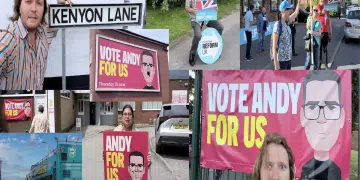
These include Nicola Sturgeon’s old seat, Glasgow Southside, now Green, with a strong win for Holly Bruce MSP. Southside voters reacted with “wonderful” and “great news” when I broke this to them.
Another greens win
Another constituency win came for Lorna Slater MSP, who ousted senior SNP figure Angus Robertson in Edinburgh Central. Slater previously signalled to the Canary that the SNP might be harder for Greens to work with than as previously in 2021.
Slater told the Canary that the SNP need Greens “holding their feet to the fire” in order to keep them on a more progressive, climate-friendly and anti-austerity direction.
Under the no-punches-pulled direction of Ross Greer, a digital native not unlike his southern colleague Zack Polanski, Slater and co will consistently lobby for bread-and-butter issues. Slater is laser-focused on:
…helping people with really immediate matters: like getting their benefits, like housing, like [supporting local cricket club], like getting to the gym, or on assisted dying, on trans rights, on getting towards a greener economy for a fairer Scotland…
She’s also committed to environmental “changes that will last for generations,” such as urgent net-zero policies and bringing back beavers after four centuries of extinction.
Next steps for Scotland
SNP ex-councillor, now-Edinburgh Eastern MSP, Kate Campbell told the Canary that questions around independence felt less prominent on doorsteps as compared with two years ago. Rather, multiplying cost-of-living crises occupy people’s strongest daily concerns.
Nonetheless, Campbell explicitly stated that SNP leader John Swinney plans on making immediate moves towards another referendum. This would be supported by the pro-independence Greens if they were to enter into another agreement as in 2021.
Swinney has previously said that an independence referendum could happen as soon as 2028. However, he is apparently willing to rule as a minority government, potentially forestalling such matters for now.
Following these results and the SNP’s fifth consecutive mandate, Swinney demanded “greater respect” from Starmer’s Labour and the wider Westminster regime.
Alongside the Brexit result, over a decade after the 2014 Indy-Ref, demographic shifts alone are likely aiding the pro-independence cause, with older, pro-union voters passing away. SNP sources privately tell the BBC that Reform also helped split the unionist vote.
It’s clear that Greens are drawing away some disillusioned progressive voters from the SNP, which has made the compromises of most established political party, including on climate and NHS privatisation.
All the same, former Westminster MP and Holyrood hopeful Tommy Sheppard told the Canary that the party is committed to sovereignty and internationalism and that:
… there is a broad, social-democratic consensus within the party.
What matters now is whether Sheppard’s values will be replicated in the party’s policies and alignments.
Featured image via author


Leave a Reply