
A note reveals exactly why the Julian Assange extradition case is based on lies

A handwritten note by WikiLeaks founder Julian Assange that simply says “emergency” could prove pivotal in demonstrating how deceitful the prosecution is in its determination to extradite him to the USA. The note features in film footage and reveals how certain charges against Assange are highly questionable. In doing so, it exposes the fragility of the extradition case.
This assessment is backed by another film that includes rare footage of Assange inside the Guardian’s ‘bunker’.
Warning issued
During the extradition hearing, overseen by Judge Vanessa Baraitser at Belmarsh magistrates’ court in London, the prosecution alleged that by publishing unredacted secret US cables Assange had put lives in danger.
However, there is a very different narrative to that.
Political commentator and former UK ambassador Craig Murray attended the extradition hearing and published a summary. He observed that barrister Mark Summers QC for the defence explained how Assange and award-winning journalist Sarah Harrison warned the US State Department that they needed to act as lives were at risk:
Once Der Freitag [a weekly German magazine] announced they had the unredacted [US cables] materials, Julian Assange and Sara [sic] Harrison instantly telephoned the White House, State Department and US Embassy to warn them named sources may be put at risk.
Film footage backs that up.
The film, the note, and the phone call
A video extract from 2011 (and featured in the flawed 2017 film Risk) shows Harrison phoning the State Department to tell them they had a problem. But during the phone call it was apparent the official at the other end wasn’t taking the warning seriously. At that point Assange dramatically held up a handwritten note to Harrison, urging her to explain that the situation was an emergency, it also suggests that he felt a meeting was needed.
This is how it played out:
The extradition hearing was provided with further details of what happened on that day. Murray explained:
In 2011 WikiLeaks also issued a statement about the phone call to the State Department:
Murray observed how the evidence submitted to the extradition hearing about that phone call to the State Department:
Passphrase published
But the controversy about the unredacted US cables and where blame lies doesn’t end there.
In 2011 Guardian journalists David Leigh and Luke Harding published a book, WikiLeaks: Inside Julian Assange’s War on Secrecy. The book provided a passphrase to the unredacted US cables.
The passphrase Leigh and Harding disclosed featured prominently in a chapter heading of the book:
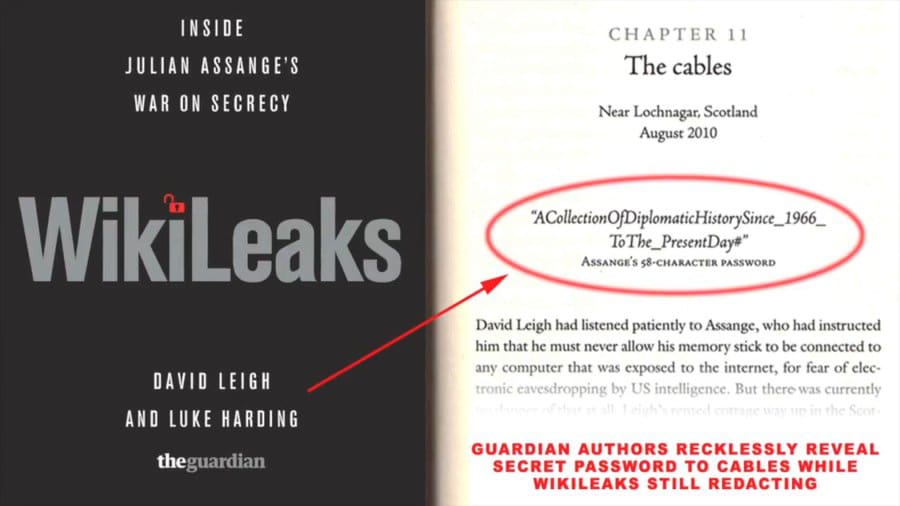
It’s worth mentioning that Harding was also co-author of a Guardian article that claimed Paul Manafort, Donald Trump’s former campaign manager, met with Assange at the Ecuadorian embassy in London. In an exclusive, The Canary went on to report the claim that the story was false.
Denial
In response to our last article on the Assange extradition case, Leigh has insisted that allegations the defence had made against him at the extradition hearing in regard to the publication of the password were “complete invention”.
He told The Canary:
The Guardian statement he referred to was penned by former WikiLeaks journalist turned critic James Ball. It denied that Leigh and Harding bore any responsibility for the security breach:
It’s nonsense to suggest the Guardian’s WikiLeaks book has compromised security in any way. Our book about WikiLeaks was published last February. It contained a password, but no details of the location of the files, and we were told it was a temporary password which would expire and be deleted in a matter of hours.
It was a meaningless piece of information to anyone except the person(s) who created the database.
No concerns were expressed when the book was published and if anyone at WikiLeaks had thought this compromised security they have had seven months to remove the files. That they didn’t do so clearly shows the problem was not caused by the Guardian’s book.
Denial challenged
However, in a 25 February 2020 tweet WikiLeaks editor-in-chief Kristinn Hrafnsson made it clear that he strongly disagreed with those claims:
David Leigh again dismisses his responsibility for the release of the unredacted cables. He posted a password for its encrypted file – in his book. Now claims Assange told him the password was temporary. Leigh himself writes in his book about a temporary WEBSITE. Not the same. pic.twitter.com/e1q9GUdDlg
— Kristinn Hrafnsson (@khrafnsson) February 25, 2020
Murray also observed that during the extradition hearing the defence:
The defence further pointed out that WikiLeaks had a comprehensive ‘harm mitigation program’, used to redact names from leaked documents prior to publication.
Moreover, it was claimed, at the 2013 court-martial of whistleblower Chelsea Manning, that the documents regarding US war crimes Manning had allegedly leaked (and which were subsequently published by WikiLeaks) had put lives at risk. But those allegations were dismissed after considering the evidence US counter-intelligence official Robert Carr submitted.
WikiLeaks also accused Leigh of compromising Manning:
Leigh, without any basis, and in a flagrant violation of journalistic ethics, named Bradley Manning as the Cablegate source in his book.
Inside the Guardian’s bunker
But there’s more evidence that supports the defence’s narrative on the redaction of material by Assange.
Award-winning Australian journalist Mark Davis shows how Guardian journalists appear to neglect any responsibility for redaction of the Afghan war logs. Instead, they left that task to Assange, who, according to Davis, spent several days and nights seeing to that.
The footage [15:00 on] is very revealing:
Prosecution case challenged
It would appear that both the prosecution and Judge Baraitser are lacking in their knowledge of what happened with the US cables and the precise circumstances that led to the publication of the unredacted version.
Indeed, far from risking lives, as alleged, there seems to be clear evidence via the video – with that revealing note – that Assange went to great lengths to protect them.
So either the prosecution did not do its homework, or potentially it deliberately tried to mislead the court. One way or another, the truth is coming out.
Featured image via YouTube / video

Comments 1
Leave a Reply







I believe the Guardian statement is comprehensively taken down here:
“Later that day (1st September 2011), the Guardian decided the most effective method of defence against the damage their reputation would receive over David Leigh’s gross negligence would be to blame WikiLeaks for his actions:
The Guardian, 1st September 2011: Unredacted U.S. Embassy cables available online after WikiLeaks breach, by James Ball
“A security breach has led to the WikiLeaks archive of 251,000 secret US diplomatic cables being made available online, without redaction to protect sources. WikiLeaks has been releasing the cables over nine months by partnering with mainstream media organisations. Selected cables have been published without sensitive information that could lead to the identification of informants or other at-risk individuals. The US government warned last year that such a release could lead to US informants, human rights activists and others being placed at risk of harm or detention.
A statement from the Guardian said: “It’s nonsense to suggest the Guardian’s WikiLeaks book has compromised security in any way. “Our book about WikiLeaks was published last February. It contained a password, but no details of the location of the files, and we were told it was a temporary password which would expire and be deleted in a matter of hours. It was a meaningless piece of information to anyone except the person(s) who created the database. No concerns were expressed when the book was published and if anyone at WikiLeaks had thought this compromised security they have had seven months to remove the files. That they didn’t do so clearly shows the problem was not caused by the Guardian’s book.”
https://www.theguardian.com/world/2011/sep/01/unredacted-us-embassy-cables-online
This Guardian statement posing as an article is deliberate nonsense. The Guardian could have checked whether the ‘passphrase’ was expired on their own Cablegate files. They could have simply asked WikiLeaks whether it was safe to publish it. They could even have checked the facts printed in their own newspaper. In an article entitled ‘Julian Assange answers your questions’ published in the Guardian on the 3rd December 2010, Julian Assange responded to one reader’s question: “The Cable Gate archive has been spread, along with significant material from the U.S. and other countries, to over 100,000 people in encrypted form. If something happens to us, the key parts will be released automatically.” So much for David Leigh’s claim that the Guardian wasn’t to know the ‘files’ were still online when he published his book. Perhaps he should have checked his own newspaper first? Further, as James Ball knows, once a file has been ‘released’ as a torrent, it cannot be ‘recovered’. The file can be spread and hosted anywhere and its torrent file used to locate and disseminate it. That James Ball would suggest otherwise is astonishingly dishonest and presupposes that his readers have an extremely limited knowledge of file sharing technology, to say the least.
“On a basic security level, revealing any information about how Julian Assange formulates his passwords could have implications in any of the other myriad of sensitive areas WikiLeaks deals with. Any files encrypted by Assange at the same time – or before – the cables, and in the possession of any entity hostile to WikiLeaks, are now more vulnerable since Leigh’s book gave up its clue about how Assange formulates passwords. And anyone who has access to the original file David Leigh was given, could now decrypt it. Unless the original file was carefully protected throughout its entire life, decrypted and unzipped, then destroyed after the data was released, that password will work on copies of it for ever. So regardless of how David Leigh & Co. imagine computer security works – and right now they are desperately trying increasingly ridiculous arguments to blame WikiLeaks for Leigh’s actions – there’s no reason to publish any password this sensitive – ever.”
Nigel Parry, 31 August 2011
A 10th September 2011 Economist article states “Mr Assange’s file management looks sloppy, but Mr Leigh’s blunder seems bigger: since digital data is easily copied, safeguarding passwords is more important than secreting files.” In the comments section David Leigh finally admits that the ‘passphrase fiasco’ was his fault after all, while still blaming Julian Assange:
“Yes, I understand the archive with z.gpg somewhere in it was posted by Assange or his friends in an obscure location around 7 December 2010, the day Assange was arrested for alleged sex offences. No-one told us this had been done [Julian Assange had told Leigh’s newspaper and its readers precisely that information 4 days previously]. Assange apparently re-used the password he gave me earlier (although the file title – z.gpg – was different.) Obviously, I wish now I hadn’t published the full password in the book. It would have been easy to alter, and that would have avoided all these false allegations. But I was too trusting of what Assange told me.””
https://marthamitchelleffect.wordpress.com/2013/04/05/part-1-redactions-and-propaganda/