
Untied Kingdom: anti-unionist parties take power across the Celtic nations

Is 8 May set to become a future independence day? This week’s results could truly signal the beginning of the end for our century-old plurinational state: ‘the United Kingdom of Great Britain and Northern Ireland’.
While many nervously watch the sweeping successes of one nationalist party across England’s council wards, three others are equally, if not more, significant.
In Scotland’s Holyrood elections, the Scottish National Party (SNP) has held onto power for an impressive fifth term under John Swinney’s direction. This improves on a sorer set of 2024 Westminster election results, where many anti-Tory voters swung Labour.
In an even more historic set of Welsh Senedd election results, pro-sovereignty Plaid Cymru have displaced unionist Welsh Labour in their century-old heartland. Labour’s collapse could be regarded as the deepest blow yet for the once-hegemonic party.
While there was no voting in the North of Ireland this week, the anti-unionist Sinn Fein party has been in power since 2024.
That now unifies the three Celtic nations in a jointly predominant mandate for the end of the United Kingdom as we’ve always known it. (The Telegraph‘s writers already fear for their “precious union”.)

Sail away Scotland?
Ever since displacing Labour’s twentieth-century dominance across most of Scotland in 2011, the SNP have remained the nation’s de facto ruling party.
Their success today, while not as overwhelming as their near-unanimous 2015 victory, likely signals the continued relevance of the constitutional independence issue.
From speaking with people across Edinburgh, Glasgow and South Scotland, ensuring that Reform remain far from power certainly motivated many voters.
But Starmer’s Labour is widely, perhaps equally, off-putting for many Scottish voters. These include Scottish Labour leader Anas Sarwar himself, who has repeatedly told Starmer to resign.
These facts, plus the fact that incumbents of all forms typically suffer electorally whereas the NSP now takes its fifth continuous term, suggest that the national question therefore remains on the ballot paper.
SNP ex-councillor, now-Edinburgh Eastern MSP, Kate Campbell told the Canary that questions of independence felt less prominent on doorsteps compared with two years ago. Rather it’s the cost-of-living crisis occupying people’s strongest worries.
Nonetheless, she explicitly stated that SNP leader John Swinney plans on making immediate moves towards another referendum. Swinney has previously said that an independence referendum could happen as soon as 2028, but he is apparently willing to rule as a minority government, potentially forestalling such matters.
The major obstacle, however, remains the UK Supreme Court’s decision in 2022 to veto or block even the possibility of another Scottish referendum on secession.
Following results, Swinney demanded “greater respect” from Starmer’s Labour.
Wave goodbye Wales?
Mere months ago, the question of Welsh independence rarely featured in mainstream discourse. That can no longer be said — it’s now an unavoidable matter.
Remarkably, in a country only ever run by Labour across all levels for a century, Welsh Labour leader Eluned Morgan was forced to resign after losing her seat.
More evidence that Labour are incapable of making any serious case for having better odds at taking on Reform. Plaid Cymru demonstrated that this task falls to them.
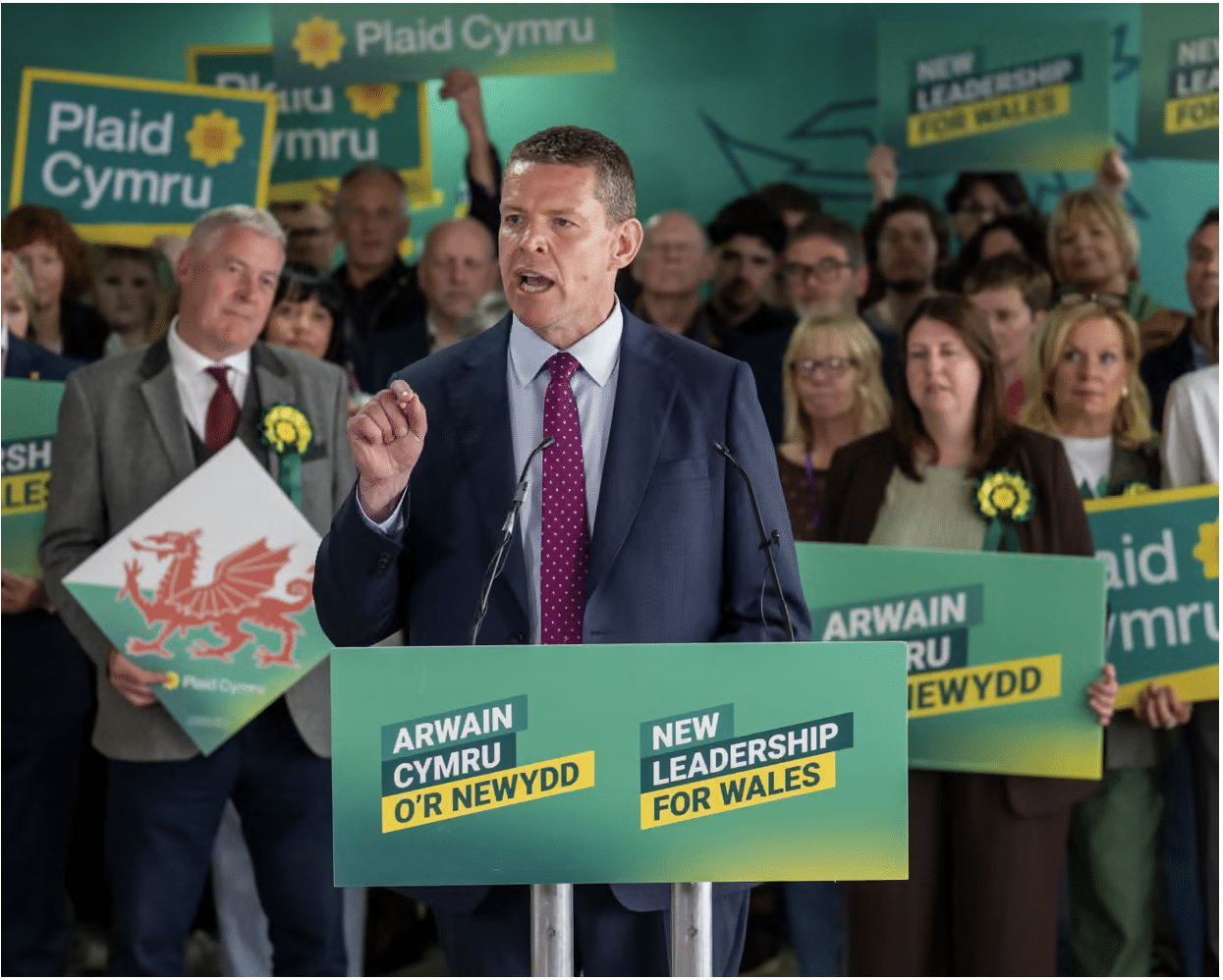
Plaid Cymru leader Rhun ap Iorwerth stated that “a new dawn beckons” for Wales as he gave his first speech since upending Labour’s power.
However, unlike in Scotland where the SNP could work with Greens for a majority in many issues of state, Plaid face a tough decision.
Plaid could be looking at ruling as a minority power, by just six seats out of 96. The only non-Reform parties with enough votes to join them are Labour or the Tories, since Greens elected only two MS’s — albeit impressively up from zero. The Welsh Lib Dems have only one MS.
That leaves Plaid, for now, in the position of probably having to choose a pro-unionist partner on its right to pass laws. This likely delays the question of national sovereignty.
Further, similarly to Scotland, Wales does not currently possess even the hypothetical right to vote on the matter of its independence. For many, this fact alone signifies the democratic imbalance at the heart of the present situation, driving calls for at least having the right to choose.
Yet the Welsh devolution settlement is also less expansive in powers than either Holyrood or Stormont. This latter fact could lead Plaid into a reformist stance and pushing for greater devolution, rather than the separatist stance of a Celtic revolution.

Now for ‘Northern Ireland’?
It’s hard to think of a more momentous moment in the North’s relations with the rest of the United Kingdom since the Good Friday peace agreements three decades ago. (Unless Brexit.)
Ratified into the Agreement is the constitutional option of a referendum, as often as every seven years, should an undeniable democratic consensus make it possible.
Sinn Fein have made the question of reunification with the Republic a major matter of pressing political debate. It remains an eventual party goal, as stated in the adoption of the 1916 Proclamations against British rule in Ireland and towards reunification
The SNP’s John Swinney has previously met with Sinn Fein leader Michelle O’Neill and vowed to work together to “irreversibly change” the UK’s constitutional settlement.
The Belfast Telegraph reported that O’Neill previously refused to comment, but still insisted that momentum is building towards Irish unity.
She stated in late April that a poll for secession is “very conceivable.” Now O’Neill has called these results a moment of “seismic change in politics.” She told Reuters:
I don’t think there can be any clearer sign that Westminster’s time is coming to an end for the people here and the people in Scotland and Wales.
United Kingdom — Centuries of English dominance
Many across the Celtic nations doubtlessly believe that their peoples have lived under the English yoke for too long. First in the form of serfly subordination; more recently in an intractable democratic deficit, despite varying degrees of devolution.
Arguably, the Welsh were the first to undergo English colonisation, centuries ago. Still, they retained their language more than any nation and a strong identity with it.
The Scots long resisted repeated English invasions, but the Scottish King James VI/II on the English throne in 1722 solidified Scotland’s position in a British Empire. Highland clearances and persistent inequalities make clear this was never on equal terms.
The Irish suffered Cromwell’s early empire, which led to the catastrophic imposition of trade dependence and eventually to the mass-starvation of the 1800s’ Great Famine(s). They later fought the long, ongoing occupation of the northern six counties.
United against the Kingdom?
Given this history, it’s no surprise that there are longstanding — if previously latent — anti-unionist sentiments. The question now, is whether historical grievance, unique national identities and cultures, and democratic deficits are enough to push those forward.
Perhaps what could emerge in coming years is a Celtic union against the Union: a tri-national push to break up the British state and devolution system as we know it.
The answer to that could depend, partly, on the soaring English nationalist party of the moment. While Reform UK are unlikely to ever be a governing force in Scottish politics, they could soon be a second-place party. In Wales, they are now the opposition.
England’s current obsession with Faragism might make the case for one type of union stronger: a union of Celtic independence factions. They might not have the mandate they need right now, but as England pulls one direction, we can expect some reaction.
In unison, the pro-sovereignty argument could be made louder and clearer. They are natural allies after all, with a common enemy in the Westminster-led centralist model.
Whether the scattered millions will unite against the present regime remains to be seen.


Comments 1
Leave a Reply









It would be so good if all of the different nations in the UK decided to leave the UK. It would mean that there would be no chance of continuing holding onto nuclear weapons or a permanent seat in the Security Council of the United Nations, among other things.
Just imagine if independent Wales and Scotland were readmitted to the European Union before England, lol. Presumably if Northern Ireland becomes part of Eire they will not need a new arrangement, it will automatically happen with reunification.