• Donate
  • Login
Friday, June 5, 2026
  • Login
  • Register
Canary
Cart / £0.00

No products in the basket.

MEDIA THAT DISRUPTS
  • UK
  • Global
  • Opinion
  • Skwawkbox
  • Manage Subscription
  • Support
  • Features
    • Health
    • Environment
    • Science
    • Feature
    • Sport & Gaming
    • Lifestyle
    • Tech
    • Business
    • Money
    • Travel
    • Property
    • Food
    • Media
  • SHOP
No Result
View All Result
MANAGE SUBSCRIPTION
SUPPORT
  • UK
  • Global
  • Opinion
  • Skwawkbox
  • Manage Subscription
  • Support
  • Features
    • Health
    • Environment
    • Science
    • Feature
    • Sport & Gaming
    • Lifestyle
    • Tech
    • Business
    • Money
    • Travel
    • Property
    • Food
    • Media
  • SHOP
No Result
View All Result
Canary
No Result
View All Result
  • Editorial
  • Explainer
  • Global
  • Opinion
  • Environment
  • Feature
  • Food
  • Health
  • Science
  • Skwawkbox
  • UK

Using delicate cycle for everyday laundry can release more microfibres, study says

The Canary by The Canary
26 September 2019
in Environment, Other News & Features, UK
Reading Time: 4 mins read
166 7
A A
0
Home Other News & Features Environment
Share on FacebookShare on TwitterShare on BlueskyShare via WhatsAppShare via TelegramShare on Threads

Using a delicate cycle for everyday laundry is causing hundreds of thousands of extra microfibres to be released into our water systems and end up in the sea, scientists have found.

Although regular washing cycles cause clothes to be bashed together and create more friction between garments, they use less water than gentler programmes which agitate the garments less, they said.

Researchers at Newcastle University found that it is the volume of water used, rather than the spinning action in the drum, which is the key factor in plucking the tiny plastic particles from man-made material.

Millions of plastic microfibres are shed every time we wash clothes that contain materials such as nylon, polyester and acrylic.

Because these fibres are so small, they drain out of the back of the washing machine and can ultimately enter the marine environment, where they can be ingested by animals and end up in our food chain.

Two years ago, Newcastle University scientists showed for the first time these fibres have now reached the deepest parts of our ocean.

PhD student Max Kelly, working with Procter & Gamble’s Newcastle lab, measured the release of microfibres from polyester clothes from a range of different cycles, temperatures and water volumes.

Counting the fibres released, they found the higher the volume of water the more fibres released, regardless of the speed and abrasive forces of the washing machine.

Using a hi-tech camera, they counted 1.4 million fibres from a delicate wash of a polyester garment, 800,000 when a normal cotton wash was used and 600,000 from a cold express programme.

Kelly said: “Counter-intuitively, we discovered that ‘delicate’ cycles release more plastic microfibres into the water, and then the environment, than standard cycles.

Scientists check clothes in washing machine
Max Kelly (left) and marine microbiologist Professor J Grant Burgess check clothing in a washing machine (Owen Humphreys/PA)

“Previous research has suggested the speed the drum spins at, the number of times it changes spinning direction during a cycle and the length of pauses in the cycle – all known as the machine agitation – is the most important factor in the amount of microfibre released.

“But we have shown here that even at reduced levels of agitation, microfibre release is still greatest with higher water volume-to-fabric ratios.

“This is because the high volume of water used in a delicate cycle which is supposed to protect sensitive clothing from damage actually ‘plucks’ away more fibres from the material.”

Consumers should make sure they are using the correct cycle for their laundry and avoid washing half loads so there is not a high volume of water to garments.

Dr Neil Lant, a research fellow at P&G who worked on the project, said: “People thought quite intuitively that a delicate wash cycle would reduce loss of fibres because the fibres are rubbing against each other less.”
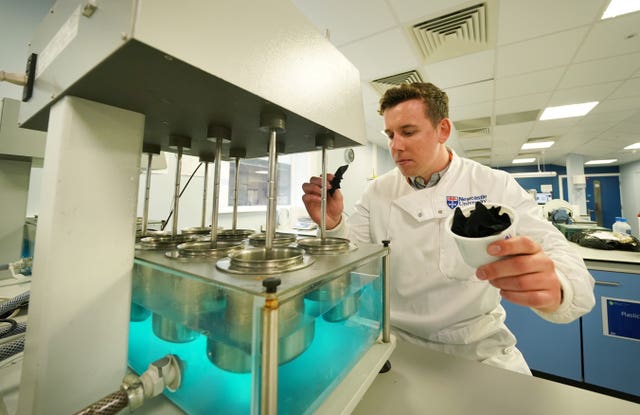
Max Kelly adds segments of material to a laboratory controlled ‘mini’ washing machine
Max Kelly adds segments of material to a laboratory controlled ‘mini’ washing machine (Owen Humphreys/PA)

He said garments from natural fibres such as wool or silk should still be washed on a delicate programme.

Washing machine manufacturers have developed microfibre filters to catch the mini-pollutants before they are released into the water system while the textile industry has worked on reducing fibre shedding.

Marine microbiologist Professor Grant Burgess said it was thought the microfibres can clog the digestive systems of tiny animals that ingest them.

He added: “Some of these fibres can attract pollutants and toxic chemicals which stick on to the fibres.

“They can act as concentrators of other toxic pollutants and act as a carrier of these nasty chemicals.”

The findings have been published in the journal Environmental Science and Technology.

Tags: pollution
Share128Tweet80ShareSendShareShare
Previous Post

Boris Johnson just spoke such sickening words in parliament, even Kuenssberg recoiled in horror

Next Post

Amazon widens Alexa’s reach despite ongoing privacy concerns

Next Post
Amazon widens Alexa’s reach despite ongoing privacy concerns

Amazon widens Alexa’s reach despite ongoing privacy concerns

PM wrong to use Jo Cox’s name in that way, says sister of murdered MP

PM could refuse to answer London Assembly questions on links to Jennifer Arcuri, says Tory Party chairman

Blackpool

Authorities in north of England still contain highest proportion of deprived neighbourhoods, report shows

Benjamin Netanyahu

Human rights group slams Israeli state's 'apartheid' practices amid post-election chaos

Leave a Reply Cancel reply

Your email address will not be published. Required fields are marked *

Sánchez
Skwawkbox

Sánchez must act against Spanish police after brutal attack on pensioner protester

by Skwawkbox
4 June 2026
Composite image showing Andy Burnham, Count Binface and Rob Kenyon in front of a street scene in Makerfield
Opinion

Count Binface Makerfield manifesto would stitch up Burnham

by John Ranson
4 June 2026
Starmer
Analysis

Starmer finds his backbone as he stands up to Elon Musk “interfering in our politics”

by Maddison Wheeldon
4 June 2026
Coutinho
Analysis

Shadow equalities minister wants any explanation other than racism for Black maternal deaths

by Alex/Rose Cocker
4 June 2026
Reform UK councillor Tom Pickup
Uncategorized

Reform promotes councillor linked to genocidal WhatsApp group

by Willem Moore
4 June 2026

The Canary
PO Box 71199
LONDON
SE20 9EX

Canary Media Ltd – registered in England. Company registration number 09788095.

For guest posting, contact [email protected]

For other enquiries, contact: [email protected]

Complaints and Corrections

About the Canary

Meet the Team

© Canary Media Ltd 2026, all rights reserved | Website by Monster | Hosted by Krystal | Privacy Settings

Ok

Create New Account!

Fill the forms below to register

All fields are required. Log In

Retrieve your password

Please enter your username or email address to reset your password.

Log In
  • UK
  • Global
  • Opinion
  • Skwawkbox
  • Manage Subscription
  • Support
  • Features
    • Health
    • Environment
    • Science
    • Feature
    • Sport & Gaming
    • Lifestyle
    • Tech
    • Business
    • Money
    • Travel
    • Property
    • Food
    • Media
  • SHOP
  • Login
  • Sign Up
  • Cart