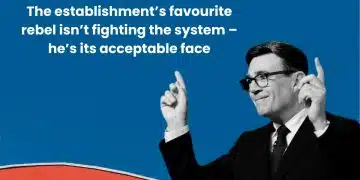
Clive Lewis beautifully explains how public ownership is common sense

In unsurprising news, on 30 November, rail companies announced their now annual fare hike. This will see fares increase by 3.1% from 2 January 2019.
In the wake of the announcement, one Labour MP had a simple solution for soaring fares. Appearing on Radio 4’s Any Questions, Clive Lewis made the case for taking the railways back into public ownership.
“Cost-neutral”
On the show, one audience member asked a crucial question in the wake of the fare rise:
Catastrophic delays and huge fare increases – surely our rail services should be nationalised?
And Lewis was clear in his belief that they should be. He also explained how this is affordable:
Let’s look at costs first of all. What we’ve said in the Labour Party is that you can move it back into public ownership by actually waiting until each franchise comes up and then moving it back under government control. So it’s cost neutral. That’s the first thing – it’s not unaffordable.
New models of public ownership
Lewis then explored what public ownership of our railways might look like in practice:
So the issue here is that there are lots of different models. And we don’t have to keep looking back to a model which may not have worked to the best of its ability back in the 1970s and so on. We can look to different models of ownership – ones which have perhaps the passengers, the government and the people who actually work on the rail all having a share in that.
He continued by explaining how public ownership might differ in other sectors too:
I’ll give you an example: community energy. And this is the thing. We’re entering into the 21st century – new technologies, community energy. We know that energy in the future will be decentralised, it can also be democratic. We can all have a share. Because wind farms, solar energy, solar batteries and the batteries that can store that energy, it can be done at a local level. Your whole community could have access to that solar power. You could have a return from that. It doesn’t have to be controlled by either a big state operator or by a private company. We could all have a share in that.
The bigger picture
But Lewis didn’t stop there. Instead, he also explained the opportunities public ownership can provide in tackling wider problems in society:
I think this opens up a bigger debate, about where in the 21st century we as a country want to go. What we’ve seen in this country is runaway wealth from the very wealthiest – the 1% in this country – who increasingly earn a bigger and bigger share, while the rest of us are left to scrabble around for a smaller pie. It’s in part why we’re in the problem; we’re having the problems we are with Brexit because people don’t feel that this country is working for them. So this is a part of a bigger story about who actually earns the wealth of this country – the majority or the minority – and I think that’s what this is about.
And elsewhere, he made a clear, simple and common sense case for public ownership:
We all contribute to our economy; we all work in this economy. We all use the trains, we all drink the water, we all breathe the air, we should all have a say, all have a part of that. That’s what it’s about – a different way of looking at the economy.
Mass public support
Despite decades of privatisation, support for public ownership in the UK is very high. Research commissioned by the Legatum Institute in 2017 revealed that 83% of the public support bringing water companies into public hands. It also found that over 70% of people support public ownership of railways, electricity and gas.
A survey conducted by YouGov in 2017 found similarly high support for public ownership.
Public opinion is firmly on the side of bringing services back into public hands. And with Labour now making the case for public ownership too, the tide is turning against the privateers.
Featured image via sasastro – Flickr

Leave a Reply