After seven years of Conservative government, several UK regions are now the poorest in Northern Europe

Seven years after Conservative Prime Minister David Cameron promised “We’re all in this together”, the only two regions of the UK that have gained are London and the South East. The UK’s 10 other regions are poorer, and some are now the poorest in Northern Europe.
The sick man of Europe
No one wants this label. Originating in the 19th century, it is applied to a European country enduring economic instability and poverty. Despite media reports that Britain’s inequality gap is closing, a range of economic reports from the last few years suggest that Britain is the sick man of Europe. And the responsibility rests with the ideological austerity programme pursued by successive Conservative-led governments.
In 2014, the Inequality Briefing found that, of the 10 poorest areas in Northern Europe, all but one were in the UK.
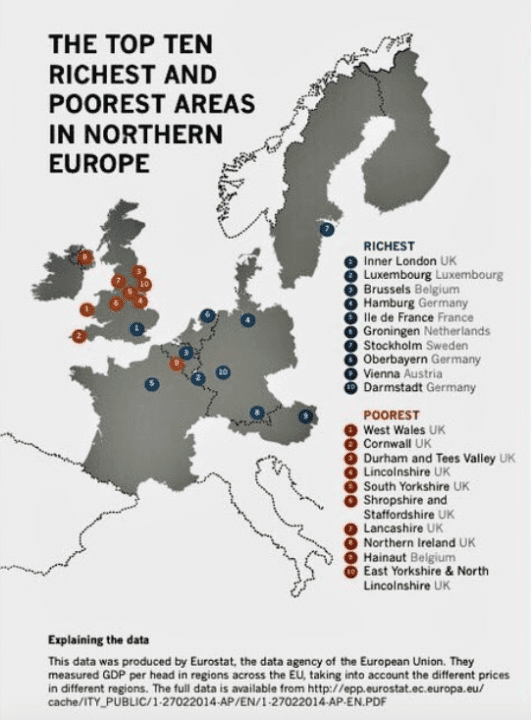
While London was the richest city in Northern Europe, no other UK cities featured in the top 10.
This matches up neatly with analysis prepared by the Bank of England. In June 2016, Chief Economist of the Bank of England Andy Haldane gave a talk in Port Talbot, Wales, entitled Whose Recovery?. During the talk, he shared a most revealing image illustrating the inequality of the UK economic recovery.
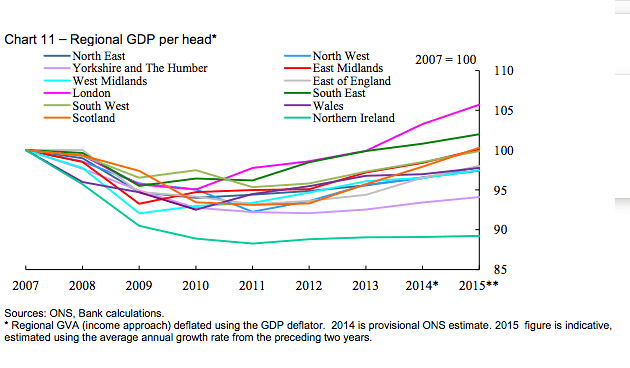
Only two regions of the UK are wealthier today than before the 2007 financial crisis. Most are poorer, and regions like Northern Ireland and Yorkshire and the Humber have seen their wealth plummet. But they haven’t just plummeted relative to their own past. They have also sunk to the bottom of the European league tables.
By the Summer of 2017, the Bank of England was warning that Britain faces a personal debt mountain. While wages have risen only 1.5% in the last year, personal debt has grown by a staggering 10%. As living costs rise and wages fall in real terms, cash-strapped members of the public are turning to lenders as a last resort to stay afloat.
How did we get here?
While the banking sector created the financial crisis, it was the public who paid the price. And they paid three times over.
First, with the bank bailout. According to the National Audit Office, the UK government spent £850bn of public money on the bailout. Based on 2009-10 spending levels, this was 1.2 times the annual UK budget. It would have funded the entire NHS (£100bn a year) for eight years, or the whole jobseekers’ allowance bill (£3.68bn a year) for 230 years. This massive injection of public money saw both the budget deficit and national debt explode.
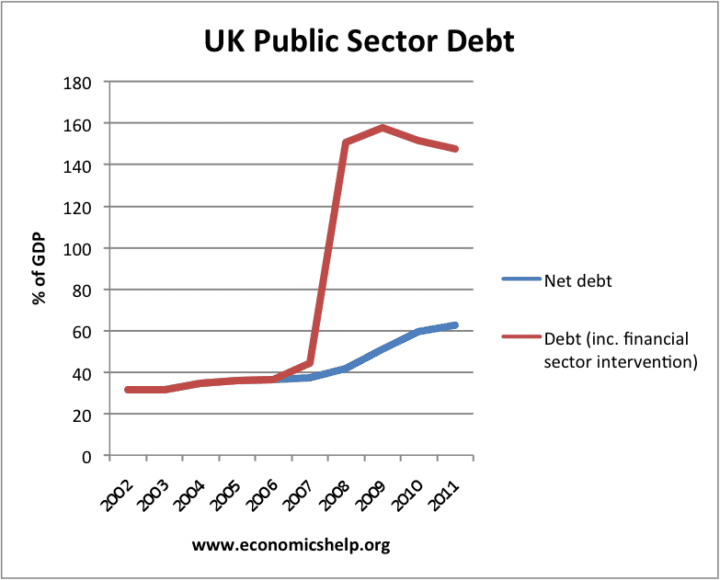
Second, the blame for the financial crisis was shifted from the private sector to the public sector. The deficit was blamed on excessive public spending by New Labour, even though the graph above shows this was clearly untrue. Austerity was implemented, public services and welfare were cut dramatically. By 2015, around 400,000 public sector workers had lost their jobs. By 2017, the use of food banks by Britons too poor to feed themselves had risen 2,792%.
And third, the public paid with wage cuts. The Conservative Party has pushed relentlessly for what it calls ‘pay restraint’ in the public and private sector. This led to the 10% pay cut reported by the Trades Union Congress (TUC). But this pay restraint was not distributed equally. During that same period, executive pay actually rose by 10%. While the average worker scraped by on £27,600 a year, the average executive is earning £5.5m.
And billionaires also saw their incomes rise. In 2010, the richest 1,000 people in Britain shared a combined wealth of £335.5bn. By 2017, that had rocketed to £658bn.
Accelerated inequality
The UK’s inequality problem did not begin with the Coalition government in 2010. Successive governments have accelerated inequality over the last 30 years.
But the financial crisis, and the reaction to it by business and government, has put wealth inequality on steroids.
The poor are getting poorer, and the rich are getting richer. That’s not a campaign slogan. It’s a fact.
Get Involved!
– Sign the petition of no confidence in a Conservative/ DUP coalition. Make your thoughts on the deal known. Contact your MP and be vocal on social media.
– Organise! Join (and participate in the activities of) a union, an activist group, and/or a political party.
– Join The Canary, so we can keep holding the powerful to account.
Featured image via YouTube Screengrab