
More lies and distraction from Boris Johnson with his latest comments on coal

As reported by The Canary, Boris Jonson’s shameful comments about coal pit closures in the 1980s have outraged people. Johnson has also refused to apologise for those comments.
But given the deep hurt Thatcher caused by closing the pits in the 1908s, and the undercover police tactics used to target union members, it’s hard to believe a UK prime minister wouldn’t be aware of how inflammatory such a comment would be. Not to mention the fact that Thatcher did nothing to deliver quality jobs for those miners after the pits closed.
Additionally, it’s hard to believe a prime minister could claim the UK is moving “away from coal” – especially when the UK has continued to import coal. According to Tory Fibs on Twitter:
UK continued to import 11 million tonnes of coal 30 years after Thatcher closed the coal mines.
Boris Johnson incorrect to claim her decision was linked to environment.
— Tory Fibs (@ToryFibs) August 6, 2021
And while the transition away from coal hasn’t come quickly enough, it has come at the expense of workers and their communities.
Johnson’s nonsense coal claims
Government figures show that while consumption of domestically-mined coal fell, consumption of imported coal increased. And this was long after the Thatcher years. So while Thatcher closed coal pits and devastated communities, she didn’t end the UK’s dependency on coal:
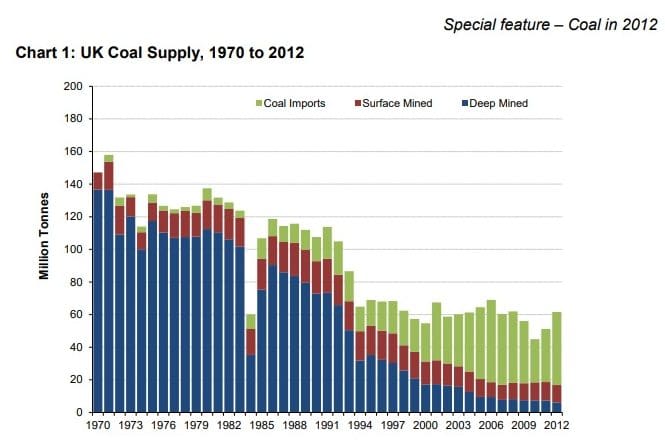
Furthermore, data shows that while “coal has become less used as a fuel for electricity generation”, the UK still imported 6.5m metric tonnes of coal in 2019.
It’s sadly too familiar
But nonsensical claims from Johnson are sadly something we’ve become accustomed to, and not just on the environment. And as pointed out by Labour MP Dawn Butler, some of his claims are just outright lies. As a result, Butler wants parliament to change so MPs can call Johnson out on his lies. Moreover, lawyer and film-maker Peter Stefanovic has been relentless in exposing Johnson’s dishonesty.
Stefanovic’s video on Johnson’s “rampant lying in Parliament” now has over 30 million views. At the start of that video, he exposes Johnson on the environment. Johnson claims successive Tory governments since 2010 cut CO2 emissions (since 1990) by 42%. This is untrue according to Stefanovic. The real figure is a reduction in CO2 emissions by 39% between 1990 and 2018:
30 MILLION VIEWS!!
Working TOGETHER we have sent a powerful message to UK News shows if they won’t hold this Prime Minister to account for his rampant lying in Parliament we will do it ourselves!
How long can you ignore it @BBCNews?
pic.twitter.com/PlvEkEij1V— Peter Stefanovic (@PeterStefanovi2) August 5, 2021
Meanwhile independent fact-checking site Full Fact couldn’t confirm if Johnson’s statements were ‘lies’. However, it did note that he hadn’t corrected any of those errors.
Because it’s hard to believe Johnson could be unaware of the impact of his outbursts, it leaves you thinking that these outbursts might be calculated:
Boris Johnson knows Thatcher didn’t close the mines for climate change.
So why say it?
Distraction.
Ignore the dead cat, follow the whiff of corruption. Something is afoot.
— Kerry-Anne Mendoza 🏳️🌈🍉 (@TheMendozaWoman) August 6, 2021
COP 26 and the Tories’ environmental position
The UN climate change conference (COP 26) takes place in Glasgow in November 2021. So Johnson’s apparent understanding of the UK’s reliance on fossil fuels is, to say the very least, worrying. Assuming of course he’s not lying.
In reality, the Tories seem to have a jittery relationship with coal. Communities secretary Robert Jenrick’s change of position on the extraction of coking coal in Cumbria highlighted this. Initially, Jenrick didn’t want to intervene in Cumbria County Council’s decision to proceed with a coking coal mine. But then, two months later, he announced a public inquiry into the plans.
Furthermore, as extensively outlined in articles by The Canary‘s environment writer Tracy Keeling, the UK is failing its wildlife and is in denial about the climate crisis.
Johnson’s lying?
Any prime minister’s lack of awareness of, or insensitivity to, the devastation coal pit closures caused in the 1980s makes them unfit for office. So too does a weak position on the environment and a questionable relationship with the truth. And incessant as that relationship is, it must never stop us calling it out and calling for radical change.
Featured image via Wikimedia Commons – EU2017EE Estonian Presidency & Unsplash – Ma Ti




Comments 4
Leave a Reply









The closing of the mines was to destroy the National Union of Mineworkers and associated trade unions, such as those in transport. The unions were forcing governments to redistribute power and wealth more widely in the community. So, the clique which has always run Westminster and the state, decided to destroy them. Mr Nicholas Winterton’s memoirs make this clear. This war – and it was a civil war – against the miners, coupled with anti-TU laws and privatisations, were to disempower the majority of us and give it to the financial and landowning clique. Brexit was part of this strategy.
Johnson is behaving with triumphalist contempt to the general public.
Beautifully put, thank you.
Now we await the thousands of annual deaths from cold and malnutrition from those Pensioners who gave their whole working lives to keep the home fires burning.
Johnson turns my stomach every time he opens his privileged mouth.
You forgot to mention that Harold Wilson closed the vast majority of the mines.
In light of what we supposedly know about climate change now, are you seriously suggesting they should have stayed open? Until the left can stop acting like rebellious student activists, they’re destined to stay irrelevant, impotent and out of power.
Thatcher’s attack on the mining industry was as unjustified as it was mistaken; the miners did not bring the Heath giovernment down, it brought itself down. The country voted against the Tories, disgusted by the non-stop series of exposures of moral and financial corruption of the Tory Party; remember the Poulson, Maudling (The Real Estate Fund of America), Birmingham, Slater Walker and Lonrho financial scandals, and the Norma Levy, Lord Lambton, Lord Lucan moral scandals; the 1970-74 Tory government made the government of Macmillan (of Profumo, John Vassall and John Bloom notoriety) look like a model of probity by comparison!