The DWP just quietly revealed tribunals are overturning most of the Universal Credit sanctions they see

On Tuesday 15 May, the Department for Work and Pensions (DWP) released its figures for benefits sanctions up to January 2018. But buried in the statistics is the figure for the outcomes of people who appeal a Universal Credit sanction decision. The figures show that tribunals rule that 83% of sanction decisions they assess are wrong.
The sanctions regime
The Money Advice Service says sanctions occur when:
Benefits… [are] stopped or reduced (cut) if you don’t do the things you agreed to do in your claimant commitment or if you miss appointments or meetings.
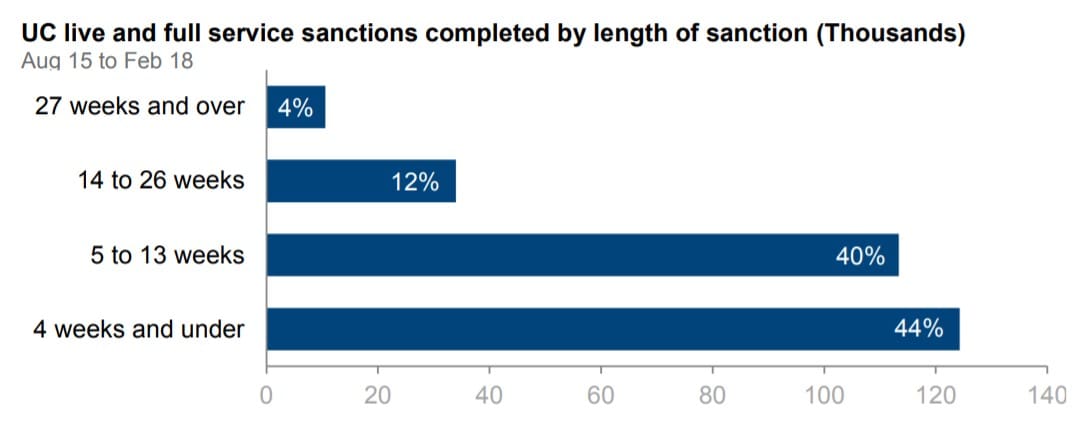
In its headline document [pdf], the DWP showed [pdf, p1] that, in February 2018, 4.1% of Universal Credit claimants were sanctioned, which is a fall on previous months. Also, [pdf, p7] 44% of sanctions lasted less than four weeks, and 40% lasted between five and 13 weeks:
The DWP’s figures also showed [pdf, p9] that, since 1 August 2015, the majority (66%) of people who were sanctioned stayed on Universal Credit for 180 days after the sanctions. In other words, if sanctions are an incentive to try and get people off benefits, then they aren’t working.
Between 1 August 2015 and 31 January 2018, the DWP applied 442,198 sanctions [xls, table 3_3, row 39, column AH]. Of these, 66% were due to a claimant’s “fail[ure] to comply with an interview requirement”. It does not give any more detail on what this means. But as the Haringey Law Centre points out [pdf, p17]:
Remember that some of these claimants may be people with irregular health concerns which could coincide with a scheduled date for an interview.
An even more worrying figure, however, is buried in the DWP spreadsheet [xls].
The DWP: increasingly wrong
If claimants think the DWP has wrongly sanctioned them, they can ask it to look at the decision again. This is called a mandatory reconsideration. If, after this decision, a claimant still doesn’t agree, they can go to an independent tribunal which will look at the case and decide (an appeal).
Between 1 August 2015 and 31 January 2018, 29% of Universal Credit mandatory reconsiderations ended in the sanction decision being overturned [pdf, p4]. But look into the data not contained in the headline document, and it shows the number of sanctions that tribunals overturn.
In short, independent tribunals have overturned 83% of the DWP’s sanction decisions, when claimants have appealed [xls, table 3_6, row 39 columns H-J].
The numbers of mandatory reconsiderations and appeals where a sanction is overturned are low: 21,736 and 1,067 respectively [xls, table 3_6, row 39, columns F and J].
A DWP spokesperson told The Canary:
We’re committed to ensuring that people receive the benefits they’re entitled to, but it is reasonable that people have to meet certain requirements in return.
Sanctions are only used in a very small percentage of cases when people fail to meet their agreed commitments to look, or prepare, for work.
When sanction decisions are overturned it’s very often because new evidence is provided during mandatory consideration or appeal.
But as the Child Poverty Action Group has pointed out:
The process of mandatory reconsideration and appeal can be daunting and lengthy…
A culture of subservience
Is the length and anxiety of the process putting claimants off challenging sanction decisions? Many would probably tell you anecdotally that the answer to this is ‘yes’. But when tribunals are overturning such a high percentage of sanctions, it’s concerning.
How many DWP sanctioned claimants who don’t appeal have actually been punished incorrectly?
This article was updated at 2.50pm on Wednesday 16 May to reflect a statement from the DWP.
Get Involved!
– Support Disabled People Against Cuts (DPAC) and the Mental Health Resistance Network, fighting for disabled people’s rights.
Featured image via DPAC and UK government/Wikimedia