• Donate
  • Login
Friday, June 5, 2026
  • Login
  • Register
Canary
Cart / £0.00

No products in the basket.

MEDIA THAT DISRUPTS
  • UK
  • Global
  • Opinion
  • Skwawkbox
  • Manage Subscription
  • Support
  • Features
    • Health
    • Environment
    • Science
    • Feature
    • Sport & Gaming
    • Lifestyle
    • Tech
    • Business
    • Money
    • Travel
    • Property
    • Food
    • Media
  • SHOP
No Result
View All Result
MANAGE SUBSCRIPTION
SUPPORT
  • UK
  • Global
  • Opinion
  • Skwawkbox
  • Manage Subscription
  • Support
  • Features
    • Health
    • Environment
    • Science
    • Feature
    • Sport & Gaming
    • Lifestyle
    • Tech
    • Business
    • Money
    • Travel
    • Property
    • Food
    • Media
  • SHOP
No Result
View All Result
Canary
No Result
View All Result
  • Editorial
  • Explainer
  • Global
  • Opinion
  • Environment
  • Feature
  • Food
  • Health
  • Science
  • Skwawkbox
  • UK

Finally, an answer to those annoying interruptions that kill your productivity

Lucy Goodchild van Hilten by Lucy Goodchild van Hilten
5 December 2015
in Science
Reading Time: 3 mins read
168 6
A A
0
Home Other News & Features Science
Share on FacebookShare on TwitterShare on BlueskyShare via WhatsAppShare via TelegramShare on Threads

Isn’t it annoying when you’re in the zone, working on something really tricky, when your phone vibrates or you notice a popup email notification in the corner of your screen? These kinds of interruptions cost us our concentration and pull us out of our flow. Wouldn’t it be great if there was a way your devices knew when to leave you alone?

Researchers from the University of New South Wales have developed something that can do just that – by analysing the way a person’s head nods.

Wearable technology can tell us how active we are, monitor how well we sleep and tell us when we have a meeting coming up. Effectively, with a laptop, smartphone and smart watch, we’re always online and always connected.
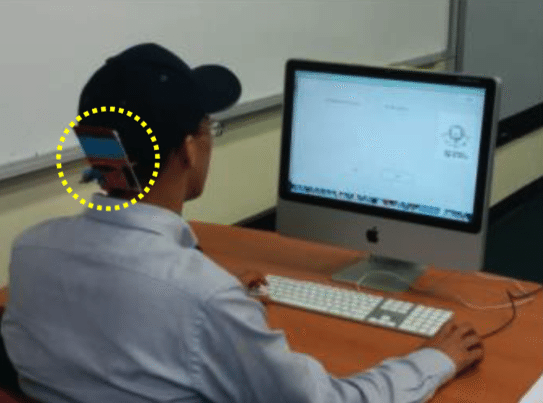
Activity-tracking device
Dr. Epps’s prototype can be used to track head movements. Photo credit: Robert Makepeace.

Although this can be beneficial and save us time, it can also make a huge dent in our productivity. According to interruption expert Prof. Gloria Mark, a break in our flow can cost us huge amounts of time. She told Fast Company:

We found about 82 percent of all interrupted work is resumed on the same day. But here’s the bad news — it takes an average of 23 minutes and 15 seconds to get back to the task.

Dr. Julien Epps, who created the new device, wanted to develop something that could tell all our other devices when to keep quiet and when it’s safe to interrupt us – between tasks, for example, or when we’re not really concentrating. He explained to the New Scientist:

Computing devices are with us all the time. Our smartphones are on our person. I think they need to be able to understand what we’re doing in order to interrupt us at the right time.

Our heads move more when we’re doing simple tasks than when we’re concentrating really hard on something difficult. The new device can sense how tricky the task is based on our head movements. It can also tell when we’re between tasks. Dr. Epps explained to The Canary:

In my lab, we have used low-cost, commercial-ready sensors that can be mounted into glasses to automatically determine when a person switches between tasks (between mental tasks and between physical tasks) and what task load intensity they experience during each task.

Dr. Epps tested the device with a group of 20 students. They wore it strapped to a baseball cap while they did a series of maths problems. The device could tell how hard each problem was, with 70-80% accuracy. It could also identify a break between problems 90% of the time.

While writing this article, I’ve received emails, WhatsApp messages and text messages; I’ve been reminded to stand up and told there are new podcasts waiting for me to download. Maybe if I’d been wearing Epps’s new device, I would have been spared these interruptions and finished it faster.

Dr. Epps is now working on a new prototype that goes even further, tracking eye movement and speech in addition to head movement. This sort of device can be mounted in glasses, and could be used for analysing tasks and monitoring occupational health and safety, as well as handling interruptions. Dr. Epps said:

The sensors currently being used are eye-directed cameras for novel measurements of pupil dilation and blinking, and head-mounted inertial motion units (for head movement) and microphones.

I may be one of the first in the queue for these concentration-protecting glasses.

Featured image: anton petukhov/Flickr

 

Share129Tweet81ShareSendShareShare
Previous Post

The Syrian oil fields targeted in UK airstrikes were already “obliterated” by Russia

Next Post

We’re bombing Syria – but here’s 5 things you can do about it

Next Post
We’re bombing Syria – but here’s 5 things you can do about it

We're bombing Syria - but here's 5 things you can do about it

Police arrest a table, in petty attack on housing campaigners (TWEETS)

Police arrest a table, in petty attack on housing campaigners (TWEETS)

Cameron’s ‘greenest government ever’ has no credibility on climate change

National Express throw a Muslim man off coach because fellow passengers feel “uncomfortable”

National Express throw a Muslim man off coach because fellow passengers feel "uncomfortable"

David Cameron tries to say “You Ain’t No Muslim Bruv.” Yes, it’s as cringeworthy as it sounds (VIDEO)

David Cameron tries to say "You Ain't No Muslim Bruv." Yes, it's as cringeworthy as it sounds (VIDEO)

Sánchez
Skwawkbox

Sánchez must act against Spanish police after brutal attack on pensioner protester

by Skwawkbox
4 June 2026
Composite image showing Andy Burnham, Count Binface and Rob Kenyon in front of a street scene in Makerfield
Opinion

Count Binface Makerfield manifesto would stitch up Burnham

by John Ranson
4 June 2026
Starmer
Analysis

Starmer finds his backbone as he stands up to Elon Musk “interfering in our politics”

by Maddison Wheeldon
4 June 2026
Coutinho
Analysis

Shadow equalities minister wants any explanation other than racism for Black maternal deaths

by Alex/Rose Cocker
4 June 2026
Reform UK councillor Tom Pickup
Uncategorized

Reform promotes councillor linked to genocidal WhatsApp group

by Willem Moore
4 June 2026

The Canary
PO Box 71199
LONDON
SE20 9EX

Canary Media Ltd – registered in England. Company registration number 09788095.

For guest posting, contact [email protected]

For other enquiries, contact: [email protected]

Complaints and Corrections

About the Canary

Meet the Team

© Canary Media Ltd 2026, all rights reserved | Website by Monster | Hosted by Krystal | Privacy Settings

Ok

Create New Account!

Fill the forms below to register

All fields are required. Log In

Retrieve your password

Please enter your username or email address to reset your password.

Log In
  • UK
  • Global
  • Opinion
  • Skwawkbox
  • Manage Subscription
  • Support
  • Features
    • Health
    • Environment
    • Science
    • Feature
    • Sport & Gaming
    • Lifestyle
    • Tech
    • Business
    • Money
    • Travel
    • Property
    • Food
    • Media
  • SHOP
  • Login
  • Sign Up
  • Cart